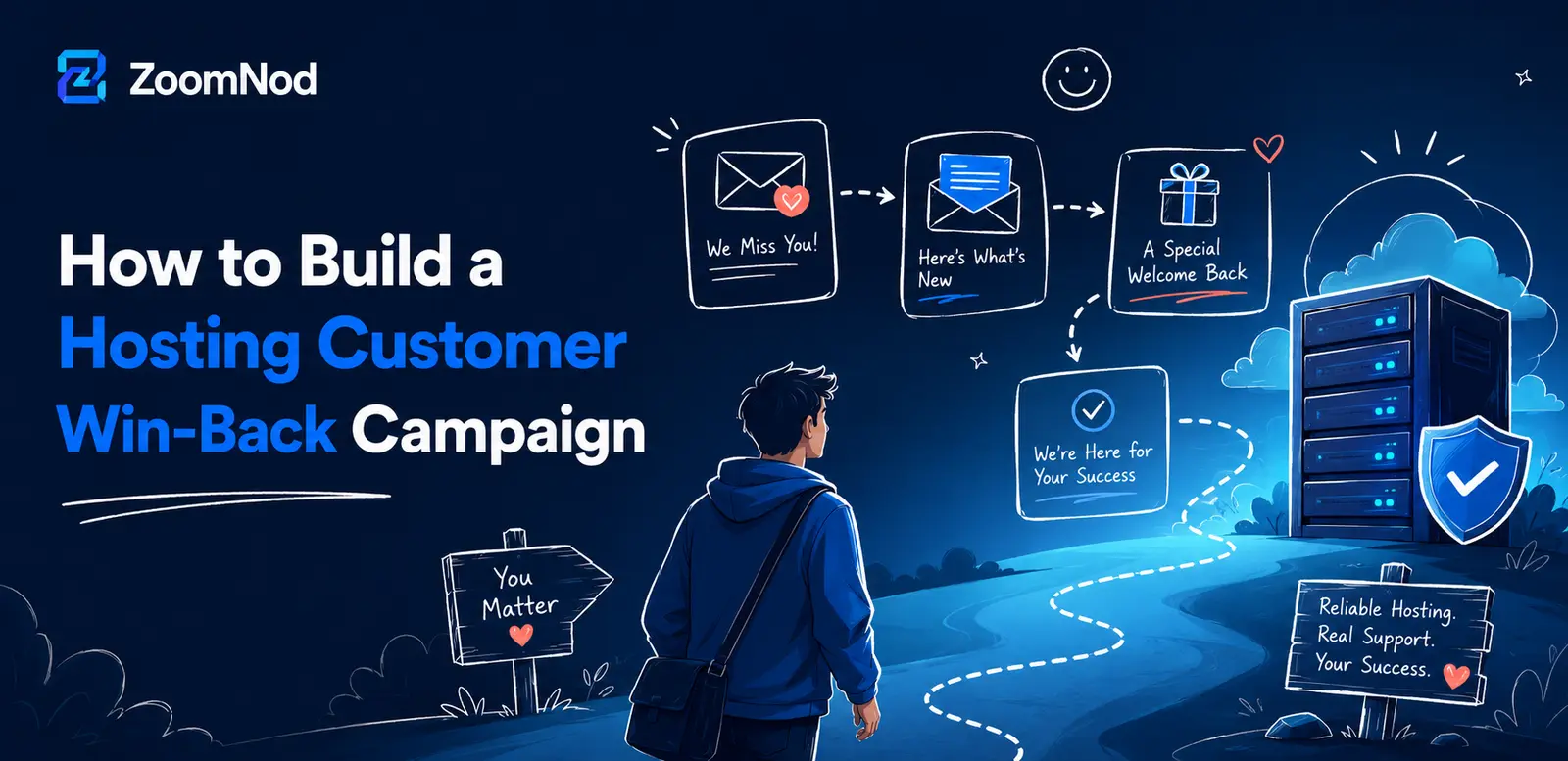
A hosting customer win-back campaign is a structured effort to reconnect with former customers and encourage suitable accounts to return.
It should not be treated as a generic discount email sent to every cancelled customer.
Hosting customers leave for many different reasons. Some cancel because a temporary project ended. Others experienced a migration problem, selected the wrong plan, encountered repeated support issues, moved to a competitor or no longer needed the service.
A former customer who left because of an expired project requires a different message from a managed VPS customer who cancelled after an unresolved support case.
A sound win-back strategy starts with customer data, cancellation reasons and product history. It identifies which former customers remain commercially and technically suitable, what prevented them from staying and whether the company now has a credible reason to restart the relationship.
Win-back campaigns can strengthen recurring revenue because the former customer already knows the brand, has previously evaluated the service and may still have relevant infrastructure needs.
However, familiarity does not guarantee trust. If the customer left because of a poor experience, the campaign must address that experience honestly rather than simply offering a lower price.
Zoomnod provides specialist digital marketing for hosting companies, email lifecycle and customer-retention services based on six years of hosting-industry experience.
This guide covers how shared hosting, VPS, cloud, dedicated server, WordPress hosting and managed infrastructure companies can build a practical customer win-back campaign.
What Is a Hosting Customer Win-Back Campaign?
A hosting customer win-back campaign is a sequence of targeted communications designed to reactivate former customers who cancelled, failed to renew or stopped using a hosting service.
The campaign may use email, CRM tasks, account-manager outreach, paid remarketing, in-account messaging or direct sales communication.
It shows the customer why returning may now be relevant.
A win-back campaign should not be confused with a failed-payment recovery workflow. Payment recovery focuses on customers who intended to continue but could not complete payment. Win-back focuses on customers whose service has already ended or whose relationship has become inactive.
- Target former customers rather than active subscribers.
- Use cancellation and product data.
- Segment by reason and value.
- Provide a credible reason to return.
- Build a re-onboarding journey after reactivation.
- Measure renewed revenue and future retention.
Why Hosting Companies Should Use Win-Back Campaigns
Hosting companies often concentrate most of their marketing budget on new customer acquisition.
SEO for hosting companies, paid search, affiliate marketing for hosting companies, content, social media marketing for hosting companies and lead generation for hosting companies can attract new buyers, but former customers may represent an overlooked audience.
A former customer has already interacted with the brand. The company may know which product they purchased, which server location they selected, how long they stayed, why they cancelled and whether they had support or billing problems.
This data can support more relevant communication than a general prospecting campaign.
Some customers may return after a new server location becomes available, a managed option is launched, migration support improves or a former technical limitation is resolved.
Others should not be targeted because their requirements remain unsupported or their previous relationship involved fraud, abuse, repeated non-payment or unresolved compliance concerns.
The aim is to identify customers who can return to a suitable, sustainable relationship, rather than trying to reactivate every former account.
Win-Back Is Different From Churn Prevention
Churn prevention works to retain a customer before the relationship ends. A win-back campaign begins after cancellation, non-renewal or meaningful inactivity.
An active customer may still have websites, applications or data on the platform. A former customer may have completed a migration, removed services or changed providers.
The campaign must recognise that the customer has already decided to leave. In many cases, reactivation should be treated as a new onboarding process.
| Strategy | Timing | Goal | Typical actions |
|---|---|---|---|
| Churn prevention | Before cancellation or non-renewal | Resolve risk and preserve the active subscription | Support escalation, plan review, payment recovery, product education and renewal communication |
| Win-back | After cancellation or meaningful inactivity | Create a suitable new reason for the customer to return | Reactivation email, migration assistance, updated product offer, personal account review and re-onboarding |
Define Who Is Eligible for a Win-Back Campaign
Not every cancelled customer should receive a win-back campaign. Eligibility rules protect deliverability, brand trust, sales capacity and operational resources.
Potentially Eligible Customers
- Customers who cancelled because a temporary project ended
- Customers who selected the wrong plan
- Customers who moved because a required feature was unavailable
- Customers who experienced a migration problem that can now be resolved
- Customers who left because of a previous support issue that has been addressed
- Customers whose business needs may have changed
- Former customers who previously generated healthy recurring revenue
- Customers who requested a product or server location that is now available
- Former agency or reseller partners with relevant current opportunities
Customers to Exclude or Review Carefully
- Customers who opted out of marketing communication
- Accounts associated with fraud or abuse
- Customers with unresolved legal or compliance restrictions
- Customers with repeated unpaid balances
- Accounts terminated for policy violations
- Customers whose requirements remain unsupported
- Customers who explicitly requested no further contact
- Contacts with invalid or undeliverable information
- Customers currently involved in an unresolved dispute
- Customers who have already returned through another route
Collect the Data Needed for Win-Back Segmentation
A generic former-customer list is not enough to build an effective campaign.
The campaign should use relevant customer, product, billing, support and cancellation data.
- Customer and company name
- Previous product and plan
- Server location
- Managed or unmanaged status
- Original purchase and cancellation dates
- Customer lifetime
- Monthly or annual revenue
- Total historical revenue
- Cancellation reason
- Support and migration history
- Payment history
- Previous acquisition channel and affiliate source
- Last email engagement
- Previous account owner
- Consent and communication preferences
The company should avoid irrelevant or overly intrusive personalisation. The objective is to make the message useful, not to demonstrate how much data the company has collected.
Segment Former Customers by Cancellation Reason
Cancellation reason is a key factor in win-back messaging. A discount cannot solve every reason for leaving.
Price
- Review whether a more suitable plan is available.
- Explain billing options clearly.
- Show a lower-cost product only when it genuinely fits.
- Avoid presenting an unsustainable discount as the only reason to return.
Product Mismatch
- Recommend a different service.
- Explain how the new product matches the customer’s needs.
- Offer a plan-selection consultation.
Migration Difficulty
- Explain improved migration support.
- Offer a migration assessment.
- Provide a clear migration process.
- Assign specialist help for suitable accounts.
Support Problem
- Acknowledge the previous concern.
- Explain what support process has changed.
- Offer a named contact or account review.
- Avoid claiming that everything is fixed without evidence.
Missing Feature or Server Location
- Contact the customer only when the requested capability is now available or a suitable alternative exists.
- Show how the capability works.
- Explain which products are available in the relevant location.
- Avoid vague promises.
Project Ended or Customer Moved to a Competitor
- Use low-frequency communication.
- Reconnect when a new project may be relevant.
- Focus on meaningful product improvements.
- Offer a migration review without making unsupported claims about competitors.
Segment Former Customers by Product
Different hosting products require different reactivation messages and conversion paths.
Shared Hosting
Focus on simple website relaunch, domain connection, WordPress setup, clear pricing and easy reactivation. The primary CTA can be to choose a hosting plan.
VPS Hosting
Highlight current configurations, operating systems, NVMe storage, server locations, migration support and managed or unmanaged options. The primary CTA can be to review VPS plans.
Managed VPS
Explain management scope, monitoring, security, updates, migration and support. The primary CTA can be to book a plan review.
WordPress Hosting
Focus on migration, staging, backups, performance, security and managed updates. The primary CTA can be to request a WordPress migration review.
Agency Hosting
Highlight multi-site management, client migrations, team access, billing and agency support. The primary CTA can be to book an agency hosting consultation.
Dedicated Servers
Explain hardware availability, bandwidth, server location, DDoS protection, management and custom configuration. The primary CTA can be to request a dedicated server quote.
Cloud or Enterprise Hosting
Focus on architecture, scalability, migration planning, security, account management and commercial review. The primary CTA can be to schedule an infrastructure consultation.
Segment Former Customers by Commercial Value
The level of personalisation and sales involvement should reflect account value and reactivation potential.
Low-Value Self-Service Customers
- Automated email sequence
- Product-specific landing page
- Self-service checkout
- Limited follow-up
Mid-Value VPS or Agency Customers
- Segmented email
- Migration or plan-review offer
- Optional consultation
- Sales notification after strong engagement
High-Value B2B Customers
- Account-manager review
- Personal email
- Technical consultation
- Custom proposal
- Re-onboarding plan
Choose the Right Time to Launch the Win-Back Campaign
No single waiting period works for every hosting customer.
Timing should reflect the product, cancellation reason, previous customer lifetime and whether the company has a meaningful reason to reconnect.
Contacting a dissatisfied customer immediately with a sales offer may appear insensitive. Waiting too long may reduce relevance if the customer has already committed to another provider.
A relevant change in the customer or product is often a better trigger than a fixed number of days.
- Contact setup-problem customers after the problem has been reviewed and a credible resolution is available.
- Reconnect with temporary-project customers when a reasonable new project cycle may begin.
- Contact customers requesting a location when that location and product become available.
- Contact missing-feature customers only after the feature or a suitable alternative genuinely exists.
- Review high-value competitor losses personally before outreach.
Create a Clear Reason for the Customer to Return
Saying that the company misses the customer is not enough for a win-back message.
The customer should understand what is different, why the service may now fit and what action to take.
Credible Reasons to Return
- A relevant new hosting plan
- A new server location
- Improved migration assistance
- A managed service option
- A previously missing feature
- A simpler onboarding process
- Improved account management
- A product better suited to the customer
- A technical review
- A relevant billing option
- A legitimate reactivation offer
Weak Reasons to Return
- A generic discount with no explanation
- Claims that the service is better without details
- Urgency that does not reflect a genuine deadline
- Promises that cannot be verified
- The same message sent to every former customer
- Repeated messages after the customer shows no interest
Decide Whether to Use a Win-Back Offer
A financial incentive may help selected customers return, but it should not be the default strategy for every segment.
Discounts can create temporary reactivation while failing to solve the original reason for cancellation. They may also train customers to wait for special offers.
| Offer | Best suited to |
|---|---|
| Migration assistance | Customers concerned about technical migration risk |
| Plan review | Customers who selected the wrong service |
| Managed setup | Customers who struggled with technical activation |
| Temporary reactivation discount | Selected price-sensitive customers with a healthy account history |
| Annual billing option | Customers seeking predictable pricing |
| Account credit | Approved service-recovery situations |
| Technical consultation | B2B, managed hosting and dedicated infrastructure customers |
| New product trial | Former customers evaluating a materially different service |
Any pricing, credit or trial terms should be explained clearly. The campaign should avoid unsupported guarantees and artificial urgency.
Build a Hosting Win-Back Email Sequence
A win-back sequence should be concise, relevant and responsive to customer behaviour.
Sequence length depends on the product, audience and reason for leaving. Customers who opt out, return or clearly decline should leave the workflow immediately.
Email 1: Acknowledge the Previous Relationship
- Reference the former product appropriately.
- Explain the relevant reason for contacting the customer.
- Avoid aggressive sales language.
- Offer a clear path to review what has changed.
CTA: See what is new
Email 2: Address the Previous Reason for Leaving
- Explain the relevant product, support, migration or location improvement.
- Use specific information.
- Provide a product page, guide or account-review option.
CTA: Review the updated service
Email 3: Reduce Reactivation Risk
- Explain migration or re-onboarding support.
- Show what the return process involves.
- Answer common concerns.
- Include a consultation option for complex services.
CTA: Plan your return
Email 4: Present a Suitable Offer
- Use a product-appropriate incentive only where justified.
- Explain all terms.
- Connect the offer to a relevant customer need.
CTA: Reactivate your service
Email 5: Close the Campaign Respectfully
- Summarise the opportunity.
- Provide one final clear action.
- Allow the customer to update preferences or decline future promotional contact.
CTA: Review your options
Zoomnod’s email marketing for hosting companies service can help build these lifecycle sequences.
Hosting Win-Back Email Subject Line Ideas
- A hosting option that may fit your current needs
- Your previous hosting plan has changed
- New server locations are now available
- Need help moving your website back?
- A simpler way to restart your hosting
- Managed hosting may now be a better fit
- Review your current VPS options
- Migration support is available
- Ready to host your next project?
- Let us review your hosting requirements
- Your previous account may qualify for reactivation
- A new option for your agency websites
Create Product-Specific Win-Back Landing Pages
Do not send a former customer to a generic homepage unless it is genuinely the most relevant destination.
The landing page should continue the message from the email or advertisement, explain what has changed and make the return process easy to understand.
- Headline aligned with the campaign
- Relevant customer segment
- Previous issue or need addressed
- Updated product details
- Current and renewal pricing where relevant
- Server locations
- Migration or reactivation process
- Support scope
- Frequently asked questions
- Primary CTA
- Contact option for complex accounts
Learn more about conversion rate optimisation for hosting companies.
Use Content to Support the Win-Back Decision
Former customers may need more information before returning. Useful content can reduce uncertainty and demonstrate that the company understands the customer’s technical concerns.
- Migration checklist
- Managed versus unmanaged hosting guide
- Updated server-location page
- Product comparison
- Security guide
- VPS setup tutorial
- Agency hosting guide
- Case study
- Technical product walkthrough
- Reactivation FAQ
- Billing and renewal explanation
- Customer onboarding guide
Explore content marketing for hosting companies.
Use Paid Remarketing Carefully
Eligible former customers may also be reached through paid remarketing when consent, platform rules and audience requirements allow it.
Paid campaigns can reinforce the win-back message after the customer visits a reactivation page or engages with relevant content.
Remarketing should not expose sensitive account information or create excessive frequency.
Relevant options include Google Ads for hosting companies and LinkedIn Ads for hosting companies.
Use Personal Outreach for High-Value Accounts
High-value managed hosting, cloud and dedicated server customers may require a personal approach.
An automated email may not be enough when the previous relationship involved technical requirements, contracts, account management or several decision-makers.
- Review the previous contract value and products used.
- Confirm the cancellation reason and support history.
- Review technical requirements and previous stakeholders.
- Confirm whether the previous problem has been resolved.
- Identify the most relevant stakeholder.
- Send a personal and specific message.
- Offer a technical or commercial review.
- Prepare a re-onboarding plan.
- Record the response in the CRM.
- Stop outreach when the customer declines.
Build a Re-Onboarding Process for Returning Customers
A returning customer should not automatically enter the standard new-customer journey without review.
The company should recognise the previous relationship and address the factors that caused the original cancellation.
- Confirm the new product and billing terms.
- Review the previous cancellation reason.
- Confirm current technical requirements.
- Plan website or data migration.
- Update account and payment information.
- Introduce current support processes.
- Confirm server location and configuration.
- Provide setup guidance.
- Schedule an account review for higher-value customers.
- Monitor early activation and product adoption.
Measure success beyond the reactivation transaction. The returning customer should activate, receive value and remain suitable for the service.
Coordinate Win-Back Campaigns With Support and Sales
Marketing should not reactivate customers without informing the teams responsible for the resulting experience.
- Campaign audience
- Previous cancellation reasons
- Offers and terms
- Migration commitments
- Lead-routing rules
- High-value account ownership
- Support escalation process
- Billing setup
- Reactivation tracking
- Exclusion rules
If a campaign promises migration help, the migration team must have the capacity and process to deliver it. If a former enterprise customer requests a consultation, the lead should reach a salesperson with relevant account history.
Protect Email Deliverability and Customer Trust
Former customers may be less engaged than active subscribers. Sending a large campaign to old, unverified or unresponsive contacts can damage deliverability and brand reputation.
- Respect unsubscribes and previous contact preferences.
- Exclude invalid addresses.
- Use recent and relevant customer data.
- Limit campaign frequency.
- Stop communication after reactivation or clear refusal.
- Use accurate sender identity.
- Avoid misleading subject lines.
- Provide an unsubscribe option where required.
- Monitor bounce and complaint rates.
- Separate critical account communication from promotional messages.
Test the Win-Back Campaign
Improve win-back campaigns through structured testing focused on meaningful customer and revenue outcomes, rather than email opens alone.
- Audience segment
- Cancellation reason
- Time since cancellation
- Subject line
- Sender identity
- Primary message
- Offer type
- CTA
- Landing page
- Email sequence length
- Personal outreach timing
- Migration-support offer
Use conversion and reactivation data, review future retention, compare margin after incentives and migration costs, and avoid declaring success based only on clicks.
Measure Hosting Win-Back Performance
Measure a win-back campaign through customer reactivation, recurring revenue and future retention.
| Metric | Purpose |
|---|---|
| Eligible former customers | Shows the size of the qualified win-back audience. |
| Delivery rate | Shows whether campaign messages reached valid recipients. |
| Click-through rate | Indicates interest in the reactivation offer or content. |
| Reactivation rate | Measures the percentage of eligible former customers who return. |
| Cost per reactivated customer | Shows the marketing and operational cost of each return. |
| Recurring revenue reactivated | Measures the recurring value restored by the campaign. |
| Migration completion rate | Shows whether returning customers complete the operational return process. |
| Re-onboarding activation rate | Measures whether reactivated customers reach product value. |
| Second renewal rate | Shows whether returning customers remain beyond the initial period. |
| Win-back margin | Considers incentives, migration costs, support and recurring revenue. |
| Unsubscribe and complaint rate | Helps protect deliverability and trust. |
Calculate the Commercial Value of a Win-Back Campaign
Calculate the value of a win-back campaign after accounting for the cost of reactivation.
Costs to Include
- Email and CRM tools
- Campaign strategy and production
- Paid remarketing
- Discounts or account credits
- Migration labour
- Sales and support time
- Onboarding and infrastructure costs
- Payment processing
Value to Include
- Initial reactivation revenue
- Monthly recurring revenue
- Annual contract value
- Upgrade and cross-sell revenue
- Expected customer lifetime
- Gross margin
Basic win-back return: Revenue and gross profit from reactivated customers minus total win-back and delivery costs.
Common Hosting Win-Back Campaign Mistakes
Sending the Same Offer to Every Former Customer
Segment by product, cancellation reason, value and current relevance.
Using a Discount Without Solving the Original Problem
A lower price does not repair migration, support or product-fit problems.
Contacting Customers Without a Credible Reason
Explain what has changed and why returning may now be useful.
Ignoring Previous Support History
Review unresolved concerns before inviting the customer back.
Sending Traffic to the Homepage
Use product-specific reactivation pages aligned with the campaign.
Over-Messaging Former Customers
Use a limited sequence and respect customer preferences.
Treating Reactivation as the Final Goal
Measure re-onboarding, adoption and future renewal.
Promising Improvements That Are Not Operationally Ready
Marketing, support and product teams must deliver what the campaign promises.
Ignoring Account Profitability
Include discounts, migration and support costs when calculating return.
Failing to Suppress Unsuitable Accounts
Exclude opt-outs, abuse cases, invalid contacts and unsupported requirements.
A Step-by-Step Hosting Customer Win-Back Plan
- Define the win-back goal: Choose whether the campaign will reactivate shared hosting, VPS, agency, managed hosting or high-value B2B customers.
- Create eligibility rules: Define which former customers can be contacted and which accounts must be excluded.
- Clean and enrich customer data: Connect product, cancellation, billing, support and consent information.
- Segment the audience: Group customers by cancellation reason, product, value, country and time since cancellation.
- Identify the reason to return: Define what has changed and why the offer is relevant.
- Choose the conversion path: Use self-service reactivation, migration assessment, consultation, quote request or account-manager outreach.
- Build the campaign assets: Create email copy, landing pages, content, CRM tasks and remarketing assets.
- Prepare re-onboarding: Ensure support, billing, migration and product teams can manage returning customers.
- Launch a controlled test: Begin with a defined segment and review engagement, reactivation, cost and customer quality.
- Measure long-term retention: Track activation, recurring revenue, second renewal and profitability.
How Zoomnod Builds Hosting Win-Back Campaigns
Zoomnod approaches customer win-back as a lifecycle strategy rather than a single promotional email.
We review why customers left, which products they used, how they were acquired, whether their previous concerns have been resolved and what would be required for a successful return.
- Cancellation data review
- Former-customer segmentation
- Eligibility and suppression rules
- Win-back campaign strategy
- Email sequence development
- Offer planning
- Reactivation landing-page recommendations
- Migration-assistance funnel planning
- B2B account reactivation
- CRM workflow design
- Re-onboarding strategy
- Campaign measurement
- Long-term retention analysis
Related Zoomnod services include digital marketing for hosting companies, email marketing for hosting companies, content marketing for hosting companies, conversion rate optimisation for hosting companies and lead generation for hosting companies.
Win Back Suitable Customers With a Better Reason to Return
A hosting customer win-back campaign should not attempt to reverse every cancellation.
It identifies former customers whose needs can now be served more effectively and creates a clear path for them to return.
The message should explain what has changed, address the original concern and provide a conversion action that matches the complexity of the service.
Returning customers should enter a structured re-onboarding process so the problem that caused the original cancellation is not repeated.
The strongest win-back programmes connect marketing, CRM, support, billing, migration and customer success. They measure not only reactivation but also adoption, recurring revenue, future renewal and profitability.
Book a free consultation with Zoomnod to discuss your former-customer data, cancellation reasons and hosting reactivation opportunities.
Frequently Asked Questions
What is a hosting customer win-back campaign?
A hosting customer win-back campaign is a targeted strategy designed to reactivate suitable former customers who cancelled, failed to renew or stopped using a hosting service.
How can a hosting company win back cancelled customers?
A hosting company can segment former customers by product, cancellation reason and value, then provide a relevant reason to return through email, migration support, account reviews or product-specific offers.
Should every cancelled hosting customer receive a win-back email?
No. Companies should exclude customers who opted out, violated policies, have unresolved disputes, remain an unsuitable product fit or should not be contacted for another legitimate reason.
When should a hosting company send a win-back campaign?
Timing depends on the product, cancellation reason and customer value. The strongest trigger is often a meaningful change, such as a new server location, improved migration support or a more suitable product.
How many emails should a hosting win-back campaign include?
The appropriate sequence length depends on the audience and product. A concise sequence of relevant messages is generally more useful than repeatedly contacting unresponsive former customers.
Should hosting companies use discounts in win-back campaigns?
Discounts may help selected customers, but they should not replace resolving product, support, migration, pricing or customer-fit problems.
What should a hosting win-back email include?
It should acknowledge the previous relationship, explain why the customer is being contacted, describe what has changed and provide a clear reactivation or consultation action.
How should former VPS customers be reactivated?
VPS win-back campaigns can highlight current configurations, operating systems, server locations, migration support and managed or unmanaged options.
How can hosting companies win back B2B customers?
B2B reactivation may require account-history review, personal outreach, technical consultation, migration planning, stakeholder coordination and a custom re-onboarding process.
What is the difference between payment recovery and customer win-back?
Payment recovery helps active customers resolve failed billing, while win-back campaigns target former customers whose service or relationship has already ended.
Do returning hosting customers need onboarding?
Yes. Returning customers may need account updates, migration, configuration, support introductions and product-specific re-onboarding.
How should hosting win-back campaigns be measured?
Measure eligible customers, reactivation rate, cost per reactivated customer, recurring revenue, re-onboarding completion, second renewal rate and campaign profitability.
Can content support a hosting win-back campaign?
Yes. Migration guides, product comparisons, tutorials, case studies and updated server-location pages can reduce uncertainty and support the return decision.
Can Zoomnod build a hosting customer win-back campaign?
Yes. Zoomnod can support customer segmentation, email sequences, offers, landing pages, CRM workflows, re-onboarding and performance measurement.
How do we get started?
Book a free consultation with Zoomnod to review your former-customer data, cancellation reasons and reactivation opportunities.
How long should a hosting provider wait before starting a customer win-back campaign after cancellation?
Win-back messages should reflect why the customer left. A pricing objection, temporary project closure, support problem, migration issue, and failed payment each require a different offer or explanation.
A hosting win-back campaign should exclude poor-fit accounts and unresolved disputes. Measuring reactivation rate, retained revenue, post-return churn, and discount cost provides a clearer view of campaign quality.
A hosting customer win-back campaign should probably begin with the original cancellation reason rather than sending the same offer to every former customer. Someone who left because a temporary project ended may return when the next project starts, while a customer who experienced poor support or server performance needs evidence that the problem has changed. I would segment by product, customer value, tenure, cancellation reason, previous support history, and time since cancellation. The campaign could then use different messages for price sensitivity, missing features, migration difficulty, payment failure, or project completion.
A discount should not be the default win-back tactic. Product improvements, migration help, account credits, managed support, or a better-fit hosting plan may address the real reason the customer left.
Win-back performance should include reactivation rate, recovered recurring revenue, gross margin, time to return, and second-churn rate. A customer who returns for one discounted month is not necessarily a successful recovery.