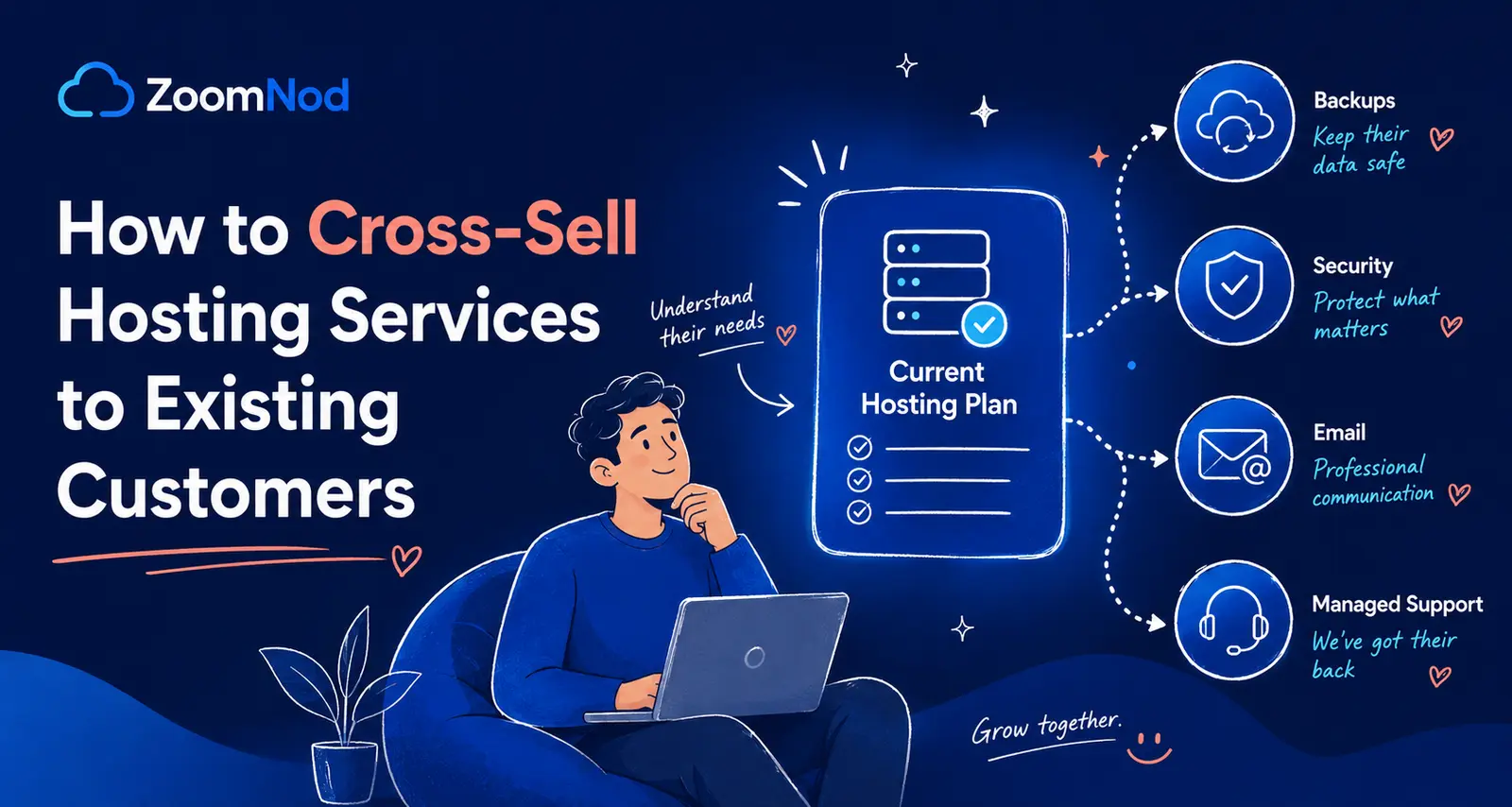
Cross-selling hosting services means recommending an additional product that supports a customer’s existing hosting environment.
A shared hosting customer may need a domain, business email, backup or website-security service.
A VPS customer may need monitoring, managed support, backup storage or additional IP addresses.
An agency customer may need more websites, team access, migration support or another server location.
The most effective cross-sell is not a generic promotion.
It is a relevant recommendation based on customer needs, product usage, account stage and service fit.
Poor cross-selling can reduce trust when customers receive repetitive offers, irrelevant add-ons or sales messages while important support issues remain unresolved.
Effective cross-selling helps customers solve related problems, increases product adoption and can improve customer lifetime value.
Connect cross-selling to onboarding, customer health, lifecycle email, support, billing and product data.
Zoomnod provides specialist digital marketing and lifecycle growth services for hosting companies based on six years of hosting-industry experience and work with multiple hosting providers.
Our approach connects acquisition, retention, lifecycle communication, expansion and recurring-revenue measurement.
Here is how shared hosting, VPS, cloud, dedicated server, WordPress hosting and agency hosting companies can cross-sell services without damaging customer experience.
What Is Hosting Cross-Selling?
Hosting cross-selling is the practice of offering an additional product or service that complements the customer’s existing purchase.
It differs from an upgrade, which moves the customer to a larger or more advanced version of the same core product.
A VPS resource upgrade is generally an upsell. Adding backup storage, monitoring or managed support is generally a cross-sell.
The distinction matters because the customer need, message and conversion path may be different.
- Shared hosting plus a domain
- VPS plus backup storage
- WordPress hosting plus security services
- Dedicated server plus monitoring
- Agency hosting plus additional sites
- Unmanaged VPS plus managed support
- Hosting plan plus business email
- Cloud hosting plus migration assistance
Why Cross-Selling Matters for Hosting Companies
Existing customers may develop additional needs as websites, applications and businesses grow.
A relevant cross-sell allows the hosting company to support more of that customer’s infrastructure.
This can increase recurring revenue and customer lifetime value while helping the customer avoid managing several disconnected providers.
Cross-selling can also strengthen retention when the additional service increases product usefulness or reduces operational risk.
However, commercial value should be measured after service-delivery, support and infrastructure costs.
- Higher average revenue per customer
- Higher customer lifetime value
- More expansion revenue
- Stronger product adoption
- Greater account depth
- More relevant customer relationships
- Potentially stronger retention
- Improved customer convenience
Cross-Sell Only When the Additional Service Fits
A cross-sell should solve a related customer need.
The company should not recommend every available add-on to every account.
Relevance can be determined through product type, usage, support history, lifecycle stage and stated goals.
- Does the service solve a current customer problem?
- Is the customer technically and commercially eligible?
- Is the recommendation appropriate for the current product?
- Has the customer completed onboarding?
- Are there unresolved support or billing problems?
- Can the company deliver the additional service effectively?
- Is the pricing clear?
- Can the reason for the recommendation be explained?
Build a Cross-Sell Matrix
A cross-sell matrix maps each core hosting product to relevant complementary services.
It helps marketing, sales, support and customer-success teams make consistent recommendations.
Shared hosting
- Domain registration
- Business email
- Website backup
- Website security
- Professional migration
- Additional websites
WordPress hosting
- Premium backup
- Security monitoring
- Malware removal
- Additional websites
- Staging
- Professional migration
Unmanaged VPS
- Backup storage
- Monitoring
- Managed support
- Additional IP addresses
- Control panel
- Security services
Managed VPS
- Additional storage
- Additional server
- Advanced monitoring
- Disaster recovery
- Additional location
- Migration services
Agency hosting
- Additional client sites
- Team access
- White-label support
- Client migration
- Additional staging
- Additional server resources
Dedicated server
- DDoS protection
- Backup
- Monitoring
- Managed administration
- Additional bandwidth
- Additional servers
Use Customer Segmentation
Customer segmentation makes cross-selling more relevant across products, value levels, usage patterns and lifecycle stages.
A low-value self-service customer may need an automated product recommendation.
A high-value managed account may require a technical review and personal proposal.
- Core product
- Current plan
- Managed or unmanaged service
- Customer value
- Monthly or annual billing
- Industry
- Business or consumer customer
- Server location
- Product usage
- Support history
- Onboarding status
- Customer health
- Renewal timing
- Acquisition channel
Use Product Usage as a Trigger
Usage-based cross-selling is usually more relevant than a fixed promotional schedule.
The customer’s behavior can reveal a genuine need for an additional service.
| Signal | Recommendation |
|---|---|
| Backup is not configured | Relevant backup service |
| Customer opens repeated server-management tickets | Managed support review |
| Agency adds more client websites | Additional sites or larger agency plan |
| Customer expands into another region | Additional server location |
| Security concerns appear in support history | Appropriate security or monitoring service |
| Customer adds a new domain | Email, hosting or related site service |
| Resources approach limits | Plan review, upgrade or additional server |
Cross-Sell After the Customer Reaches Value
A new customer should usually complete the primary onboarding journey before receiving several expansion offers.
Cross-selling too early can distract from activation and create the impression that the original product is incomplete.
Good timing often follows a successful milestone.
- Website published
- Migration completed
- Application deployed
- Backup configured
- First client site added
- First renewal completed
- Positive support resolution
- Account review completed
Avoid Cross-Selling During Unresolved Problems
Customers with unresolved support, billing or migration problems should not receive routine cross-sell messages.
The company should suppress promotional campaigns during critical incidents or active disputes.
Solve the problem first, then review whether another service is genuinely relevant.
- Critical support ticket open
- Migration incomplete
- Payment dispute
- Failed payment unresolved
- Cancellation requested
- Negative customer feedback
- Major service incident
- Account under compliance review
Build Lifecycle Email Cross-Sell Workflows
Lifecycle email can deliver relevant cross-sell recommendations at scale.
Each workflow should have a clear trigger, product eligibility rule, message and exit condition.
| Workflow | Trigger | Message | CTA |
|---|---|---|---|
| Backup adoption | Eligible account has no active backup service | Explain backup responsibilities, available options and restoration process. | Review backup options |
| Managed support | Unmanaged customer shows repeated management-related support needs | Explain the difference between unmanaged and managed service. | Review managed support |
| Agency expansion | Agency account adds or plans additional client sites | Show additional site, migration and team options. | Review agency expansion |
| Security service | Customer has a relevant security need | Explain the service scope and customer benefit without using fear-based claims. | Review security options |
| Additional location | Customer traffic or operations expand geographically | Explain available locations and technical considerations. | Discuss another location |
Related: email marketing for hosting companies
Create Cross-Sell Landing Pages
A cross-sell email should lead to a page that continues the same message.
Sending customers to a general homepage creates unnecessary friction.
The landing page should explain who the service is for, how it works with the current product and what it costs.
- Clear target customer
- Compatible products
- Customer problem addressed
- Included features
- Service limitations
- Pricing and billing period
- Setup or activation process
- Support scope
- Frequently asked questions
- Primary CTA
Related: conversion rate optimisation for hosting companies
Use Educational Content Before the Offer
Some customers need more context before they can evaluate an additional service.
Content can explain the problem, available options and decision criteria without forcing an immediate purchase.
- Why hosting backups matter
- Managed versus unmanaged VPS
- When a website needs additional security
- How server monitoring works
- When to add another hosting location
- How agencies can manage more client sites
- When to use a dedicated IP
- How to prepare for infrastructure growth
Related: content marketing for hosting companies
Use Support and Customer Success Carefully
Support and customer-success teams may understand customer needs before marketing does.
They can identify situations where an additional service may solve a recurring problem.
Keep recommendations helpful and transparent.
Support should not turn every technical interaction into a sales conversation.
- Suggesting managed support after repeated administration requests
- Recommending backup after explaining current backup responsibility
- Offering additional capacity after confirming sustained resource growth
- Suggesting migration support for a complex move
- Recommending another location after discussing geographic requirements
Cross-Sell Through the Customer Portal
The customer portal can present contextual recommendations based on the active product and account state.
Recommendations should not block essential account tasks or create misleading warnings.
- Product dashboard
- Backup settings
- Resource-usage page
- Server-location page
- Team-management page
- Billing page
- Post-migration confirmation
- Account review summary
Use Annual Reviews for High-Value Accounts
Managed hosting, cloud and dedicated server customers may require consultative cross-selling.
An account review can examine capacity, security, geography, support and future plans.
The goal is to identify genuine infrastructure needs rather than present a standard add-on list.
- Current infrastructure
- Resource trends
- Upcoming projects
- Security requirements
- Backup and recovery
- Additional locations
- Support requirements
- Budget and contract timing
- Migration or consolidation
Make Pricing and Terms Clear
Customers should understand the price, billing period, renewal terms and service scope before adding another product.
Cross-sell conversion should not depend on hidden fees or unclear defaults.
- Initial price
- Renewal price
- Billing period
- Usage-based charges
- Setup fees
- Cancellation terms
- Included resources
- Support scope
- Trial or credit terms
Measure Cross-Sell Performance
Evaluate cross-selling using recurring revenue, customer value and retention outcomes.
A high conversion rate may not indicate success when the additional service creates refunds, support pressure or future churn.
- Eligible customers
- Cross-sell conversion rate
- Attach rate
- Expansion monthly recurring revenue
- Average revenue per customer
- Gross margin
- Activation rate for the additional service
- Refund rate
- Support cost
- Retention after cross-sell
- Customer lifetime value
- Net revenue retention
| Metric | Formula |
|---|---|
| Cross-sell conversion rate | Customers purchasing the additional service divided by eligible customers exposed to the offer, multiplied by 100 |
| Attach rate | Customers with the additional service divided by customers with the eligible core product, multiplied by 100 |
Test Cross-Sell Campaigns
Testing should focus on relevance, timing, channel and customer outcomes.
Avoid testing methods that reduce pricing clarity or customer control.
- Behavior trigger
- Lifecycle timing
- Email subject line
- Educational content before offer
- CTA
- Landing page
- Portal placement
- Human review versus automation
- Offer format
- Product segment
Common Hosting Cross-Selling Mistakes
- Offering every service to every customer
- Cross-selling before activation
- Promoting products during unresolved support issues
- Using fear-based security messaging
- Recommending unnecessary resources
- Hiding pricing or renewal terms
- Sending customers to irrelevant landing pages
- Failing to suppress duplicate offers
- Measuring only initial conversion
- Ignoring support and service-delivery costs
- Confusing cross-sells with upgrades
- Failing to measure retention after purchase
A Step-by-Step Hosting Cross-Sell Strategy
- Define Eligible Products: Identify complementary services for each hosting product.
- Build the Cross-Sell Matrix: Map customer needs, products, triggers and exclusions.
- Segment Customers: Use product, usage, value, lifecycle and health data.
- Choose Meaningful Triggers: Use behavior and customer need rather than generic schedules.
- Create Education and Offers: Explain the problem, service scope, pricing and next step.
- Build Suppression Rules: Exclude customers with unresolved support, billing or cancellation issues.
- Create Conversion Paths: Use relevant landing pages, portal actions or consultations.
- Prepare Fulfilment: Ensure support, billing and technical teams can deliver the service.
- Measure Commercial Outcomes: Track expansion revenue, margin, adoption, retention and lifetime value.
- Optimize Continuously: Improve segments, triggers, content and product fit.
How Zoomnod Helps Hosting Companies Cross-Sell Services
Zoomnod treats cross-selling as a customer-value and lifecycle strategy rather than a generic promotional campaign.
We review core products, customer segments, usage signals, lifecycle stages and relevant expansion opportunities.
Our six years of hosting-industry experience helps us understand the different cross-sell journeys for shared hosting, VPS, WordPress hosting, agency hosting, cloud and dedicated servers.
- Cross-sell strategy audit
- Product and add-on mapping
- Customer segmentation
- Usage-based trigger planning
- Lifecycle email campaigns
- Cross-sell landing-page recommendations
- Customer portal recommendations
- Educational content strategy
- High-value account review workflows
- Expansion revenue reporting
- Retention analysis
- Customer lifetime-value strategy
Related services: digital marketing for hosting companies · email marketing for hosting companies · conversion rate optimisation for hosting companies · content marketing for hosting companies
Build a More Relevant Hosting Cross-Sell Strategy
Zoomnod can review your products, customer segments, lifecycle data and expansion opportunities before developing a practical cross-selling plan.
Cross-Sell by Solving the Next Customer Need
Hosting cross-selling works best when the additional service solves a real customer problem.
The most useful recommendations are based on product fit, usage, lifecycle timing and account health.
Customers should usually receive value from the core service before seeing several additional offers.
Promotional messages should be suppressed when support, billing or migration issues remain unresolved.
Hosting companies should use clear pricing, product-specific landing pages, behavior-based email and consultative account reviews for higher-value customers.
Measure success through expansion revenue, gross margin, service adoption, retention and customer lifetime value.
Zoomnod can help hosting and infrastructure providers build this connected customer expansion system.
Book a free consultation with Zoomnod to discuss your hosting products, cross-sell opportunities and customer-expansion strategy.
Frequently Asked Questions
What is cross-selling in web hosting?
Cross-selling means offering an additional service that complements the customer’s existing hosting product, such as backup, security, email, monitoring or managed support.
What is the difference between a hosting cross-sell and an upsell?
An upsell moves the customer to a larger version of the same product, while a cross-sell adds a complementary service.
What services can hosting companies cross-sell?
Common services include domains, business email, backups, security, monitoring, managed support, migration, additional IP addresses and extra server locations.
When should hosting companies cross-sell?
Cross-sell after the customer has reached value or when product usage reveals a relevant additional need.
Should hosting companies cross-sell during onboarding?
Only essential or highly relevant services should be introduced during onboarding. Too many offers can distract from activation.
How can hosting companies personalize cross-sell offers?
Use product, usage, lifecycle, support, billing and customer-value data to choose relevant recommendations.
How can lifecycle email support hosting cross-selling?
Lifecycle email can trigger product-specific recommendations after events such as backup inactivity, resource growth or additional site creation.
How should hosting cross-selling be measured?
Track conversion, attach rate, expansion recurring revenue, margin, product activation, retention and customer lifetime value.
Can cross-selling reduce hosting churn?
A relevant additional service may improve retention when it increases product value or solves an operational need.
Can Zoomnod build a hosting cross-selling strategy?
Yes. Zoomnod can map products, segment customers, plan lifecycle triggers and create cross-sell campaigns and landing-page recommendations.
How can a hosting provider identify the right moment to cross-sell backups, managed support, security, additional IPs, email, or a higher-capacity server?
Relevant cross-selling should solve a visible customer need. Product usage, support conversations, resource alerts, and account growth provide better signals than sending every customer the same promotion.
A hosting cross-sell campaign should measure adoption, incremental recurring revenue, support impact, and churn after purchase. An additional service is only valuable when it improves the customer’s overall hosting outcome.
How can a hosting company cross-sell additional services without making every customer interaction feel like a sales pitch? I would base recommendations on product usage and account signals. A shared hosting customer launching a business website may need email, backups, security, or a domain, while a growing VPS customer may need managed support, monitoring, extra storage, or additional IP addresses. The most effective cross-sell offer probably depends on timing, customer maturity, support history, and whether the additional service solves a visible problem rather than simply increasing average revenue per user.
The best cross-sell moment may be after the customer has successfully activated the original hosting service. Recommending add-ons before the first website or server is working can create friction during onboarding.
Cross-selling should be measured by attachment rate, incremental margin, product adoption, support impact, and retention. A higher order value is not useful if the extra service increases refunds or customer confusion.