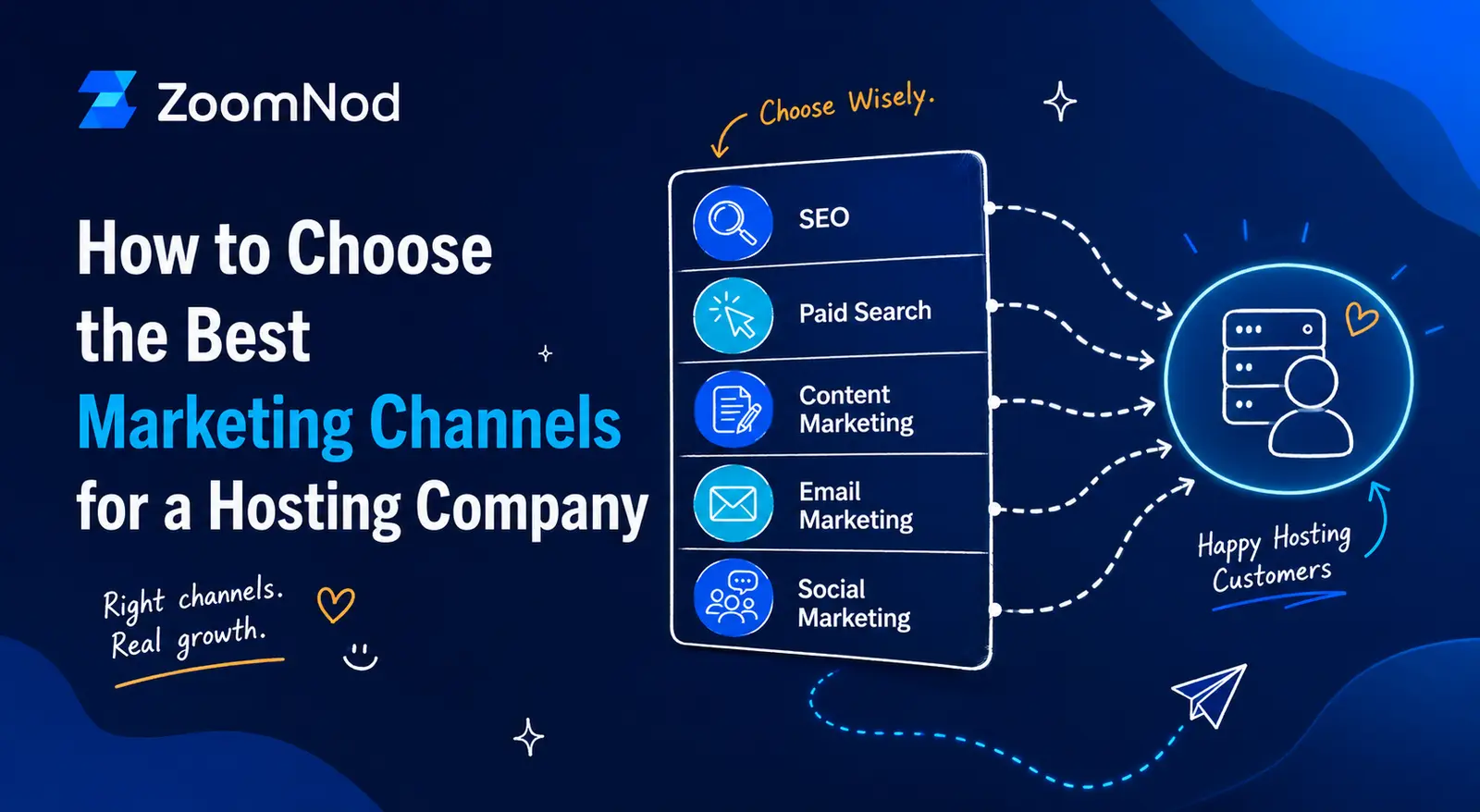
Choosing the best marketing channels for a hosting company involves more than picking the platform with the largest audience or copying a successful competitor.
A shared hosting provider selling entry-level plans has a very different customer journey from a managed cloud company targeting enterprise technology teams. A VPS company may need to capture technical searches, while an agency hosting provider may grow through relationships, partnerships and referrals.
The right channel depends on your products, customers, pricing, target markets, sales process and customer lifetime value.
SEO may build sustainable visibility over time. Google Ads can capture buyers who are ready to purchase. LinkedIn can help you reach business decision-makers. Affiliate marketing can place your brand in trusted reviews and tutorials. Email can turn trials and abandoned checkouts into paying customers.
An effective strategy usually combines several channels, with each one serving a clearly defined role.
Zoomnod provides specialised digital marketing for hosting companies based on six years of hosting-industry experience and work with multiple hosting businesses. Our approach connects customer acquisition with products, margins, buyer journeys and recurring revenue.
It explains how to compare the main marketing channels, decide which ones fit your hosting business and build a digital marketing strategy that supports sustainable growth.
What Are Marketing Channels for Hosting Companies?
Marketing channels for hosting companies are the platforms and methods used to reach, educate, convert and retain customers interested in hosting and infrastructure services.
These services may include:
- Shared web hosting
- Virtual private servers
- Managed VPS hosting
- Cloud infrastructure
- Dedicated servers
- WordPress hosting
- Reseller hosting
- Agency hosting
- Data-centre services
- Website migrations
- Backup and security services
A channel may introduce your brand to a potential customer, answer a technical question, capture an active search, generate a sales enquiry or encourage an existing customer to upgrade.
The main digital marketing channels for hosting providers include:
- Search engine optimisation
- Google Ads
- LinkedIn Ads
- Content marketing
- Affiliate marketing
- Email marketing
- Social media marketing
- Video marketing
- Partnerships
- Remarketing
- Conversion rate optimisation
These channels work best together, with each one supporting a different part of the customer journey.
Awareness
The customer becomes aware of a problem, product or hosting provider.
Consideration
The customer compares services, plans, specifications and providers.
Conversion
The customer purchases a plan, starts a trial, requests a quotation or books a consultation.
Onboarding
The customer activates the service, completes a migration and begins using the product.
Retention
The provider helps the customer continue receiving value and renew the service.
Expansion
The customer upgrades, adds resources or purchases another product.
The best marketing channel mix supports more than the initial sale. It connects customer acquisition with onboarding, retention and recurring revenue.
There Is No Single Best Marketing Channel for Every Hosting Company
Several commercial and operational factors determine which channel will work best for your company.
These include:
- The hosting products you sell
- Whether your audience is B2B or B2C
- Your average customer value
- Your target countries
- Your available server locations
- Your sales-cycle length
- Your marketing budget
- Your current organic visibility
- Your landing-page quality
- Your conversion tracking
- Your internal marketing resources
- Your sales team’s capacity
A low-cost shared hosting company may depend heavily on SEO, affiliates and efficient online checkout.
A managed VPS provider may use SEO and Google Ads to capture demand, content to educate prospects and email to nurture leads.
A dedicated server company may need paid search, technical content, lead qualification and direct sales involvement.
An enterprise cloud provider may rely more heavily on LinkedIn, account-based marketing, webinars and sales enablement.
The best channel is not necessarily the one producing the most impressions or clicks. It is the one that reaches suitable buyers at an acquisition cost the business can support.
Start With Your Hosting Product, Not the Platform
Hosting companies often begin by asking whether they should invest in Google, LinkedIn, social media or content.
Start with the product instead.
Ask:
- Who needs this product?
- What problem does it solve?
- How do buyers research it?
- How quickly do they make a decision?
- What is the average customer value?
- Does the customer purchase online or speak with sales?
- Which questions must be answered before conversion?
The answers will help reveal which channels fit best.
Shared Hosting
Shared hosting customers often prioritise:
- Affordable pricing
- Ease of use
- Fast setup
- WordPress installation
- Domain registration
- Business email
- Customer support
- Introductory offers
Suitable marketing channels may include:
- SEO
- Google Ads
- Affiliate marketing
- Social media
- YouTube
- Remarketing
Shared hosting generally requires an efficient self-service journey because the cost of sales-led acquisition may be too high for a low-value plan.
VPS Hosting
VPS buyers may compare:
- CPU
- RAM
- NVMe storage
- Root access
- Operating systems
- Control panels
- Management levels
- Server locations
- DDoS protection
- Scalability
Suitable channels may include:
- SEO
- Google Ads
- Technical content
- YouTube
- Affiliates
- Email automation
- Developer communities
VPS companies should separate managed and unmanaged audiences because their technical knowledge and support requirements differ.
Managed Hosting
Managed hosting buyers often care about:
- Reduced technical workload
- Server administration
- Monitoring
- Security
- Software updates
- Backups
- Migration support
- Expert assistance
Suitable channels may include:
- SEO
- Google Ads
- Content marketing
- Lead generation
- Email nurturing
- Webinars
Managed hosting typically requires more education and trust than low-cost self-service hosting.
Dedicated Servers
Dedicated server customers may evaluate:
- Hardware
- Bandwidth
- Data-centre location
- Security
- DDoS protection
- Customisation
- Managed support
- Deployment requirements
Suitable channels may include:
- Google Ads
- SEO
- Technical content
- Lead-generation campaigns
- Email nurturing
- Direct sales
A dedicated server provider may optimise for quotation requests or consultations rather than immediate online purchases.
Cloud and Enterprise Infrastructure
Cloud and enterprise buyers may prioritise:
- Scalability
- Availability
- Architecture
- Migration risk
- Security
- Technical compatibility
- Total cost
- Account management
- Service continuity
Suitable channels may include:
- Account-based marketing
- SEO
- Thought leadership
- Webinars
- Email nurturing
- Google Ads
- Sales enablement
These services often involve several decision-makers and a longer sales process.
Agency and Reseller Hosting
Agency and reseller customers may care about:
- Multi-site management
- White-label services
- Client migrations
- Centralised billing
- Partner support
- Margins
- Account management
Suitable channels may include:
- Affiliate marketing
- Partner marketing
- SEO
- Webinars
- Community marketing
SEO for Hosting Companies
SEO helps a hosting company appear when potential customers search for products, features, locations, comparisons and technical solutions.
A hosting SEO strategy may target searches such as:
- Managed VPS hosting
- Windows VPS hosting
- Dedicated servers in Germany
- Hosting for SaaS companies
- Shared hosting versus VPS
- How to migrate a website
- Best hosting for an online store
- When to upgrade from shared hosting
SEO’s main advantage is its ability to create a long-term source of qualified organic traffic.
A well-structured hosting website can attract buyers at several stages of the journey. Commercial pages capture product searches, while guides and comparisons help customers who are still researching.
SEO can also reduce reliance on paid advertising and create useful assets for sales, affiliates, email and social media.
However, hosting SEO can be difficult.
Hosting websites often contain similar product pages, billing variations, server-location pages, documentation and dynamically generated URLs. Without careful planning, important pages may compete with one another or search engines may spend resources crawling low-value URLs.
SEO is most suitable when:
- The company has a long-term growth plan
- Search demand exists for the products
- The website can support technical improvements
- The business can create useful commercial and educational content
- Conversion paths can be measured
- The company is prepared to build authority over time
Zoomnod’s SEO for hosting companies connects keyword strategy, technical SEO, commercial-page optimisation, content, internal links and conversion improvement.
The goal is not simply more traffic. It is visibility for the products and markets that can create valuable customers.
Google Ads for Hosting Companies
Google Ads helps hosting providers reach buyers who are actively searching for a product or solution.
A user searching for “managed Windows VPS in Germany” may already know what they need and may be close to purchasing.
This makes paid search especially useful for:
- Managed VPS
- Unmanaged VPS
- Linux VPS
- Windows VPS
- Dedicated servers
- Cloud hosting
- WordPress hosting
- Server-location campaigns
- Website migration services
- Agency and reseller hosting
Google Ads can generate visibility quickly, making it useful when launching a new product, entering a new market or testing an offer.
It can also provide valuable information about:
- High-converting search terms
- Customer language
- Product demand
- Strong geographic markets
- Landing-page performance
- Customer acquisition costs
The main limitation is cost.
Hosting-related searches can be competitive. Poor keyword selection, broad targeting, weak negative keywords and generic landing pages can consume budget without generating profitable customers.
Google Ads is most suitable when:
- The product has a clear commercial audience
- The company understands its margins
- Customer value can support paid acquisition
- Relevant landing pages are available
- Purchases or qualified leads can be tracked
- A testing budget is available
- Campaigns can be reviewed regularly
Zoomnod’s Google Ads for hosting companies service structures campaigns around products, locations, buyer intent, customer value and recurring revenue.
Campaigns can be separated by shared hosting, VPS, cloud, dedicated servers and other services so performance remains commercially meaningful.
LinkedIn Ads for B2B Hosting Companies
LinkedIn is particularly useful for hosting companies that sell higher-value services to businesses.
Potential audiences include:
- Founders
- Chief technology officers
- IT directors
- DevOps managers
- Infrastructure teams
- SaaS companies
- Digital agencies
- E-commerce businesses
- Managed service providers
LinkedIn campaigns may promote:
- Infrastructure consultations
- Migration assessments
- Technical guides
- Webinars
- Cloud cost reviews
- Dedicated server quotations
- Partner programmes
- Product demonstrations
LinkedIn’s strength is professional targeting.
A hosting company can build campaigns around business roles, industries, seniority, company size and selected target accounts.
However, LinkedIn users are not always actively searching for a hosting provider when they see an advertisement.
The campaign may need to create awareness, educate the buyer and nurture the opportunity before a sales conversation begins.
LinkedIn is most suitable when:
- The service has a meaningful contract value
- The target customer can be identified professionally
- The sales cycle supports lead nurturing
- The company has a strong offer
- Marketing and sales teams can coordinate follow-up
- Lead quality matters more than raw volume
Zoomnod’s LinkedIn Ads for hosting companies service helps hosting and VPS companies reach professional buyers with audience targeting, lead generation, retargeting and account-based campaigns.
Content Marketing for Hosting Companies
Hosting products are technical and often need explanation.
Content marketing helps customers understand:
- Which product they need
- How hosting technologies differ
- What resources are included
- Why server location matters
- How migrations work
- When to upgrade
- What managed services include
- How a provider is different
Useful hosting content may include:
- Product guides
- Comparison pages
- Technical tutorials
- Migration checklists
- Case studies
- Industry landing pages
- Server-location pages
- White papers
- Webinars
- Videos
- Research reports
Content marketing supports several other channels.
SEO needs useful pages. Sales teams need case studies and technical resources. LinkedIn campaigns need valuable offers. Email sequences need educational material. Affiliates need information they can use when discussing your products.
Content is especially valuable when:
- The product is complex
- Customers research before purchasing
- The sales cycle is long
- Search visibility is important
- Buyers have repeated technical questions
- The company wants to build authority
- Sales teams need educational assets
Zoomnod’s content marketing for hosting companies service turns hosting expertise into commercial pages, guides, comparisons and resources that support traffic, trust and customer acquisition.
Affiliate Marketing for Hosting Companies
Affiliate marketing allows hosting companies to reach customers through trusted publishers, creators, developers, agencies and review platforms.
Potential affiliates include:
- Hosting review websites
- Comparison publishers
- YouTube creators
- WordPress educators
- Web developers
- SEO professionals
- Digital agencies
- Technology bloggers
- Coding communities
- Business publishers
Affiliate marketing is particularly suitable for products customers frequently research before buying, such as:
- Shared hosting
- WordPress hosting
- VPS hosting
- Agency hosting
- Reseller hosting
- Developer hosting
Affiliates can reach buyers at different stages.
A comparison website may reach someone close to purchase. A developer may introduce a VPS during a tutorial. An agency may recommend hosting directly to a client.
The advantages include performance-based acquisition, access to established audiences and the ability to enter new markets through regional partners.
The challenges include:
- Partner recruitment
- Affiliate activation
- Tracking and attribution
- Fraud prevention
- Coupon leakage
- Brand bidding
- Commission planning
- Partner retention
Thousands of inactive affiliates do not make a program successful.
Zoomnod’s affiliate marketing for hosting companies service covers program strategy, commission planning, partner recruitment, onboarding, activation, tracking and optimisation.
Lead Generation for Hosting Companies
Some hosting services are too complex or valuable for a direct online purchase.
Managed cloud, enterprise hosting, colocation and custom dedicated servers may require technical discovery, qualification and a proposal.
Lead-generation campaigns can promote offers such as:
- Free consultation
- Migration assessment
- Infrastructure review
- Cloud cost analysis
- Dedicated server quotation
- Security review
- Technical demonstration
- Scalability assessment
The goal should not be to collect the maximum number of contact forms.
A qualified hosting lead should match factors such as:
- Required product
- Technical needs
- Budget
- Server location
- Migration timeline
- Company size
- Buying authority
- Contract potential
Lead generation may use a combination of SEO, Google Ads, LinkedIn, content, email, outreach and partnerships.
Zoomnod’s lead generation for hosting companies service connects target audiences, channels, offers, landing pages, qualification and sales follow-up.
Email Marketing for Hosting Companies
Email marketing matters throughout the hosting customer lifecycle.
It can support:
- Lead nurturing
- Trial conversion
- Abandoned checkout recovery
- Customer onboarding
- Website migration
- Product education
- Plan upgrades
- Renewals
- Failed payment recovery
- Win-back campaigns
Email is particularly valuable because hosting is a recurring-revenue business.
The relationship continues after purchase. Customers need to activate their service, understand the product, maintain payment details and choose suitable upgrades.
Email becomes more important when:
- The company offers trials
- Customers abandon checkout
- Subscription renewals matter
- Several products are available
- Cross-selling opportunities exist
- Customer churn is a concern
- Leads need nurturing before sales contact
Zoomnod’s email marketing for hosting companies service helps providers build lifecycle campaigns for conversion, onboarding, upgrades, renewals and retention.
Social Media Marketing for Hosting Companies
Social media can help hosting providers build awareness, demonstrate expertise and distribute useful content.
Potential platforms include:
- YouTube
- X
- Technical communities
The right platform depends on the audience.
LinkedIn may suit managed hosting and enterprise services. YouTube may support technical tutorials and product demonstrations. Facebook and Instagram can reach small-business owners, freelancers and website creators. X and specialist communities may help brands participate in developer and infrastructure conversations.
Social media can support:
- Brand awareness
- Technical education
- Founder authority
- Product launches
- Customer stories
- Community engagement
- Content distribution
- Remarketing
- Customer support
However, social media should not be the default customer acquisition channel for every hosting company.
For high-intent products, SEO and paid search may produce more direct demand. Social media may perform better as a supporting channel that builds trust and assists future conversions.
Zoomnod’s social media marketing for hosting companies service connects platform selection, content strategy, community activity and lead generation with commercial objectives.
Conversion Rate Optimisation Improves Every Channel
Conversion rate optimisation is not an acquisition channel, but it can change the performance of every acquisition channel.
More traffic will not fix a confusing hosting website.
Visitors may leave because:
- Plans are difficult to compare
- Technical terms are unexplained
- Renewal pricing is unclear
- The landing page does not match the advertisement
- The form asks for too much information
- The checkout contains too many steps
- The mobile experience is difficult
- Trust information is missing
CRO focuses on making the customer journey easier to understand and complete.
Important areas include:
- Product pages
- Pricing pages
- Comparison tables
- Campaign landing pages
- Consultation forms
- Trial registration
- Checkout
- Calls to action
- Mobile usability
- Trust signals
Zoomnod’s conversion rate optimisation for hosting companies service helps providers improve plan selection, landing pages, forms and checkout journeys.
Marketing Channels Compared
| Marketing channel | Primary role | Typical speed | Best suited to | Common conversion |
|---|---|---|---|---|
| SEO | Build long-term search visibility | Slow | Most hosting products | Purchase, trial or lead |
| Google Ads | Capture active demand | Fast | High-intent products | Purchase, quote or consultation |
| LinkedIn Ads | Reach professional buyers | Medium | B2B and enterprise services | Qualified lead |
| Content marketing | Educate and build authority | Medium | Technical products | Assisted conversion |
| Affiliate marketing | Partner-led acquisition | Medium | Shared hosting, WordPress and VPS | Purchase |
| Email marketing | Nurture and retain customers | Fast after setup | Leads and customers | Purchase, renewal or upgrade |
| Social media | Build awareness and trust | Medium | Brand development and education | Assisted conversion |
| CRO | Improve funnel performance | Variable | Every hosting product | Higher conversion efficiency |
Choose Channels Based on B2B or B2C Buyers
Best Channels for B2B Hosting Companies
A B2B channel mix may include:
- SEO
- Google Ads
- Content marketing
- Email nurturing
- Account-based marketing
- Webinars
- Partnerships
Typical conversion actions include:
- Book a consultation
- Request a quotation
- Schedule a demonstration
- Request a migration assessment
- Submit infrastructure requirements
Best Channels for B2C Hosting Companies
A B2C channel mix may include:
- SEO
- Google Ads
- Affiliate marketing
- YouTube
- Meta Ads
- Remarketing
- Social media
Typical conversion actions include:
- Purchase a hosting plan
- Start a trial
- Register an account
- Register a domain
- Upgrade a package
Choose Channels Based on Customer Lifetime Value
Customer lifetime value should influence how much you can invest in acquisition.
Low-LTV Hosting Products
Entry-level shared hosting may require:
- Low acquisition costs
- Self-service checkout
- Efficient automation
- Strong SEO
- Affiliate acquisition
- High-volume conversion optimisation
A sales-led process may be too expensive.
Mid-LTV Hosting Products
VPS and managed WordPress products may support a mix of:
- SEO
- Google Ads
- Content
- Affiliates
- Remarketing
High-LTV Hosting Products
Managed cloud, enterprise hosting and dedicated infrastructure may justify:
- Account-based marketing
- Google Ads
- Lead generation
- Webinars
- Sales enablement
- Email nurturing
The cheapest lead is not always the best lead.
A higher-cost campaign may still be profitable when it generates customers with stronger recurring value.
Match Each Channel to the Buyer’s Stage
Awareness Channels
- Social media
- Video
- Educational content
- Digital PR
Consideration Channels
- SEO
- Comparison pages
- Case studies
- Retargeting
- Webinars
Conversion Channels
- Google Ads
- Product pages
- Affiliate recommendations
- Landing pages
- Sales consultations
- CRO
Retention Channels
- Marketing automation
- Product education
- Customer success
- Community content
Expansion Channels
- Upgrade campaigns
- Cross-selling
- Account management
- Email automation
- Customer retargeting
How to Evaluate a Marketing Channel Before Investing
Before choosing a channel, ask:
- Is our target audience active on this channel?
- Does the channel match the buyer’s intent?
- Can our product support the acquisition cost?
- Do we have a relevant landing page?
- Can we track meaningful conversions?
- Can our team manage the channel properly?
- How quickly do we need results?
- Is the channel suitable for B2B or B2C?
- Can it support our target countries?
- Does it support retention or only acquisition?
A channel may look attractive but still fail when the landing page, tracking or internal resources are not ready.
Use a Marketing Channel Scorecard
Score each potential channel from one to five across these areas:
- Audience fit
- Buyer intent
- Customer value
- Cost
- Speed
- Scalability
- Measurement
- Internal capability
- Competitive difficulty
- Retention value
This makes the decision process more objective.
For example, SEO may receive a lower score for speed but a high score for long-term scalability. Google Ads may score highly for intent and speed but lower for cost. LinkedIn may be expensive but commercially suitable for high-value B2B services.
Do Not Launch Every Channel at Once
Launching several channels simultaneously can create:
- Scattered budgets
- Weak tracking
- Insufficient data
- Incomplete landing pages
- Poor-quality execution
- Difficulty identifying what works
- Excessive internal workload
A stronger sequence is:
- Select the highest-priority audience and product.
- Choose the strongest channel for that buyer.
- Build the landing page and conversion path.
- Validate the offer.
- Improve tracking.
- Add a supporting channel.
- Introduce retention and expansion campaigns.
- Scale only after commercial validation.
Recommended Channel Mixes
New Shared Hosting Company
- SEO
- Google Ads
- Affiliate marketing
- CRO
VPS Provider
- SEO
- Google Ads
- Technical content
- Affiliates
- YouTube
Managed Hosting Company
- SEO
- Google Ads
- Lead generation
- Content
- Email nurturing
Dedicated Server Provider
- Google Ads
- SEO
- Technical content
- Lead qualification
Global Hosting Brand
- International SEO
- Multi-market PPC
- Affiliate marketing
- Content
- Social media
- Email automation
- CRO
Agency or Reseller Hosting Provider
- Partner marketing
- SEO
- Affiliate marketing
- Webinars
How to Measure Channel Performance
Useful marketing metrics include:
- Customer acquisition cost
- Cost per qualified lead
- Purchase conversion rate
- Trial-to-paid conversion rate
- Average order value
- Monthly recurring revenue
- Annual contract value
- Customer lifetime value
- Renewal rate
- Churn
- Payback period
- Revenue by channel
- Assisted conversions
- Sales pipeline value
Clicks, impressions, followers and raw leads may provide useful context, but they should not be treated as final business outcomes.
Common Mistakes When Choosing Hosting Marketing Channels
Choosing a Channel Because Competitors Use It
A competitor may have different margins, brand awareness, conversion rates and customer values.
Starting With the Platform Instead of the Product
Begin with the customer, product and commercial model.
Ignoring Customer Lifetime Value
Acquisition costs should be compared with recurring value, support costs and a retention strategy.
Measuring Every Lead Equally
A qualified managed hosting opportunity is not equivalent to an irrelevant form submission.
Sending Every Campaign to the Homepage
Campaigns should lead to pages that match the product, customer and message.
Expecting One Channel to Do Everything
One channel may create awareness while another captures the conversion.
Ignoring Retention
Customer acquisition is only one part of sustainable hosting growth.
Scaling Before Tracking Is Reliable
Increasing budget without accurate measurement can increase waste rather than revenue.
How Zoomnod Helps Hosting Companies Choose the Right Channels
Zoomnod starts with the business, not a generic marketing package.
We begin by reviewing:
- Your hosting products
- Target audiences
- Priority countries
- Server locations
- Pricing
- Margins
- Customer lifetime value
- Sales process
- Existing campaigns
- Current conversion performance
We then assess which channels are most likely to support your commercial goals.
Our process may include:
- Product and business review
- Audience analysis
- Market and competitor research
- Customer journey mapping
- Channel opportunity assessment
- Commercial prioritisation
- Tracking review
- Landing-page planning
- Campaign execution
- Revenue-focused optimisation
Zoomnod combines six years of hosting-industry experience with specialist knowledge across SEO, paid media, content, affiliates, email, social media and conversion optimisation.
Explore our specialist digital marketing services for hosting companies or book a free consultation to discuss your current marketing channel mix.
Build a Channel Mix Around Commercial Outcomes
The best marketing channel for a hosting company is not the channel that generates the most traffic.
It is the channel that:
- Reaches the right audience
- Matches the product and buying journey
- Produces measurable conversions
- Supports an acceptable acquisition cost
- Contributes to recurring customer value
- Can be managed consistently
- Can scale without sacrificing lead quality
Most hosting companies need more than one channel.
SEO can create long-term demand. Google Ads can capture high-intent searches. LinkedIn can reach professional buyers. Content can educate customers. Affiliates can provide trusted recommendations. Email can convert, retain and expand customer relationships.
The right mix depends on your products, market and stage of growth.
Need help choosing the best marketing channels for your hosting company?
Zoomnod can assess your products, target audiences, customer economics and existing acquisition performance before recommending a practical growth strategy.
Book a Free Consultation
Frequently Asked Questions
What is the best marketing channel for a hosting company?
The best channel depends on the hosting product, target audience, market, budget, sales cycle and customer lifetime value. SEO and Google Ads often capture active demand, while LinkedIn, content, affiliates and email support different parts of the customer journey.
Is SEO or Google Ads better for hosting companies?
SEO is generally better for building long-term organic visibility, while Google Ads can generate immediate exposure to active searches. Many hosting companies benefit from using both.
Should a new hosting company start with SEO or PPC?
A new hosting company may use PPC to test demand and offers while developing SEO as a longer-term acquisition asset. The decision depends on budget, competition and landing-page readiness.
Does LinkedIn work for hosting companies?
LinkedIn can be effective for managed hosting, cloud, dedicated infrastructure, agency hosting and enterprise services targeting professional decision-makers.
Is affiliate marketing effective for hosting companies?
Affiliate marketing can be effective for shared hosting, WordPress hosting, VPS, agency hosting and reseller products when the company actively recruits and supports relevant partners.
Which channels are best for B2B hosting companies?
Common B2B channels include SEO, Google Ads, LinkedIn, content marketing, email nurturing, webinars, account-based marketing and partnerships.
Which channels are best for B2C hosting companies?
Common B2C channels include SEO, Google Ads, affiliate marketing, YouTube, Meta Ads, email, remarketing and social media.
How many marketing channels should a hosting company use?
A hosting company can begin with one or two measurable priority channels and add supporting channels after validating its offer, landing pages and conversion tracking.
How should a hosting company divide its marketing budget?
Budget allocation should reflect customer acquisition cost, customer lifetime value, product margin, market demand, sales capacity and each channel’s performance.
How can hosting companies measure marketing channel performance?
Hosting companies can measure customer acquisition cost, qualified leads, purchases, trial conversions, recurring revenue, renewal rates, customer lifetime value and revenue by channel.
Does social media generate hosting customers?
Social media can generate awareness, trust, website visits and assisted conversions. Its direct sales effectiveness depends on the product, platform and audience.
Why do hosting marketing campaigns fail?
Common causes include poor audience targeting, weak offers, irrelevant landing pages, inaccurate tracking, unclear pricing and insufficient follow-up.
Can Zoomnod create a marketing channel strategy for a hosting company?
Yes. Zoomnod can assess products, audiences, markets, customer economics and current campaigns before recommending and executing a practical marketing channel strategy.
Does Zoomnod work with B2B and B2C hosting companies?
Yes. Zoomnod develops separate acquisition and conversion journeys for business buyers and direct consumer hosting customers.
How do we get started?
Book a free consultation with Zoomnod to discuss your hosting products, target customers and current marketing challenges.
Recommended Schema
Use the following schema types for this article:
- Article
- BreadcrumbList
- FAQPage
- Organization
- WebSite
The FAQPage markup must match the visible questions and answers.
Do not include unsupported ratings, reviews, results, awards, prices or guarantees.
Which marketing channels are strongest for VPS and dedicated-server companies targeting developers, agencies, SaaS teams, and infrastructure buyers?
Channel choice should reflect search demand, sales cycle, average contract value, geography, and the technical maturity of the buyer. Shared hosting and enterprise infrastructure rarely need the same media mix.
Testing should compare qualified customers and recurring revenue, not only traffic or lead volume. SEO, paid search, affiliates, LinkedIn, communities, and lifecycle email can play different roles in the same acquisition system.
How should a hosting provider choose marketing channels when several platforms can generate traffic but the buying intent is very different? Google Search may work well for urgent queries such as managed VPS, dedicated server, or a specific server location. SEO and comparison content can capture longer research journeys, while affiliate marketing adds third-party trust. LinkedIn may suit enterprise infrastructure or hosting partnerships but not low-cost shared hosting. I would compare each channel using qualified demand, sales cycle, conversion rate, customer acquisition cost, gross margin, renewal rate, and the provider’s ability to create the required landing pages and content.
A hosting company should avoid evaluating channels only by cost per lead. Search traffic with strong product intent may cost more but produce better activation, renewal, and lifetime value than broad low-cost traffic.
Channel selection should also reflect operational capacity. There is little value in scaling paid traffic to a VPS landing page when sales follow-up, onboarding, migration support, or conversion tracking is not ready.