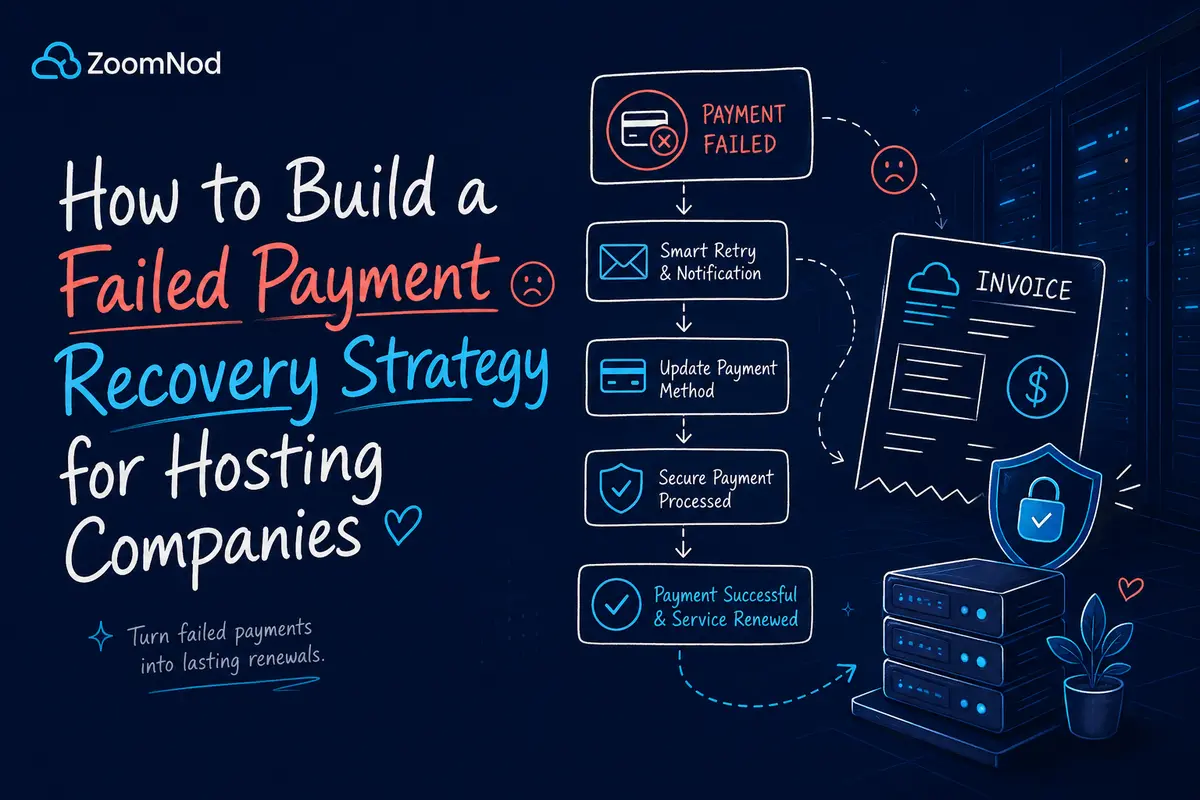
A failed hosting payment is an operational problem that can lead to involuntary churn. The invoice is unpaid, but the customer may still depend on the website, server or application tied to the account.
A recovery strategy coordinates billing events, retry rules, customer communication, account access, service status and manual escalation.
The strategy should make payment correction simple while preventing endless retries, unclear notices and inconsistent suspension decisions.
Hosting companies also need different paths for low value monthly plans, annual VPS invoices, agency accounts and contract based infrastructure.
The framework must account for these differences instead of assuming one processor configuration fits every product.
Set recovery goals and boundaries
Define what the business intends to recover and where its limits are. The primary goals may include collecting valid invoices, preserving suitable customers and limiting avoidable service interruption.
Set boundaries for retry count, grace period, manual work, account value and data retention. Billing, operations and legal owners should approve these decisions.
Create a payment failure event map
Document every event from the first failed attempt to recovery, suspension or closure.
The map should show the system event, customer message, internal owner, account status and next scheduled action.
- Invoice created
- Payment attempted
- Payment failed
- Customer notified
- Payment method updated
- Retry attempted
- Invoice recovered
- Grace period expires
- Service limited or suspended
- Account manually reviewed
- Service restored or closed
Segment recovery rules
Use customer and invoice context to set recovery rules. A single policy can fail when products have different costs and customer dependencies.
| Segment | Considerations |
|---|---|
| Monthly shared hosting | High account volume, smaller invoices, automated communication and clear suspension timing. |
| VPS and agency hosting | Application dependence, migration cost, account value and possible manual contact. |
| Annual hosting | Larger charge, older payment method, earlier notice and billing contact verification. |
| Managed cloud or dedicated server | Procurement process, contract terms, service criticality and named account ownership. |
Build retry rules that respond to failure type
A temporary decline may justify another attempt. An expired card requires customer action. An authentication request requires a confirmation flow.
Use retry tools supported by the processor or carefully defined custom schedules. Record each attempt and prevent duplicate collection.
| Failure | Response |
|---|---|
| Temporary decline | Retry under the approved schedule and notify the customer. |
| Expired payment method | Request an update before another attempt. |
| Authentication required | Send the customer to the confirmation page. |
| Invalid account details | Request corrected billing information. |
| Disputed invoice | Pause routine messages and route to billing review. |
Create a secure update and payment path
The recovery message should lead directly to a secure account page where the customer can update the payment method or pay the invoice.
Once the issue is resolved, synchronize the payment method with the correct subscription and remove the account from active recovery messages.
Related: conversion rate optimisation for hosting companies
Write a staged recovery sequence
Each message should reflect the current account state. The first notice can be factual and helpful. Later notices can explain the approaching service impact.
Do not use false urgency. The stated dates must match the billing and service systems.
| Stage | Purpose |
|---|---|
| First failure | Explain the issue and provide a secure payment action. |
| Before next retry | Remind the customer of the invoice and planned attempt. |
| Repeated failure | Request payment method correction and explain the remaining grace period. |
| Before suspension | State the exact service impact and deadline. |
| Recovery | Confirm payment, account status and next billing date. |
Related: email marketing for hosting companies
Coordinate service suspension and restoration
Billing and service status must stay synchronized. A paid account should not remain suspended because a webhook failed or an internal queue was delayed.
Test restoration for each product. Shared hosting, virtual servers and dedicated infrastructure may use different provisioning systems.
Define what happens to backups, data, domains and related services during each status.
Create a manual review queue
Some accounts justify human review because of invoice size, strategic value, procurement complexity or service criticality.
Give reviewers a concise account summary and a deadline. Without a clear owner, manual review may only delay the same failure.
- Customer and service identifiers
- Invoice amount
- Failure reason
- Payment history
- Current support issues
- Billing contacts
- Account value
- Grace period deadline
- Recommended next action
Measure recovery quality
Measure recovery through collected revenue, customer retention, complaints and operational cost.
Compare results by product, billing interval, failure type and customer value.
- Invoices recovered
- Revenue recovered
- Average attempts before recovery
- Time to recovery
- Manual review rate
- Suspension rate
- Restoration time
- Customer churn after recovery
- Support cost per recovery
- Complaint rate
Common mistakes
- Building email before defining account states
- Retrying an invoice that needs customer authentication
- Using a general homepage as the payment action
- Failing to stop messages after recovery
- Suspending accounts before the stated deadline
- Restoring billing status without restoring service
- Sending disputed invoices through routine automation
- Ignoring annual and high value account needs
- Reporting invoice recovery without customer retention
Implementation checklist
- Define account and invoice states.
- Map processor events to internal actions.
- Create segment rules.
- Configure retries.
- Build secure update paths.
- Write staged messages.
- Set grace and suspension policies.
- Create manual review ownership.
- Test recovery and restoration.
- Report account, revenue and customer outcomes.
How Zoomnod can support the strategy
Zoomnod can review recovery communication, customer segmentation, portal content and retention measurement.
Appropriate technical owners must configure and test the payment processor, billing platform and service automation.
Next step: Book a free consultation with Zoomnod to review your failed payment customer journey and recovery reporting.
Frequently Asked Questions
What is a failed payment recovery strategy?
It is the coordinated process used to detect, communicate, retry, resolve and report unpaid hosting invoices.
Should hosting companies use one retry schedule?
Different products, invoice sizes and failure types may require different retry and escalation rules.
What should happen after payment recovery?
Stop recovery messages, confirm the payment, restore any affected service and show the next billing date.
Which accounts need manual review?
High value, annual, contract based or operationally important accounts may justify personal billing review.
How should recovery success be measured?
Measure recovered invoices, recovered revenue, recovery time, service restoration, later churn and support cost.
Explore More Hosting Marketing Resources
- digital marketing for hosting companies
- SEO for hosting companies
- Google Ads for hosting companies
- LinkedIn Ads for hosting companies
- lead generation for hosting companies
- content marketing for hosting companies
- affiliate marketing for hosting companies
- conversion rate optimisation for hosting companies
- email marketing for hosting companies
- social media marketing for hosting companies