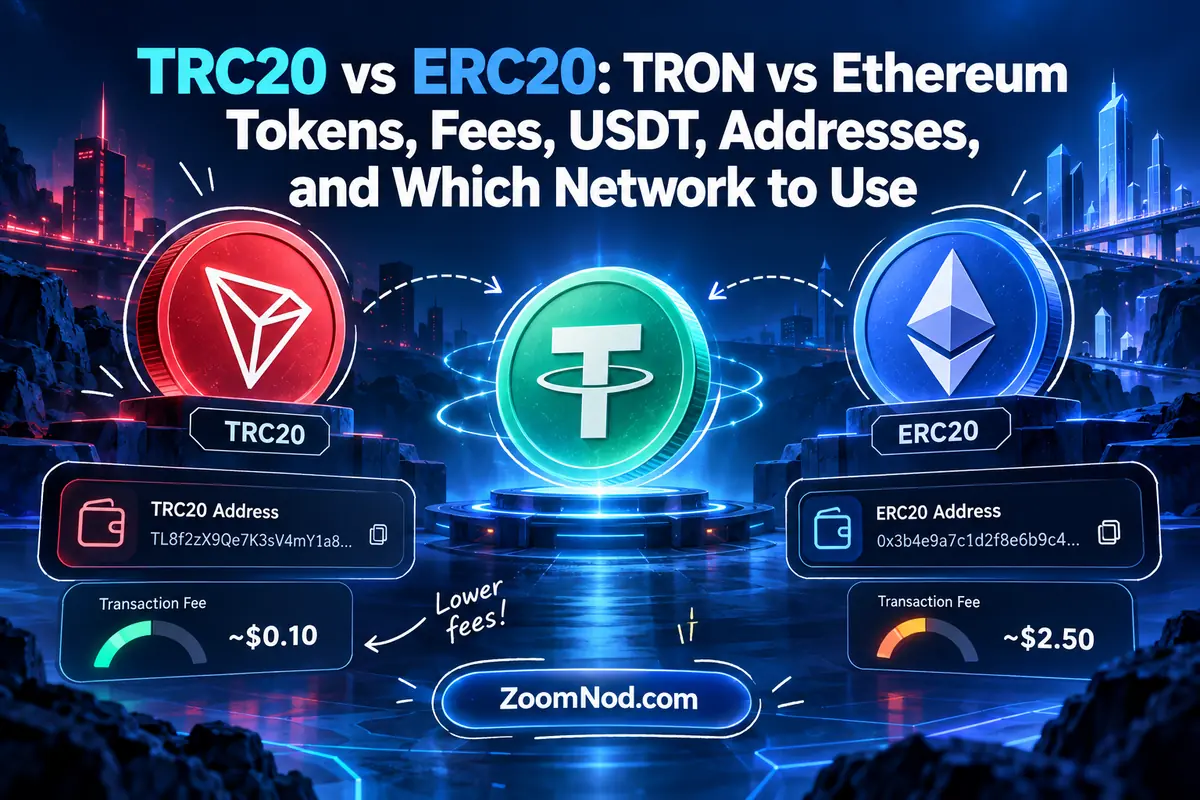
TRC20 vs ERC20 in 2026: TRON vs Ethereum Tokens, Fees, USDT, Addresses, and Which Network to Use
TRC20 and ERC20 are token standards that operate on different blockchain networks. TRC20 is the fungible-token standard used on TRON, while ERC20 is the widely adopted fungible-token standard associated with Ethereum. Both standards define how tokens can be transferred, how balances are tracked, and how smart contracts and wallets interact with fungible assets.
For most users, the TRC20 vs ERC20 question arises when transferring Tether USD₮. Tether currently supports USD₮ on TRON as a TRC20 token and on Ethereum as an ERC20 token. The Tether-denominated value may be the same, but the network, address format, fee system, wallet support, and smart-contract environment differ.
The practical difference in 2026 is this: TRC20 is often chosen when users prioritize a lower-cost transfer route and broad TRON-based stablecoin support, while ERC20 is often chosen when users need Ethereum’s deep wallet, exchange, smart-contract, DeFi, and application ecosystem. Neither network is universally better. The right choice depends on what the sending wallet, receiving platform, exchange, merchant, or smart contract supports.
The central safety rule is simple: select the same network at both ends of the transfer. An exchange that supports USDT does not necessarily support every USDT network.
TRC20 vs ERC20: Quick Comparison
| Feature | TRC20 | ERC20 |
|---|---|---|
| Blockchain | TRON | Ethereum |
| Native fee/resource asset | TRX | ETH |
| Typical user-facing address | Usually starts with T | Starts with 0x |
| Fungible-token standard | TRC20 | ERC20 |
| Smart-contract environment | TRON Virtual Machine | Ethereum Virtual Machine |
| USDT support | Yes | Yes |
| Fee mechanism | Bandwidth + Energy; TRX can be burned when resources are insufficient | Gas paid in ETH |
| Best known for | Low-cost token transfers and TRON ecosystem | Large smart-contract, DeFi, wallet, and dApp ecosystem |
What Is ERC20?
ERC20 defines a standard interface for fungible tokens implemented through Ethereum smart contracts.
Fungible means that one unit can be exchanged for another unit of the same token; each standard ERC20 unit is intended to be equivalent.
The ERC20 interface standardized the functions wallets, exchanges, decentralized applications, and smart contracts use to interact consistently with tokens.
Common ERC20 Functions
The standard includes functionality for:
- Checking total token supply
- Checking a wallet’s token balance
- Transferring tokens
- Approving another address or smart contract to spend tokens
- Transferring tokens on behalf of an owner after approval
That standardization helped Ethereum develop a large token ecosystem. A wallet or application that understands ERC20 does not need completely custom logic for every fungible token.
What Is TRC20?
TRC20 is TRON’s standard for fungible smart-contract tokens.
Current TRON documentation describes TRC20 as interface-compatible with Ethereum’s ERC20. As a result, developers can implement many familiar Solidity-style token patterns in the TRON Virtual Machine without a major conceptual shift.
What TRC20 Standardizes
Like ERC20, TRC20 provides a common interface for:
- Token balances
- Total supply
- Transfers
- Allowances
- Spending approvals
- Transfer events
The similarity is intentional, but a TRC20 token lives on TRON, not Ethereum. Settlement therefore occurs on a different blockchain even when the token name is identical.
TRC20 vs ERC20 USDT: Is the Token the Same?
Tether USD₮ is issued across several supported blockchain protocols. Tether’s current documentation lists USD₮ as an ERC20 token on Ethereum and a TRC20 token on TRON.
That means users may encounter:
- USDT-ERC20
- USDT-TRC20
These labels identify the network and token standard used to execute the transfer.
If an exchange account displays 1,000 USDT, the platform may offer one or more withdrawal networks. Choosing TRC20 sends the supported Tether token over TRON; choosing ERC20 sends it over Ethereum.
The destination must support the same route.
TRC20 vs ERC20 Address Format
TRON and Ethereum present different address formats to users.
TRC20 Address
A normal TRON wallet address is commonly displayed in Base58Check form and starts with the letter T.
Example pattern:
TxxxxxxxxxxxxxxxxxxxxxxxxxxxxxxxxxERC20 Address
Ethereum accounts use 20-byte addresses normally represented as 40 hexadecimal characters with a 0x prefix.
Example pattern:
0x1234...abcdCan a TRC20 Address Be Used for ERC20?
No. Treat them as different networks.
TRON and Ethereum share some cryptographic concepts, and TRON documentation notes technical similarities in address derivation. That does not make their user-facing deposit routes interchangeable.
When withdrawing from an exchange or sending from a wallet, match:
- The token
- The network
- The receiving platform’s supported network
- The destination address
If any item is wrong, recovering the funds may be difficult or impossible.
For a broader wallet-security checklist, see Zoomnod’s guide to protecting your crypto assets.
TRC20 vs ERC20 Fees
Fees are a primary reason users compare TRC20 with ERC20.
How ERC20 Fees Work
Ethereum uses gas to price computation.
Because an ERC20 transfer interacts with a smart contract, it generally consumes more gas than a simple ETH transfer.
Ethereum’s fee model includes:
- A network base fee
- An optional priority fee
- The amount of gas consumed by the transaction
The fee is paid in ETH.
ERC20 transfer costs can fluctuate as the base fee changes with network demand.
How TRC20 Fees Work
TRON uses two primary on-chain resource concepts:
- Bandwidth for transaction data size
- Energy for smart-contract execution
Users can obtain resources through staking and delegation. If an account lacks sufficient resources, TRX may be burned to cover the required network cost under current chain parameters.
A TRC20 token transfer is a smart-contract operation and therefore can consume both Bandwidth and Energy.
Which Is Cheaper: TRC20 or ERC20?
TRC20 is often chosen because TRON token transfers can cost less than ERC20 transfers on Ethereum mainnet. But do not assume the exchange withdrawal fee will match the blockchain fee.
A centralized exchange sets its own withdrawal fee for each network.
Check the live withdrawal screen before sending.
For other low-cost network options, see Zoomnod’s cheapest cryptocurrencies to transfer guide.
TRC20 vs ERC20 Speed
Both networks can process token transfers faster than traditional international bank settlement, but “speed” can refer to several things:
- How quickly the transaction is included
- When the network considers it final enough
- How many confirmations an exchange requires
- How quickly the receiving platform credits the deposit
A transaction may appear on a blockchain explorer before an exchange credits the deposit.
Block production alone does not determine the user experience; deposit policies also matter.
TRC20 vs ERC20 Wallet Compatibility
Wallet compatibility is network-specific.
A wallet may support Ethereum without supporting TRON, or the reverse.
For ERC20
Ethereum wallets typically support:
- ETH
- ERC20 tokens
- Ethereum smart contracts
- Ethereum dApps
- Potentially additional EVM-compatible networks
For TRC20
TRON-compatible wallets support:
- TRX
- TRC20 tokens
- TRON smart contracts
- TRON resource management
Before sending, confirm that the wallet supports the blockchain itself, not merely the ticker symbol.
TRC20 vs ERC20 Smart Contracts
Ethereum originated the ERC20 standard and supports a large smart-contract and DeFi ecosystem.
ERC20 tokens are widely used in:
- Decentralized exchanges
- Lending platforms
- Stablecoins
- DAO governance
- Tokenized assets
- Bridges
- Payment applications
TRON supports smart contracts through the TRON Virtual Machine and uses TRC20 as its primary fungible smart-contract token interface.
TRON’s ERC20-style interfaces feel familiar to Solidity developers, but TRON remains a separate blockchain environment.
TRC20 vs ERC20: Which Is Better for USDT?
The better network depends on the intended use.
Choose TRC20 USDT When:
- The receiving platform explicitly supports USDT-TRC20.
- You prioritize a lower-cost transfer route.
- You use TRON-based wallets or applications.
- The exchange’s TRC20 withdrawal fee is attractive.
Choose ERC20 USDT When:
- The destination requires Ethereum.
- You plan to use Ethereum DeFi.
- You need direct compatibility with an Ethereum smart contract.
- Your wallet/application is Ethereum-focused.
- The receiving service does not support TRON.
For merchants comparing stablecoin networks more broadly, Zoomnod’s best crypto for payments guide explains why the blockchain rail matters as much as the token.
TRC20 vs ERC20 for Exchanges
For a given token, a centralized exchange may support one network, both, or neither.
Before withdrawing USDT:
- Open the destination deposit screen.
- Select USDT.
- View supported networks.
- Choose TRON/TRC20 or Ethereum/ERC20.
- Copy the address generated for that network.
- Return to the sending exchange.
- Select the exact same network.
- Verify the address again.
- Send a test transaction when practical.
Do not select TRC20 solely because it is cheaper when the recipient supports only ERC20.
TRC20 vs ERC20 for Payments
For straightforward transfers, businesses typically consider:
- Network fee
- Settlement speed
- Wallet support
- Customer adoption
- Accounting
- Processor compatibility
TRON may suit stablecoin transfers, while Ethereum can be more useful when settlement must integrate with Ethereum-native smart contracts or DeFi.
Businesses should always state the token and network together.
Do not write only:
We accept USDT.Write:
We accept USDT on TRON (TRC20).
We accept USDT on Ethereum (ERC20).
This wording removes ambiguity.
TRC20 vs ERC20 for Developers
Developers need to compare more than transaction fees.
Consider:
- Target users
- Wallet support
- Developer tooling
- Liquidity
- Smart-contract dependencies
- RPC infrastructure
- Indexers
- Security model
- Application ecosystem
- Expected transaction volume
TRON’s documentation describes TRC20 as interface-compatible with ERC20 and provides Solidity-based tooling. Ethereum offers extensive standards, tooling, libraries, rollups, and application integrations.
TRC20 vs ERC20 Token Approvals
Both standards use allowance-style functionality that can let another contract spend tokens on behalf of a wallet.
This is useful for decentralized applications, but it also creates risk.
Before approving a token:
- Verify the application.
- Verify the contract.
- Review the amount.
- Avoid unnecessary unlimited approvals.
- Revoke permissions you no longer need.
Approval risk makes wallet hygiene important even when the underlying network operates correctly.
Can You Convert TRC20 to ERC20?
You cannot simply “change” a TRC20 token into an ERC20 token inside one wallet because the assets exist on separate blockchain ledgers.
Common conversion routes include:
- A centralized exchange that accepts one network and allows withdrawal on another
- A supported bridge or interoperability service
- A wallet or platform with integrated cross-chain functionality
Each route introduces its own fees and risks.
When using an exchange, confirm deposit and withdrawal support before sending.
TRC20 vs ERC20 Withdrawal Fees
An exchange withdrawal fee is distinct from the underlying network fee.
An exchange may:
- Charge a fixed withdrawal fee
- Adjust the fee periodically
- Temporarily disable a network
- Set a minimum withdrawal amount
Claims that “TRC20 always costs X dollars” or “ERC20 always costs Y dollars” become outdated quickly.
The reliable method is to check the live withdrawal fee when you are ready to send.
TRC20 vs ERC20 Security
Transfer security has several layers:
- Blockchain consensus
- Smart-contract security
- Wallet security
- Exchange security
- User verification
Even a secure blockchain cannot protect funds sent through the wrong network.
A hardware wallet cannot protect a transaction the user knowingly approves to a malicious contract.
Use test transfers, secure your seed phrase, and verify the destination network every time.
TRC20 vs ERC20 for Active Traders and Automated Transfers
Traders may choose a network to move stablecoins or working capital among exchanges, wallets, and automated trading systems. In that situation, the lowest blockchain fee is only one consideration.
You should also compare:
- Whether both exchanges currently support deposits and withdrawals on the network
- Exchange withdrawal fees
- Deposit confirmation requirements
- Whether the network is temporarily suspended for maintenance
- How quickly your trading account credits the deposit
- The operational risk of moving funds between multiple platforms
If the transfer supports automated trading, use restricted API credentials and hardened infrastructure rather than storing sensitive wallet credentials on a public server. Zoomnod’s VPS for crypto trading guide explains the infrastructure considerations for always-on trading systems.
Network choice also affects cross-exchange strategies. A cheap route may help with occasional rebalancing, but real-time arbitrage generally cannot wait for an on-chain transfer after an opportunity appears. Professional workflows usually pre-position balances on both exchanges. Zoomnod’s crypto arbitrage bot guide explains that distinction in more detail.
TRC20 and ERC20 Token-Issuance Safety
Because both standards make fungible tokens relatively easy to create, an ERC20 or TRC20 label does not prove that a token is legitimate.
Before buying or accepting an unfamiliar token:
- Verify the contract address from the project’s official materials.
- Check the correct blockchain.
- Review token supply and holder concentration.
- Understand minting and administrative privileges.
- Avoid contracts promoted only through unsolicited messages.
This is especially important around new token sales. Zoomnod’s crypto presale due-diligence guide explains how to evaluate token contracts, supply, vesting, legal structure, and liquidity before participating.
Common TRC20 vs ERC20 Mistakes
1. Choosing the Cheapest Network Without Checking Support
The recipient must support the selected network.
2. Confusing Token Name With Network
USDT can exist on multiple blockchains.
3. Assuming Exchange Fees Equal Blockchain Fees
Exchanges set their own withdrawal pricing.
4. Copying the Wrong Address
Verify the complete destination before large transfers.
5. Sending a Large Amount Without a Test
A small test can catch a network or address error.
6. Forgetting the Native Fee Asset
Self-custody users may need ETH for Ethereum gas or TRX/resources for TRON transactions.
7. Trusting a Network Label Without Verifying the Receiving Platform
The recipient’s deposit page is the authoritative source for what that account accepts.
TRC20 vs ERC20 Decision Checklist
| Question | If Yes |
|---|---|
| Does the recipient support only Ethereum? | Use the supported ERC20 route. |
| Does the recipient support only TRON? | Use the supported TRC20 route. |
| Does the destination need Ethereum DeFi? | ERC20 is usually the direct route. |
| Is minimizing transfer cost the priority and both sides support TRON? | TRC20 may be more economical. |
| Are you unsure which network the address belongs to? | Do not send until verified. |
Final Verdict: TRC20 or ERC20?
TRC20 is the TRON token standard and ERC20 is the Ethereum token standard. TRC20 is often favored for lower-cost token transfers, while ERC20 provides direct access to Ethereum’s large smart-contract and DeFi ecosystem.
For USDT, neither route changes the basic purpose of Tether, but the blockchain transport layer changes how the transaction is processed and what fee system, address format, wallet, and application environment are involved.
The useful question is not “Which network is universally best?” It is:
Which network does the receiving platform support for this exact token and transaction?
Match the network at both ends, verify the address, compare live withdrawal fees, and use a test transfer before moving a large amount.
Frequently Asked Questions About TRC20 vs ERC20
What is the difference between TRC20 and ERC20?
TRC20 is a fungible-token standard on TRON, while ERC20 is a fungible-token standard on Ethereum. They use different networks, addresses, fee systems, and native assets.
Is USDT TRC20 the same as USDT ERC20?
They represent Tether USD₮ on different blockchain transport protocols. The token is denominated the same way, but the network used to transfer and hold it is different.
Which is cheaper, TRC20 or ERC20?
TRC20 transfers are often cheaper than ERC20 transfers on Ethereum mainnet, but actual network conditions and exchange withdrawal fees vary. Always check the live fee before sending.
Can I send TRC20 to an ERC20 address?
You should not treat the networks as interchangeable. Use the exact network supported by the destination and verify the address generated by the receiving platform.
Why does a TRC20 address start with T?
TRON commonly displays addresses in Base58Check format, which typically starts with T. Ethereum user addresses are normally hexadecimal and start with 0x.
What pays TRC20 fees?
TRON uses Bandwidth and Energy resources. Accounts can obtain resources through the network’s staking/delegation model, and TRX may be burned when resources are insufficient.
What pays ERC20 fees?
Ethereum transaction gas is paid in ETH.
Is TRC20 faster than ERC20?
Transfer experience depends on network inclusion, finality, and the receiving platform’s deposit-confirmation policy. Both can be fast, but exchange crediting rules can differ.
Which network should I use for USDT?
Use a network supported by both the sender and receiver. If both support multiple routes, compare fee, application needs, and destination compatibility.
Can I convert TRC20 USDT to ERC20 USDT?
Yes, through a platform that supports cross-network conversion, such as an exchange or supported bridge. Do not attempt to convert it by simply sending to an address on the other network.
2 thoughts on “TRC20 vs ERC20 in 2026: TRON vs Ethereum Tokens, Fees, USDT, Addresses, and Which Network to Use”