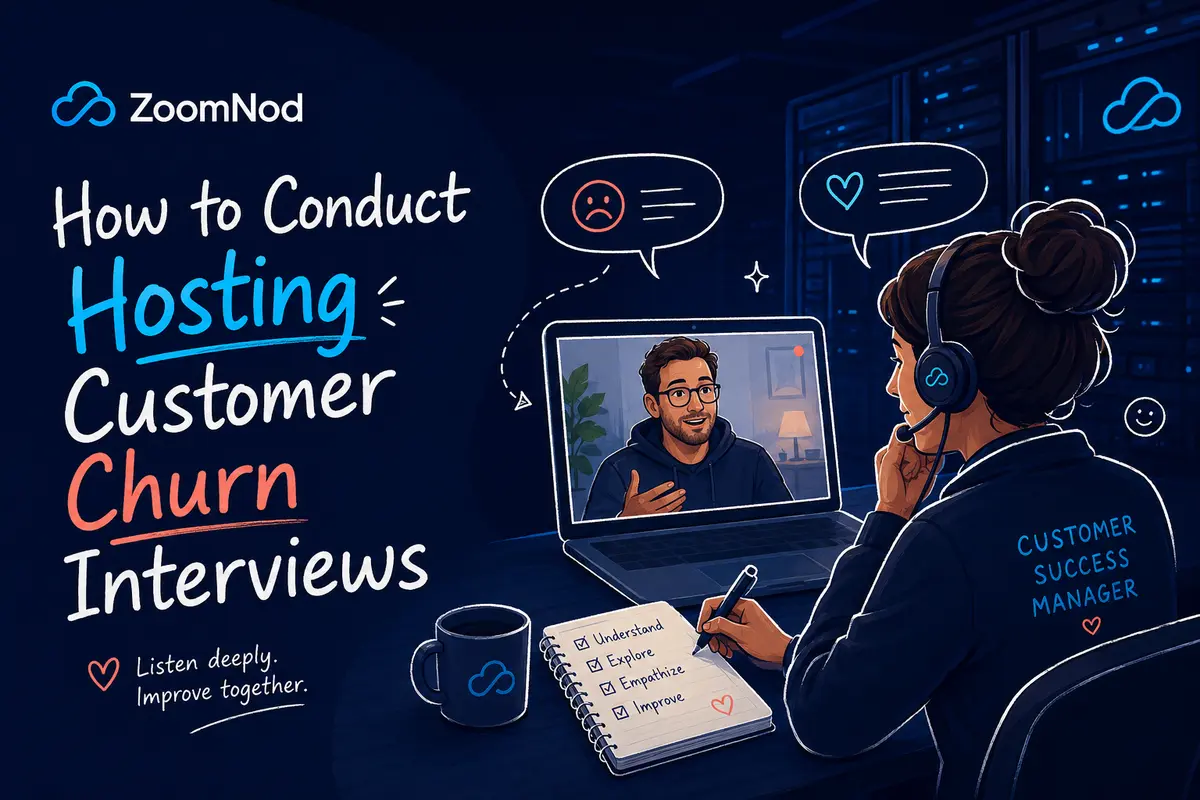
A churn interview is a structured conversation with a former or cancelling customer about the events that led to departure.
An interview can uncover issues that account data and a short cancellation survey cannot fully capture.
Good interviews avoid defensiveness, leading questions and immediate sales pressure. The goal is to reconstruct the customer journey, identify the deciding event and understand what the company could or could not have changed.
Hosting interviews require product context. Migration, control panel expectations, managed service scope, server location, billing and support may affect different customers in different ways.
Here is how to recruit participants, run the conversation, code findings and turn repeated evidence into operating decisions.
Define the research question
Choose a narrow question before recruiting customers. A broad request to understand churn often produces unfocused interviews.
Examples include first-month VPS churn, annual shared hosting nonrenewal or agency cancellations after migration.
Choose the interview sample
Choose a purposeful sample that reflects the problem you are studying.
Do not interview only customers who gave detailed complaints. Include price, product fit, project completion, support and unknown-reason cancellations where possible.
Segments
- Product
- Customer tenure
- Billing period
- Customer value
- Cancellation reason
- Acquisition channel
- Support history
- Voluntary or involuntary churn
Set appropriate timing
Contact the customer while the experience is still recent, but avoid reaching out during an active dispute or unresolved data migration.
For high-value accounts, a neutral research or customer leader may conduct the interview rather than the account owner.
Invite customers without pressure
Explain the purpose, expected length, voluntary nature and how the company will use the feedback.
Do not imply that account closure, refunds or data access depend on participation.
Invitation fields
- Reason for contact
- Approximate interview length
- Voluntary participation
- Recording request if applicable
- Incentive terms if applicable
- Scheduling link or response method
Build a neutral interview guide
Use open questions first, then clarify details.
Avoid questions that defend the company or suggest the expected answer.
Questions
- What were you trying to accomplish when you purchased the service?
- What happened between purchase and cancellation?
- When did you first consider leaving?
- Which event had the largest effect on the decision?
- What alternatives did you consider?
- What did you expect that did not occur?
- Was any part of the service useful enough that you considered staying?
- What could the company realistically have changed?
- Is there anything important that I did not ask?
Ask for a timeline, not only an opinion
A timeline helps distinguish the original cause from later frustration.
Ask about purchase expectations, activation, migration, product use, support contacts, billing events and the final decision.
Probe hosting-specific issues
Product prompts
| Area | Prompts |
|---|---|
| Product fit |
|
| Migration |
|
| Support |
|
| Billing |
|
| Performance |
|
Avoid turning the interview into a save attempt
Research quality declines when the interviewer argues, corrects the customer or introduces a discount after every complaint.
Hold a separate retention conversation only when the customer asks and the company has a relevant solution.
Record and protect the data
Obtain permission before recording. Store notes and recordings under approved access and retention rules.
Do not request passwords, private keys or full payment details.
Code interviews consistently
Code interview notes into a stable set of themes while preserving the customer’s actual sequence of events.
Allow multiple contributing factors and one primary deciding factor.
Coding fields
- Original customer goal
- Expected product outcome
- First friction point
- Primary churn reason
- Contributing reasons
- Deciding event
- Preventable or nonpreventable assessment
- Suggested operating change
- Supporting account evidence
Combine interviews with account evidence
Compare the interview with onboarding events, support tickets, billing history and product use.
Treat differences as information, not proof that the customer is wrong. The company record may show activity without revealing how the customer interpreted it.
Identify patterns without overstating them
A small set of interviews can reveal mechanisms and questions for further analysis, but it cannot establish a market-wide rate.
Use quantitative data to determine how common a pattern is.
Turn findings into operating actions
Actions
| Finding | Action |
|---|---|
| Customers selected unmanaged VPS expecting administration | Rewrite plan comparison and checkout scope. |
| Migration requests stalled because required inputs were unclear | Create a migration intake checklist and ownership rule. |
| Renewal price surprised annual customers | Change pre-renewal communication and billing page content. |
| Support history lost context across agents | Improve ticket summary and complex case ownership. |
| Projects ended normally | Classify the churn as nonpreventable and adjust win-back timing. |
Related Services
Measure the interview program
Metrics
- Customers invited
- Participation rate
- Interviews completed
- Coverage by product and churn reason
- Unknown reason reduction
- Recurring themes
- Actions assigned
- Actions completed
- Related churn trend after implementation
Common mistakes
- Interviewing only the loudest dissatisfied customers
- Asking leading questions
- Defending the company
- Offering discounts during research
- Failing to obtain recording permission
- Ignoring product and billing context
- Treating a few interviews as a representative statistic
- Collecting feedback without assigning action
- Removing important nuance during coding
Interview program sequence
- Define the research question.
- Choose customer segments.
- Set recruitment and consent rules.
- Write a neutral guide.
- Review account context before the call.
- Run and document interviews.
- Code primary and contributing causes.
- Compare with operational data.
- Assign changes to owners.
- Review quantitative trends after implementation.
How Zoomnod can support churn research
Zoomnod can help teams structure interview guides, churn taxonomies, customer segments and the connection between findings, content and marketing decisions.
Customer consent, recordings and data handling must follow the hosting company’s approved policies.
Book a free consultation with Zoomnod to review your hosting churn research and customer feedback process.
Frequently Asked Questions
What is a hosting customer churn interview?
A hosting customer churn interview is a structured conversation with a cancelling or former customer about the events and decision that led to departure.
When should churn interviews be conducted?
Contact customers while the experience is recent, while avoiding active disputes or unresolved operational issues.
What should a churn interview ask?
Ask about the original goal, timeline, first friction, deciding event, alternatives and what the company could realistically have changed.
Should the interview include a retention offer?
Keep research separate from sales unless the customer requests a relevant solution.
How should interview findings be used?
Code recurring themes, compare them with account data and assign specific changes to product, support, billing, onboarding or marketing owners.
Related Hosting Marketing Services
- digital marketing for hosting companies
- SEO for hosting companies
- Google Ads for hosting companies
- LinkedIn Ads for hosting companies
- lead generation for hosting companies
- content marketing for hosting companies
- affiliate marketing for hosting companies
- conversion rate optimisation for hosting companies
- email marketing for hosting companies
- social media marketing for hosting companies