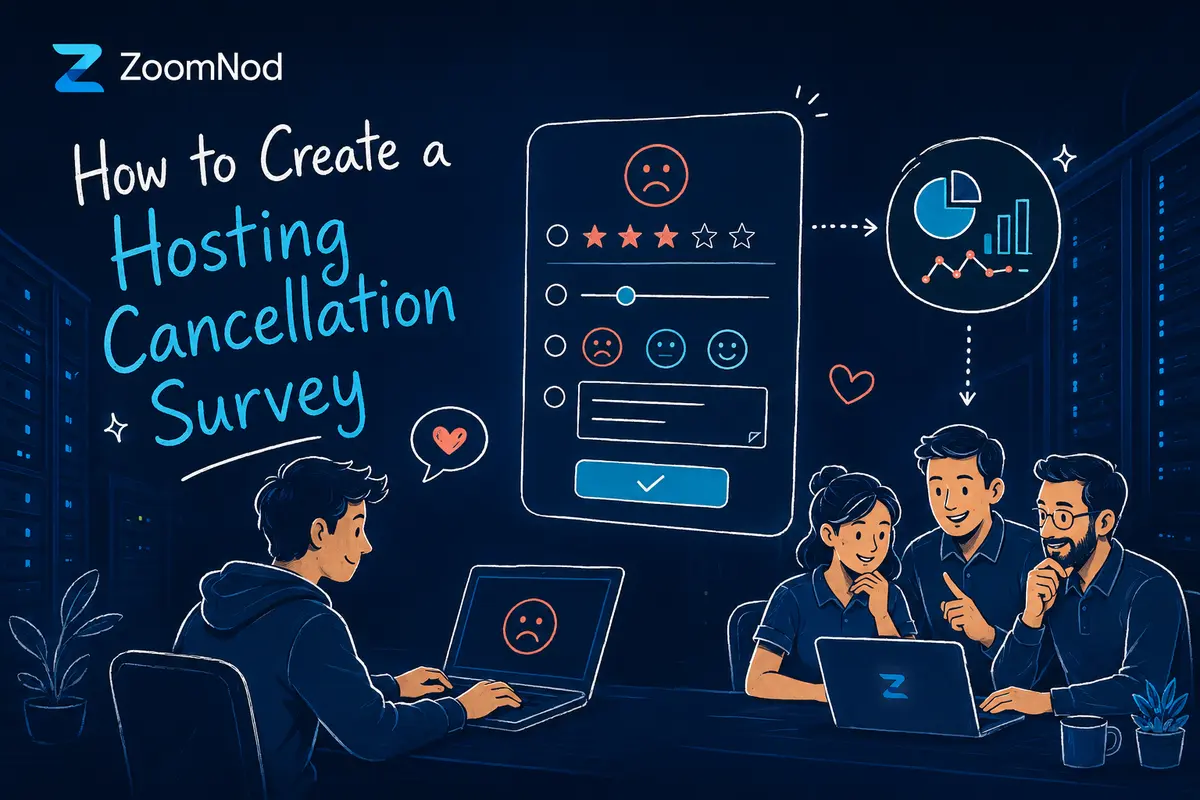
A hosting cancellation survey helps a company understand why customers decide to end a service.
It can reveal problems with product fit, onboarding, support, pricing, migration, performance, billing, missing features or changing customer needs.
Keep the survey short, optional and easy to complete.
It must not become an obstacle that prevents customers from cancelling or moving their data.
A customer who is already leaving may have limited patience, so every question needs a clear purpose.
Effective cancellation surveys combine one structured primary-reason question with a small number of relevant follow-ups and an optional comment box.
They also distinguish voluntary churn from involuntary churn caused by failed payments.
Link the data with product, plan, tenure, acquisition source, support history and customer value so the company can identify patterns.
Zoomnod provides specialist digital marketing and customer-lifecycle services for hosting companies based on six years of hosting-industry experience and work with multiple hosting providers.
What Is a Hosting Cancellation Survey?
A hosting cancellation survey is a short questionnaire presented during or immediately after a customer ends a hosting product.
It captures the primary reason for cancellation and any additional context the customer chooses to provide.
The survey may appear inside the customer portal, on the cancellation-confirmation page or in a follow-up email.
Why Hosting Companies Need Cancellation Feedback
Churn data shows that a customer left, but it does not always explain why.
A cancellation survey adds customer context to account and behavioral data.
This context helps the company identify whether churn is preventable, unavoidable or related to a specific product or process.
Benefits
- Identify common churn reasons
- Separate preventable and unavoidable churn
- Find product-fit problems
- Improve onboarding
- Detect support issues
- Review pricing communication
- Improve cancellation-save workflows
- Create better win-back segments
- Compare churn by product and acquisition channel
Do Not Block or Delay Cancellation
The survey must not make cancellation unnecessarily difficult.
Customers must be able to complete the cancellation even when they skip the survey.
The process needs to show the service end date, billing impact and any data-export requirements clearly.
Best Practices
- Make the survey optional.
- Keep the primary question visible and simple.
- Avoid repeated confirmation screens.
- Do not hide the cancellation button.
- Confirm cancellation in writing.
- Provide migration or export guidance where relevant.
Define the Survey Objective
The survey needs to answer a focused business question.
Trying to collect every possible customer opinion during cancellation can reduce completion and create poor-quality answers.
Objectives
- Identify the primary churn reason
- Find preventable support-related churn
- Understand price-related cancellations
- Measure product-fit problems
- Improve migration and onboarding
- Build win-back segments
- Identify competitor movement
Ask One Primary Cancellation-Reason Question
Recommended question: What is the main reason you are cancelling this hosting service?
Answer Options
- The service is too expensive
- I no longer need the service
- My project or website ended
- I am moving to another provider
- The product does not meet my needs
- I experienced performance or reliability problems
- I had an unresolved support issue
- The service was difficult to set up or use
- The migration process was difficult
- I need a different server location
- I need features that are not available
- I had a billing or payment issue
- I am consolidating services
- Other
Use Product-Specific Reason Options
Product Examples
Shared hosting
Additional Reasons
- Website project ended
- Domain moved
- Website builder or control panel did not fit
- Email requirements changed
VPS
Additional Reasons
- Server management was too difficult
- Resource requirements changed
- Operating system or control panel did not fit
- Application was moved
Agency hosting
Additional Reasons
- Client relationship ended
- Agency consolidated providers
- Multi-site workflow did not fit
- Team-management requirements changed
Managed cloud or dedicated server
Additional Reasons
- Contract or project ended
- Infrastructure consolidated
- Support model did not fit
- Capacity or geographic needs changed
Use Conditional Follow-Up Questions
Show follow-up questions only when they are relevant to the selected reason.
This keeps the survey short while collecting useful detail.
Follow Ups
The service is too expensive
Question: Which statement best describes the pricing issue?
Options
- The renewal price was higher than expected
- The plan costs more than I can justify
- Another provider offered a lower price
- I was paying for features I did not need
- Other
I am moving to another provider
Question: What is the main reason you selected another provider?
Options
- Lower price
- Better product fit
- Required feature
- Server location
- Support
- Performance or reliability
- Other
I had an unresolved support issue
Question: What type of support problem influenced your decision?
Options
- Issue was not resolved
- Resolution took too long
- I had to repeat information
- The service scope was unclear
- Communication was poor
- Other
Include an Optional Open-Text Question
Recommended question: Is there anything else you would like us to know about your decision?
Best Practices
- Do not require a minimum character count.
- Do not ask the customer to repeat information already provided.
- Protect sensitive information.
- Route serious complaints or security issues for review.
- Code recurring themes for analysis.
Ask Permission for Follow-Up
The question must not imply that cancellation depends on accepting contact.
Recommended question: May we contact you to learn more about your feedback?
Options
- Yes
- No
Separate Feedback From the Retention Offer
Capture the customer’s reason before presenting a relevant save option.
Showing an offer first can influence the response and reduce data quality.
Reason Based Options
| Reason | Possible Response |
|---|---|
| Too expensive | Show a lower-cost plan or remove unnecessary add-ons. |
| Service difficult to manage | Offer managed support when appropriate. |
| Project ended | Proceed with cancellation and provide export guidance. |
| Performance issue | Offer a technical review before cancellation. |
| Missing feature | Present another product only when it meets the stated need. |
Keep the Survey Short and Neutral
A practical default is one primary reason, one conditional follow-up, one optional comment and one follow-up permission question.
Keep questions neutral and easy to interpret.
Avoid Examples
- Why did you fail to use all the features?
- Are you sure you want to lose your benefits?
- Why are you leaving our reliable service?
Better Examples
- What is the main reason you are cancelling?
- Which part of setup was most difficult?
- What could have made the service a better fit?
Capture Known Customer Data Automatically
Do not ask customers for information the company already knows.
Attach account and lifecycle data automatically.
Fields
- Customer ID
- Product
- Plan
- Managed or unmanaged status
- Billing period
- Customer tenure
- Recurring revenue
- Acquisition channel
- Affiliate partner
- Onboarding completion
- Support-ticket history
- Payment status
- Renewal date
- Customer health score
- Cancellation date
Distinguish Voluntary and Involuntary Churn
A cancellation survey is primarily designed for voluntary churn.
Customers lost because of failed or unresolved payments require payment-recovery analysis rather than the same exit survey.
Voluntary Examples
- Customer chooses another provider
- Project ends
- Product no longer fits
- Price no longer fits
- Support experience causes cancellation
Involuntary Examples
- Payment card expires
- Bank declines payment
- Billing contact is outdated
- Invoice remains unpaid
- Payment retries fail
Choose the Right Survey Placement
Place the primary survey inside the cancellation flow when possible, while the reason is fresh.
A follow-up email can be used when the customer skips the survey.
Placements
- Cancellation page
- Cancellation confirmation page
- Customer portal
- Post-cancellation email
- Account-manager follow-up for high-value customers
Create a Post-Cancellation Email
Email Elements
- Service cancelled
- Effective end date
- Final billing information
- Data-export or migration guidance
- Reactivation information where appropriate
- Optional feedback link
- Support contact
Related: email marketing for hosting companies
Create a Churn Reason Taxonomy
Taxonomy
- Price and billing
- Product fit
- Performance and reliability
- Support
- Onboarding and usability
- Migration
- Missing feature
- Server location
- Competitor
- Project ended
- Business closure
- Consolidation
- Involuntary payment churn
- Other or unknown
Analyze Churn by Customer Segment
Segments
- Shared hosting
- VPS
- Managed hosting
- Agency hosting
- Cloud or dedicated server
- Monthly or annual billing
- Customer tenure
- Country
- Server location
- Acquisition channel
- Marketing campaign
- Affiliate partner
- Customer lifetime value
Related: SEO for hosting companies
Related: Google Ads for hosting companies
Related: affiliate marketing for hosting companies
Connect Survey Feedback With Operational Data
Compare customer responses with product, support and billing records.
Combining stated feedback with operational data produces a clearer diagnosis.
Examples
- Performance reason combined with repeated resource-limit events
- Support reason combined with unresolved tickets
- Price reason combined with introductory-to-renewal changes
- Setup reason combined with incomplete onboarding
Create a Monthly Churn Review
Review Agenda
- Cancellation volume
- Survey completion
- Top churn reasons
- Churn by product
- Churn by acquisition source
- High-value customer losses
- Support-related cancellations
- Price-related cancellations
- Onboarding-related cancellations
- Actions and owners
- Previous action status
Measure Cancellation Survey Performance
Metrics
- Survey view rate
- Survey completion rate
- Primary-reason completion
- Open-text response rate
- Follow-up permission rate
- Percentage of cancellations with known reason
- Preventable churn share
- Unknown reason share
- Retention-offer acceptance
- Actions completed from feedback
- Churn trend by reason
Formulas
| Name | Formula |
|---|---|
| Cancellation survey completion rate | Completed surveys divided by customers shown the survey, multiplied by 100 |
| Known cancellation reason rate | Cancellations with a recorded reason divided by total cancellations, multiplied by 100 |
Use Feedback to Improve the Customer Lifecycle
Examples
| Reason | Action |
|---|---|
| Customers buy the wrong product | Improve targeting, plan comparison and landing-page clarity. |
| Setup is difficult | Improve onboarding, checklists and product education. |
| Support problems | Review ticket ownership, escalation and recurring technical causes. |
| Renewal price surprise | Improve pricing transparency and renewal communication. |
| Missing backup understanding | Clarify backup responsibilities before and after purchase. |
Related: digital marketing for hosting companies
Related: content marketing for hosting companies
Related: conversion rate optimisation for hosting companies
Use Survey Data for Win-Back Segmentation
Segments
| Reason | Win Back Approach |
|---|---|
| Project ended | Reconnect when a new project cycle is likely. |
| Missing feature | Contact only when the relevant capability becomes available. |
| Support problem | Explain a meaningful process change before inviting a return. |
| Price | Present a more suitable plan when one exists. |
| Business closure | Exclude from routine win-back campaigns. |
Protect Customer Privacy
Best Practices
- Do not request passwords or private keys.
- Do not request full payment details.
- Limit access by role.
- Redact sensitive open-text information where needed.
- Define retention periods.
- Respect follow-up preferences.
- Document data ownership.
Common Hosting Cancellation Survey Mistakes
Mistakes
- Making the survey mandatory
- Blocking cancellation
- Using too many questions
- Using vague reason categories
- Using biased or defensive language
- Showing a retention offer before recording the reason
- Asking for information already stored
- Mixing voluntary and involuntary churn
- Ignoring product-specific reasons
- Failing to analyze open text
- Collecting feedback without assigning action
- Sending every former customer the same win-back campaign
A Step-by-Step Hosting Cancellation Survey Plan
Steps
| Step | Title | Description |
|---|---|---|
| 1 | Define the Objective | Decide which churn questions the survey should answer. |
| 2 | Create the Reason Taxonomy | Build consistent categories with product-specific options. |
| 3 | Write the Primary Question | Ask for the main cancellation reason. |
| 4 | Add Conditional Follow-Ups | Collect relevant detail without making the survey long. |
| 5 | Add Optional Comments and Permission | Allow additional context and consensual follow-up. |
| 6 | Build a Respectful Cancellation Flow | Keep the survey optional and confirm service details clearly. |
| 7 | Attach Customer Data | Connect product, tenure, support, billing and acquisition information. |
| 8 | Create Reporting | Segment churn by product, customer type and reason. |
| 9 | Assign Actions | Route recurring issues to marketing, product, support, billing or operations. |
| 10 | Review and Improve | Monitor completion, unknown reasons and operational changes. |
How Zoomnod Helps Hosting Companies Build Cancellation Surveys
Zoomnod treats cancellation surveys as part of a broader churn-analysis and retention system.
We review the cancellation flow, survey questions, churn taxonomy, customer segmentation, lifecycle data and operational reporting.
Our six years of hosting-industry experience helps us understand the different churn reasons across shared hosting, VPS, WordPress hosting, agency hosting, managed cloud and dedicated infrastructure.
Services
- Cancellation-flow audit
- Survey question design
- Product-specific churn taxonomy
- Conditional survey logic
- Customer segmentation
- Cancellation email strategy
- Churn reporting framework
- Acquisition-channel analysis
- Win-back segmentation
- Retention recommendations
Build a Better Hosting Cancellation Feedback System
Zoomnod can review your cancellation journey, churn reasons, customer data and reporting before creating a focused survey strategy.
Make Cancellation Feedback Easy to Give and Useful to Act On
A hosting cancellation survey needs to capture the main reason for leaving without making cancellation difficult.
An effective format uses one primary reason, a relevant conditional follow-up, an optional comment box and permission for further contact.
Reason options need to reflect the product and distinguish voluntary churn from payment-related involuntary churn.
Connect survey responses with product, tenure, support, billing and acquisition data.
Hosting companies need to review churn feedback regularly and assign actions to the teams that can improve the customer lifecycle.
Book a free consultation with Zoomnod to discuss your hosting cancellation flow, churn reasons and retention opportunities.
Frequently Asked Questions
What is a hosting cancellation survey?
A hosting cancellation survey is a short optional questionnaire that asks customers why they are ending a hosting service.
Should a cancellation survey be mandatory?
No. Customers should be able to cancel even when they choose not to complete the survey.
What is the most important cancellation survey question?
Ask the customer to select the main reason for cancelling the hosting service.
How many questions should a hosting cancellation survey contain?
A practical survey can use one primary reason, one conditional follow-up, one optional comment and one follow-up permission question.
What hosting cancellation reasons should be included?
Include price, product fit, performance, support, setup, migration, missing features, project completion, competitor movement, billing and other.
Should hosting cancellation surveys include open text?
Yes, an optional comment box can capture details that fixed answer choices miss.
Can a hosting company show a retention offer during cancellation?
Yes, but record the customer’s reason first and show only a relevant offer that does not obstruct cancellation.
How should cancellation survey data be analyzed?
Segment responses by product, plan, tenure, billing period, support history, acquisition source and customer value.
What is the difference between voluntary and involuntary churn?
Voluntary churn occurs when a customer chooses to leave, while involuntary churn results from failed or unresolved payment.
Can Zoomnod create a hosting cancellation survey?
Yes. Zoomnod can design questions, churn categories, conditional logic, reporting and retention workflows for hosting companies.
What are the most useful hosting cancellation survey questions for separating pricing concerns from support, performance, migration, billing, and missing-feature problems?
A short cancellation survey is usually more valuable than a long form. One primary reason, an optional explanation, and a question about what could have prevented the cancellation should produce cleaner churn data.
Hosting companies should segment cancellation survey responses by product, customer tenure, plan value, and cancellation reason. That makes the feedback more actionable than reviewing every answer as one combined group.
For a hosting cancellation survey, would you recommend asking customers to choose one primary cancellation reason first and then showing a short optional follow-up field? I am trying to keep the survey completion rate high while still collecting useful details about pricing, support quality, website migration problems, server performance, billing issues, and missing hosting features. It would also be useful to know whether responses should be segmented by shared hosting, VPS, dedicated server, and reseller hosting customers, since each group may cancel for very different reasons.
A useful cancellation survey probably needs a separate option for temporary project completion. That reason is very different from poor hosting performance or customer support, and it may identify customers who could return later through a hosting win-back campaign.
It may also help to connect hosting cancellation survey responses with account data such as plan type, customer age, support ticket history, renewal date, and recent payment failures. The survey answer alone explains what the customer selected, while the account context can reveal whether the underlying issue was onboarding, pricing, server reliability, billing, or product fit.