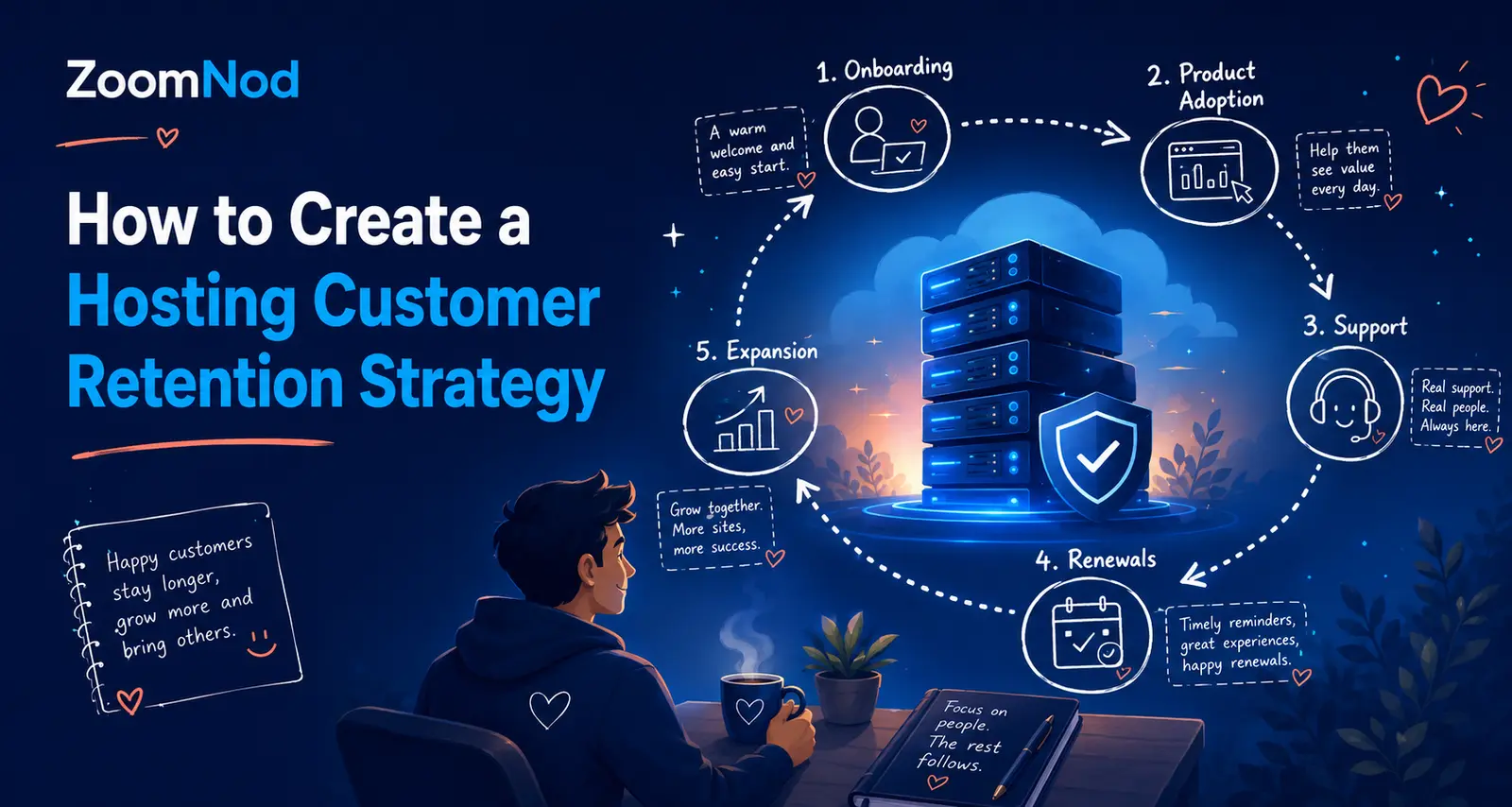
A hosting customer retention strategy is a structured plan for helping suitable customers continue receiving value from a hosting service over time.
It connects acquisition, onboarding, product adoption, support, billing, renewals, expansion and win-back activity around recurring customer value.
Hosting providers often treat retention as a renewal email problem. However, a customer’s decision to stay is shaped throughout the relationship.
Customers are more likely to remain when they choose the right plan, complete setup successfully, understand their responsibilities, receive useful support and experience clear billing communication.
Customers may leave because of poor product fit, weak onboarding, unresolved technical problems, unexpected renewal pricing, payment failures or changing business requirements.
An effective strategy must address both voluntary and involuntary churn while distinguishing between low-value self-service accounts and high-value managed hosting, cloud or dedicated infrastructure customers.
Zoomnod provides specialist digital marketing for hosting companies and lifecycle growth services based on six years of hosting-industry experience.
Here is how shared hosting, VPS, WordPress hosting, agency hosting, cloud and dedicated server companies can build a complete customer retention system.
What Is a Hosting Customer Retention Strategy?
A hosting customer retention strategy is a set of coordinated processes that reduce preventable customer loss and strengthen long-term customer value.
It includes the actions taken before purchase, during onboarding, throughout product use and around renewal.
The goal is not to keep every customer at any cost. It is to retain customers whose needs match the service and whose relationship can remain commercially and operationally sustainable.
- Customer-fit analysis
- Product-specific onboarding
- Product adoption
- Customer education
- Technical support
- Customer health monitoring
- Billing communication
- Failed-payment recovery
- Renewal management
- Plan reviews
- Expansion
- Cancellation feedback
- Win-back campaigns
Why Retention Matters for Hosting Companies
Hosting is built around recurring customer relationships.
A customer may remain for several billing periods, add resources, purchase another server or move into a higher-value product.
When customers leave early, the provider may not recover acquisition, migration and support costs.
Retention can improve recurring-revenue predictability, customer lifetime value and the commercial return from marketing.
It also provides a clearer measure of customer quality. A campaign producing inexpensive purchases but weak renewals may be less valuable than a campaign producing fewer customers with stronger retention.
Define Retention Goals
Retention activity should begin with measurable commercial goals.
A general goal such as reducing churn is too broad unless the company identifies the product, customer segment and period involved.
- Reduce first-30-day shared hosting churn
- Improve first annual renewal rates
- Recover more failed VPS payments
- Increase managed hosting contract renewals
- Reduce cancellations after introductory pricing
- Improve customer activation
- Increase net revenue retention
- Reduce churn from selected acquisition channels
- Increase win-back reactivation
- Improve customer lifetime value
Measure Retention Correctly
A company should measure both customer retention and revenue retention.
Customer retention shows how many relationships continue. Revenue retention shows how much recurring value remains after churn, downgrades and, when applicable, expansion.
Customer Retention Rate
Formula: Customers at the end of the period minus customers acquired during the period, divided by customers at the beginning of the period, multiplied by 100.
Customer Churn Rate
Formula: Customers lost during the period divided by customers at the beginning of the period, multiplied by 100.
Gross Revenue Retention
Formula: Starting recurring revenue minus churned revenue minus downgrade revenue, divided by starting recurring revenue, multiplied by 100.
Net Revenue Retention
Formula: Starting recurring revenue plus expansion revenue minus churned revenue minus downgrade revenue, divided by starting recurring revenue, multiplied by 100.
Segment Retention Data
A company-wide retention rate can hide weak products, campaigns or markets.
- Shared hosting
- Managed and unmanaged VPS
- WordPress hosting
- Agency hosting
- Cloud hosting
- Dedicated servers
- Monthly and annual billing
- Country and server location
- Customer value
- Acquisition channel and campaign
- Affiliate partner
- Introductory offer
- Customer cohort
Improve Customer Fit Before Purchase
Retention begins with customer acquisition.
Marketing that attracts unsuitable customers can create refunds, high support demand and early churn.
Hosting pages should explain who each product is for and what the customer must manage. Managed and unmanaged services should not use interchangeable messaging.
- Define the ideal customer for each product.
- Use product-specific landing pages.
- Clarify managed and unmanaged responsibilities.
- Show resource limits.
- Explain migration scope.
- Display introductory and renewal pricing.
- Use accurate server-location information.
- Avoid unsupported performance claims.
- Measure retention by acquisition source.
Zoomnod can connect lead generation for hosting companies with conversion rate optimisation for hosting companies so the right audiences reach the right plans.
Build Product-Specific Onboarding
New customers are at risk before they reach a meaningful product outcome.
Onboarding should help each customer complete the actions required to receive value.
Shared Hosting
- Access the control panel
- Connect a domain
- Install a website
- Create email accounts
- Enable SSL
- Configure backups
VPS
- Access the server securely
- Review operating-system information
- Configure security
- Deploy the application
- Enable backups
- Monitor resources
Managed Hosting
- Confirm management scope
- Collect migration requirements
- Complete migration
- Activate monitoring
- Introduce support and escalation
- Complete account handoff
Agency Hosting
- Migrate the first client site
- Add team members
- Configure staging
- Review client-management workflows
- Confirm support contacts
These journeys can be delivered through specialist email marketing for hosting companies.
Reduce Time to First Value
Time to first value is the period between purchase and the customer achieving a meaningful result.
Reducing time to value can increase confidence and product adoption. A customer who remains inactive may question the value of the subscription and become more likely to cancel.
- Use setup checklists.
- Provide guided migration.
- Send behavior-based reminders.
- Detect inactive accounts.
- Offer human assistance when customers are blocked.
- Preconfigure common settings.
- Create product-specific tutorials.
- Measure activation time by product.
Increase Product Adoption
Retention improves when the customer actively uses the features and resources that create value.
Login frequency alone is not enough to measure adoption. Each product should have specific activation and adoption events.
Shared Hosting Signals
- Domain connected
- Website published
- Email configured
- Backup enabled
VPS Signals
- Server accessed
- Application deployed
- Resources used
- Monitoring active
- Backup configured
Agency Hosting Signals
- Client sites added
- Team members active
- Staging used
- Additional sites created
Managed Infrastructure Signals
- Migration completed
- Monitoring active
- Support relationship established
- Account review completed
Build Customer Education Into the Lifecycle
Educational content can reduce setup friction, improve adoption and help customers use the service correctly.
- How to connect a domain
- How to configure DNS
- How to migrate a website
- How to secure a VPS
- How to configure backups
- How to monitor resources
- How to use a hosting control panel
- When to upgrade a hosting plan
- How managed hosting responsibilities work
- How renewal billing works
A structured content marketing for hosting companies programme can turn recurring support questions into retention assets.
Improve Support and Escalation
Support quality can influence retention because hosting customers rely on the provider when websites, servers and applications experience problems.
Fast acknowledgement helps, but resolution quality, ownership and communication are equally important.
- Define escalation paths.
- Maintain context across tickets.
- Assign ownership to important cases.
- Review recurring support causes.
- Follow up after major incidents.
- Prioritize high-risk and high-value accounts.
- Convert repeated questions into educational content.
- Track support satisfaction and resolution outcomes.
Identify At-Risk Customers Early
At-risk customers often show warning signs before cancellation.
A customer health system can combine onboarding, usage, support, billing, renewal and sentiment data.
- Incomplete onboarding
- Declining product usage
- No login after purchase
- Repeated support tickets
- Unresolved critical issue
- Negative customer feedback
- Failed payment
- Payment method approaching expiration
- Cancellation-page activity
- Domain transfer request
- Resource limits repeatedly reached
- Downgrade request
- Stakeholder disengagement
Create Customer Health Scores
A customer health score combines several leading indicators into an explainable view of account condition.
Use the score to support prioritization rather than replace human judgment. Validate weights and thresholds using actual customer outcomes.
- Onboarding completion
- Product adoption
- Support health
- Billing health
- Relationship engagement
- Renewal readiness
| Band | Meaning |
|---|---|
| Healthy | The customer is active and receiving value. |
| Watch | The account has one or more warning signs. |
| At risk | The customer has meaningful adoption, support, billing or relationship problems. |
| Critical | The account shows strong cancellation or non-payment risk. |
Reduce Involuntary Churn
Some customers leave because payment cannot be collected, not because they intend to cancel.
A structured payment-recovery process can reduce avoidable subscription loss.
- Detect the failed payment.
- Notify the customer clearly.
- Provide a direct payment-update link.
- Use appropriate payment retries.
- Show the issue in the customer portal.
- Escalate high-value accounts.
- Explain service-impact timing.
- Stop messages after successful payment.
- Record the recovery outcome.
Improve Renewal Communication
Start renewal planning before the payment date.
Customers should understand what is renewing, when it renews and how much it will cost.
- Service name
- Renewal date
- Renewal amount
- Billing period
- Payment method
- Billing-update link
- Plan-review option
- Support contact
- Cancellation information
- Successful payment confirmation
Offer Relevant Plan Changes
Some customers leave because the current plan no longer fits their requirements.
A plan review may preserve the relationship through a legitimate downgrade, upgrade or product change.
- Move to a lower-cost plan
- Change billing frequency
- Upgrade resources
- Switch from unmanaged to managed hosting
- Remove unused add-ons
- Add backup or security services
- Change server location
- Consolidate services
Use Lifecycle Email Marketing
Lifecycle email links customer behavior with onboarding, education, retention and renewal communication.
- Welcome and onboarding
- Incomplete setup
- Migration updates
- Product education
- Usage-based guidance
- Customer health check
- Renewal reminders
- Payment recovery
- Cancellation follow-up
- Win-back campaign
Build these flows with email marketing for hosting companies.
Build Expansion Into Retention
Retention does not mean keeping every customer on the same plan forever.
As customer needs change, relevant upgrades and cross-sells can help the provider continue serving the account.
- Plan upgrades
- Additional servers
- Additional websites
- Managed support
- Backup services
- Security products
- Monitoring
- Additional storage
- Additional bandwidth
- New server locations
- Annual billing
Create a Cancellation-Save Process
A cancellation-save process should identify why the customer wants to leave and whether a suitable solution exists.
It should not make cancellation unnecessarily difficult.
| Reason | Response |
|---|---|
| Price | Review plan fit and present a suitable lower-cost option. |
| Technical issue | Escalate the problem and provide a resolution plan. |
| Migration difficulty | Offer migration support and clarify next steps. |
| Missing feature | Recommend another product only when a suitable alternative exists. |
| Project ended | Confirm cancellation and provide export guidance. |
Build a Win-Back Campaign
Former customers may return when the provider has a relevant reason to reconnect.
Win-back campaigns should be segmented by previous product, cancellation reason, customer value and time since departure.
- New server location
- Improved migration support
- New managed service
- Previously missing feature
- More suitable plan
- Resolved support issue
- New project cycle
Connect Retention With Acquisition Channels
Continue measuring marketing performance after purchase.
Hosting companies should compare activation, churn, renewal and lifetime value across channels.
Review retention across SEO for hosting companies, Google Ads for hosting companies, LinkedIn Ads for hosting companies, affiliate marketing for hosting companies and social media marketing for hosting companies.
Create a Retention Dashboard
A useful retention dashboard combines lagging outcomes with leading indicators.
- Customer retention rate
- Customer churn rate
- Gross revenue retention
- Net revenue retention
- Activation rate
- Time to first value
- First-30-day churn
- Renewal rate
- Failed payment rate
- Payment recovery rate
- Customer health score
- Upgrade rate
- Customer lifetime value
- Retention by acquisition channel
Common Hosting Retention Mistakes
- Treating retention as a renewal-email project
- Ignoring customer fit
- Using one onboarding journey for every product
- Waiting until cancellation to intervene
- Using discounts as the default retention tool
- Ignoring failed payments
- Hiding renewal pricing
- Upselling customers with unresolved problems
- Measuring acquisition without retention
- Using one company-wide retention rate
- Failing to assign account ownership
- Making cancellation unnecessarily difficult
A Step-by-Step Hosting Retention Plan
- Set retention goals: Define the product, customer segment and commercial outcome.
- Measure a baseline: Calculate retention, churn, renewals and revenue retention.
- Segment the data: Compare products, channels, markets and customer cohorts.
- Improve customer fit: Refine targeting, positioning, pricing and product selection.
- Improve onboarding: Help customers reach first value faster.
- Track adoption and risk: Monitor meaningful product, support and billing signals.
- Build lifecycle workflows: Create education, renewal, payment-recovery and risk journeys.
- Create intervention playbooks: Use different responses for onboarding, support, billing and renewal risk.
- Build expansion and win-back: Create relevant upgrade and former-customer journeys.
- Review commercial outcomes: Measure recurring revenue, customer lifetime value and retention by acquisition source.
How Zoomnod Builds Hosting Customer Retention Strategies
Zoomnod treats retention as a complete customer-lifecycle system rather than a single campaign.
We review how customers are acquired, what they experience during onboarding, how they use the product, why they contact support and which signals appear before cancellation.
- Customer retention audit
- Retention and churn segmentation
- Acquisition-quality analysis
- Onboarding strategy
- Lifecycle email planning
- Customer health scoring
- Support and billing workflow review
- Renewal campaign development
- Payment-recovery planning
- Cancellation feedback strategy
- Win-back campaigns
- Retention and lifetime-value reporting
Explore our digital marketing for hosting companies, email marketing for hosting companies, conversion rate optimisation for hosting companies, content marketing for hosting companies and lead generation for hosting companies.
Retention Is the Result of the Complete Customer Experience
Hosting customer retention cannot be improved through one email, discount or cancellation popup.
It depends on the customer’s complete experience from the first marketing interaction to onboarding, product adoption, support and renewal.
An effective strategy attracts suitable customers, helps them reach value quickly and identifies problems before they become cancellation decisions.
It distinguishes voluntary churn from failed-payment churn and uses different responses for different risk drivers.
Zoomnod can help hosting and infrastructure providers build this connected retention system.
Book a free consultation with Zoomnod to discuss your hosting churn, renewal process and customer-retention opportunities.
Frequently Asked Questions
What is a hosting customer retention strategy?
A hosting customer retention strategy is a structured plan for helping suitable customers continue receiving value through onboarding, support, billing, renewals and lifecycle communication.
How can a hosting company improve customer retention?
A hosting company can improve retention through better customer fit, onboarding, product adoption, support, payment recovery, renewal communication and early risk detection.
Why do hosting customers leave?
Customers may leave because of poor product fit, failed migration, weak support, unclear pricing, technical problems, payment failure or changing requirements.
How does onboarding affect hosting retention?
Onboarding helps customers activate the service, complete setup and reach value before they decide whether to continue.
What is involuntary hosting churn?
Involuntary churn occurs when a subscription ends because of a failed or unresolved payment rather than an intentional cancellation.
How can hosting companies identify at-risk customers?
They can combine onboarding, product usage, support, billing, renewal and sentiment data into explainable risk signals.
What metrics should a hosting retention dashboard include?
Useful metrics include retention rate, churn, revenue retention, activation, time to first value, renewals, payment recovery and customer lifetime value.
Should hosting companies use discounts to prevent churn?
Discounts may help selected customers, but they should not replace resolving product, support, pricing or onboarding problems.
How can lifecycle email improve retention?
Lifecycle email can guide onboarding, product adoption, renewals, payment recovery, cancellation feedback and win-back.
Can Zoomnod build a hosting customer retention strategy?
Yes. Zoomnod can review acquisition, onboarding, churn, renewal, email automation, customer health and lifetime-value reporting.
Which hosting customer retention metrics should be reviewed first: renewal rate, logo churn, revenue churn, product adoption, support satisfaction, or customer lifetime value?
A hosting retention strategy should begin during acquisition and onboarding, not only when renewal emails are sent. Poor-fit customers and incomplete setup often become churn risks months before cancellation.
Segmenting retention by hosting product, billing cycle, customer tenure, acquisition channel, and account value can expose very different churn patterns. One generic retention campaign is unlikely to solve every cause.
A hosting customer retention strategy probably needs separate playbooks for shared hosting, VPS, reseller hosting, and dedicated server customers because the reasons for churn are different. Shared hosting users may struggle with onboarding or website setup, while VPS customers may leave because of performance, management complexity, support scope, or server location. I would build the strategy around lifecycle stages: activation, product adoption, support experience, billing health, renewal preparation, expansion, and win-back. Each stage should have measurable signals and a clear owner rather than relying only on renewal reminder emails.
Early retention indicators such as completed onboarding, first successful deployment, backup activation, support satisfaction, and stable payment status may be more useful than waiting for a customer to approach the renewal date.
Retention should also be reviewed by acquisition channel and signup cohort. Customers acquired through a high-intent hosting comparison may behave differently from customers attracted by a deep introductory discount.