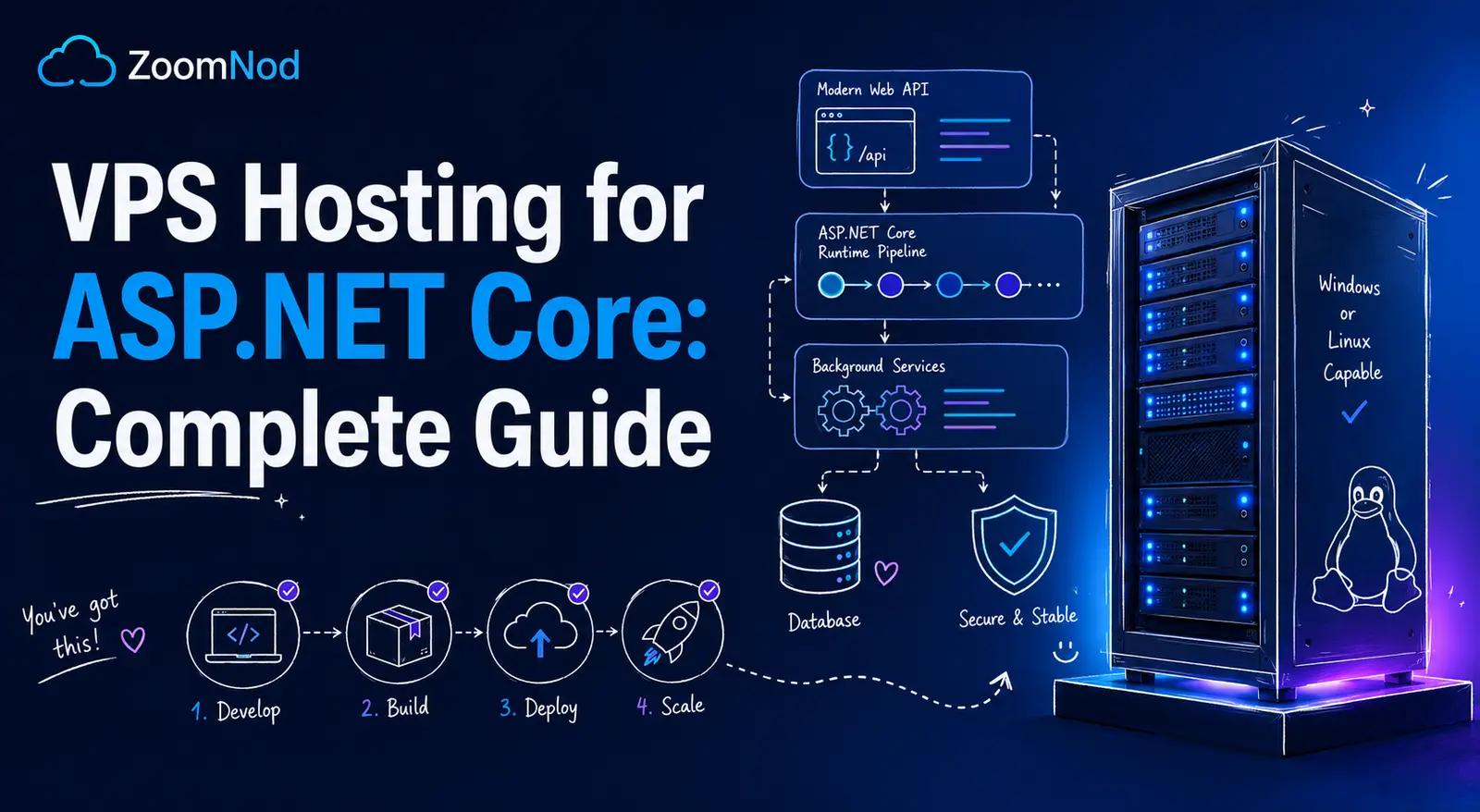
VPS Hosting for ASP.NET Core: Complete Guide for 2026
VPS hosting is an excellent choice for ASP.NET Core applications that need predictable CPU and RAM, .NET runtime control, Kestrel, Nginx or IIS, background services, private databases, distributed caching, SignalR, Blazor, CI/CD, Docker, and more control than shared hosting provides. A practical starting point for a small production ASP.NET Core application is 2–4 vCPUs, 4–8 GB RAM, 60–120 GB NVMe storage, a supported Linux distribution or Windows Server, .NET 10 LTS, Kestrel behind Nginx on Linux or IIS on Windows, systemd or Windows Service supervision, HTTPS, persistent Data Protection keys, monitored health checks, off-server backups, and 30% to 50% capacity headroom.
As of July 2026, .NET 10 is the current Long-Term Support release and is supported until November 14, 2028. .NET 9 is a Standard Term Support release in maintenance until November 10, 2026, while .NET 8 LTS also reaches end of support on November 10, 2026. New deployments should generally target .NET 10 when application, package, hosting, and operating-system compatibility allow it.
A single VPS can host an ASP.NET Core API, MVC application, Razor Pages site, Blazor app, SignalR service, internal business platform, or SaaS backend economically. As traffic and availability requirements grow, separate databases, distributed cache, background work, object storage, and real-time services, then add multiple application nodes behind a load balancer.
ASP.NET Core VPS Requirements at a Glance
| ASP.NET Core workload | Suggested starting VPS | Important controls |
|---|---|---|
| Development or staging | 1–2 vCPUs, 2–4 GB RAM | .NET SDK, snapshots, separate secrets |
| Small production API or MVC app | 2–4 vCPUs, 4–8 GB RAM | Kestrel, Nginx or IIS, systemd, backups |
| Growing business application | 4–8 vCPUs, 8–16 GB RAM | Separate database, distributed cache, health checks |
| SignalR or server-side Blazor app | 4–8 vCPUs, 8–16 GB RAM | Connection monitoring, shared backplane, proxy tuning |
| High-throughput service | 8+ dedicated vCPUs, 16–32 GB+ RAM | Load balancing, profiling, job isolation, DR |
These are planning ranges rather than request guarantees. Garbage collection, allocation rate, thread-pool behavior, database queries, response size, SignalR connections, Blazor circuits, background services, and external dependencies determine real capacity.
Why Developers Use a VPS for ASP.NET Core
- Choose and patch a supported .NET runtime.
- Host Kestrel behind Nginx, Apache, IIS, or another proxy.
- Run Web APIs, MVC, Razor Pages, Blazor, and SignalR.
- Use PostgreSQL, SQL Server, MySQL, or another database.
- Configure Redis and distributed caching.
- Run BackgroundService and hosted workers.
- Use Entity Framework Core migrations.
- Deploy framework-dependent or self-contained builds.
- Use Docker containers and CI/CD.
- Control logging, Data Protection, monitoring, backups, and scaling.
When a VPS Is Better Than Shared Hosting
Traditional shared hosting may not provide persistent Kestrel processes, custom .NET runtime versions, background services, SignalR, private databases, Docker, system-level packages, or deployment automation.
A VPS is appropriate when the application needs:
- A long-running ASP.NET Core host.
- Custom Kestrel or proxy configuration.
- WebSockets and SignalR.
- Background workers.
- Private Redis, SQL Server, PostgreSQL, or MySQL.
- Custom native libraries.
- Self-contained deployment.
- Docker.
- System-level monitoring and security controls.
When a Managed Platform Is Better
A managed application platform can be better when the team wants to deploy code without maintaining Linux or Windows, the .NET runtime, Nginx or IIS, certificates, service supervision, monitoring agents, backups, and operating-system upgrades.
Choose a managed platform when developer productivity is more valuable than root access, automatic scaling is important, or no one owns server operations and recovery.
Managed vs Unmanaged ASP.NET Core VPS
| Choose managed VPS when | Choose unmanaged VPS when |
|---|---|
| No one owns operating-system security | The team administers Linux or Windows confidently |
| 24/7 incident support is required | Monitoring and on-call support already exist |
| Backups and patching need provider oversight | Infrastructure is automated and tested |
| Business uptime justifies management cost | Complete hosting control is essential |
Use How to Set Up a VPS Server from Scratch when building an unmanaged environment.
How to Size an ASP.NET Core VPS
Measure:
- Requests per second.
- Concurrent requests, SignalR connections, or Blazor circuits.
- p95 and p99 response time.
- Managed heap and process resident memory.
- Allocation rate and garbage-collection pauses.
- Thread-pool queue length.
- Database pool demand.
- Background-job duration.
- Static and uploaded-file growth.
- Log, dump, and backup capacity.
Keep 30% to 50% capacity headroom above normal peaks and test realistic traffic before launches or campaigns.
CPU Requirements
ASP.NET Core uses CPU for request processing, JSON serialization, Razor rendering, encryption, compression, garbage collection, Entity Framework query materialization, image processing, reports, authentication, and background services.
Strong single-core performance improves latency-sensitive work. More cores help with concurrent requests, thread-pool work, garbage collection, background consumers, and separate services.
Compare processors with Choosing the Best Server CPU.
Shared vs Dedicated vCPU
Shared vCPU suits development, staging, and bursty APIs. Dedicated vCPU provides more consistent latency for sustained production traffic, large SignalR workloads, report generation, media processing, and service-level objectives.
Monitor CPU steal time, thread-pool queueing, garbage-collection CPU, and request latency rather than comparing core counts alone.
RAM Requirements
| RAM | Typical ASP.NET Core workload |
|---|---|
| 2 GB | Small development service or minimal API |
| 4 GB | Small production API or MVC application |
| 8 GB | Growing application with cache, database, and workers |
| 16 GB+ | SignalR, Blazor Server, several services, or memory-heavy workloads |
RAM supports the managed heap, native runtime memory, thread stacks, JIT code, Kestrel buffers, distributed-cache clients, database pools, Nginx or IIS, monitoring, and operating-system cache.
.NET Memory Budget
Total VPS RAM =
Managed heap
+ native runtime memory
+ thread stacks
+ JIT and code pages
+ Kestrel buffers
+ application native libraries
+ reverse proxy
+ monitoring
+ operating system
+ safety headroom
Monitor both managed heap metrics and process resident memory. A process can exceed the expected footprint because of native allocations, large buffers, image libraries, or memory-mapped data.
Garbage Collection
.NET garbage collection balances throughput, pause time, memory use, and CPU. Server GC is commonly appropriate for server applications, while workload and VPS size determine the best behavior.
Monitor:
- Heap size.
- Allocation rate.
- Generation 0, 1, and 2 collection frequency.
- Pause duration.
- Large Object Heap growth.
- Pinned objects.
- GC CPU use.
- Memory after collection.
Do not assume every memory increase is a leak, but investigate memory that does not stabilize under a repeatable workload.
Thread-Pool Health
Blocking synchronous calls, long locks, excessive Task.Run use, slow database operations, and synchronous external APIs can exhaust thread-pool capacity and increase latency.
Track worker availability, queue length, completed work, request duration, and downstream response time. Use asynchronous I/O through the complete call path where it provides a real benefit.
NVMe Storage
NVMe storage improves publish extraction, application startup, logs, temporary files, local databases, static assets, upload processing, crash dumps, container layers, and backups.
Plan capacity for:
- Current and rollback publish directories.
- NuGet caches and build artifacts.
- Container images.
- Static files and uploads.
- Logs and diagnostics.
- Memory dumps.
- Database files when local.
- Temporary exports.
- Backups and snapshots.
Keep at least 20% free disk space and ensure crash dumps cannot fill the production filesystem during an incident.
Choose Linux or Windows Server
| Platform | Best fit | Considerations |
|---|---|---|
| Linux | Cross-platform ASP.NET Core, Nginx, containers, lower license cost | Requires Linux administration and systemd knowledge |
| Windows Server | IIS, Windows authentication, Windows-only dependencies | Licensing, patching, and larger resource footprint |
Compare operating systems with Best Server OS in 2026. The comparison of Linux vs Windows dedicated server platforms also covers licence costs and application compatibility in more depth.
Choose the .NET Version
.NET 10 LTS is the preferred target for new deployments in July 2026 when compatible. .NET 9 and .NET 8 both reach end of support on November 10, 2026, so teams still using those versions should have an active upgrade plan.
Verify compatibility with:
- ASP.NET Core packages.
- Entity Framework Core.
- Database drivers.
- Authentication libraries.
- Native dependencies.
- Monitoring agents.
- Container base images.
- Operating-system support.
Framework-Dependent vs Self-Contained Deployment
| Deployment model | Advantages | Trade-offs |
|---|---|---|
| Framework-dependent | Smaller publish output and shared runtime servicing | Correct runtime must be installed on the VPS |
| Self-contained | Includes the runtime and reduces server dependency | Larger artifact and runtime patches require republishing |
| Container image | Immutable packaging and repeatable deployment | Registry and container operations are required |
Document who patches the runtime. A self-contained deployment does not receive a new runtime merely because the VPS package manager updates.
Publish for Production
dotnet publish --configuration ReleaseBuild in CI from a known commit, restore locked dependencies, run tests and security checks, produce one versioned publish artifact, and deploy the same artifact to every application node.
Do not compile a different application independently on every production VPS.
Kestrel
Kestrel is ASP.NET Core’s cross-platform web server. It can serve HTTP traffic directly, but production Linux deployments commonly place Nginx or another reverse proxy in front to handle HTTPS termination, static content, request limits, and public-network concerns.
Bind Kestrel to localhost, a Unix socket, or a private interface when it should not be directly public.
Nginx Reverse Proxy
Microsoft’s Linux hosting guidance places an ASP.NET Core application behind Nginx, forwards requests to Kestrel, runs the app as a managed daemon, and uses systemd to monitor and restart it.
Configure Nginx for:
- HTTP-to-HTTPS redirects.
- Correct Host and forwarded headers.
- Request-body limits.
- Proxy timeouts.
- WebSocket and SignalR upgrades.
- Static-file delivery.
- Compression.
- Rate limits.
- Access and error logs.
- Upstream failure behavior.
The full walkthrough in How to Host a Website on a Linux VPS covers Nginx server blocks, reverse proxying, and HTTPS setup in detail.
Forwarded Headers
ASP.NET Core must understand the original scheme, host, and client address when a reverse proxy sits in front. Configure Forwarded Headers Middleware before middleware that depends on request scheme or client information.
Trust only known proxies and networks. Accepting arbitrary forwarded headers can affect HTTPS redirects, authentication callbacks, URL generation, logging, and rate limits.
Use systemd on Linux
systemd can start the application after boot, restart failures, load environment variables, apply resource limits, and centralize service logs.
[Unit]
Description=ASP.NET Core Application
After=network.target

[Service]
WorkingDirectory=/var/www/myapp
ExecStart=/usr/bin/dotnet /var/www/myapp/MyApp.dll
Restart=always
RestartSec=5
KillSignal=SIGINT
SyslogIdentifier=myapp
User=dotnetapp
Environment=ASPNETCORE_ENVIRONMENT=Production
EnvironmentFile=/etc/myapp/myapp.env

[Install]
WantedBy=multi-user.target
Adjust paths, runtime location, environment, user, shutdown signal, and restart behavior for the actual application. Test startup, crash recovery, graceful shutdown, and VPS reboot.
IIS on Windows Server
On Windows Server, IIS can act as the public web server and process manager for ASP.NET Core through the ASP.NET Core Module. It provides Windows-integrated administration, certificates, logging, and application pools.
Use a supported Windows Server release, install the correct Hosting Bundle, patch IIS and .NET, isolate application-pool identities, and review bindings, request limits, and recycling behavior.
For remote administration, review Best Windows RDP Client, but protect RDP with MFA, a VPN or gateway, source restrictions, named accounts, and logging.
HTTPS and Certificates
Automate certificate issuance and renewal, then monitor expiration externally. Test all hostnames, redirects, proxy headers, secure cookies, SignalR, Blazor, and authentication callbacks.
On Linux, Nginx commonly terminates HTTPS. On Windows, IIS can manage certificates and bindings. Keep DNS and certificate credentials restricted.
Configuration and Environments
ASP.NET Core loads configuration from JSON files, environment variables, command-line arguments, secret stores, and other providers. Production configuration should be explicit and documented.
Separate:
- Development.
- Testing.
- Staging.
- Production.
Do not depend on launchSettings.json for production runtime configuration because it is a development convenience rather than a deployment control.
Secrets Management
Protect connection strings, API keys, signing keys, certificate passwords, payment credentials, storage keys, and deployment tokens.
- Keep production secrets out of source control.
- Do not use development Secret Manager as production encryption.
- Use restricted environment delivery or a production secret store.
- Separate secrets by environment and application.
- Rotate exposed credentials.
- Use short-lived identities where possible.
- Prevent secrets from entering logs and crash dumps.
Data Protection Keys
ASP.NET Core Data Protection protects authentication cookies, antiforgery tokens, TempData, and other application data. If keys are stored only in memory, restarts can invalidate cookies and make protected values unreadable.
Persist the key ring to a protected location and encrypt it at rest. In multi-node deployments, every application instance must share the appropriate key ring and application discriminator.
Back up key material when required for recovery, but restrict access because possession of keys can allow protected data to be decrypted.
Authentication and Authorization
Use established ASP.NET Core authentication handlers and identity providers. Apply authorization policies to every sensitive endpoint and resource.
- Require MFA for administrators.
- Use secure cookie settings.
- Validate token issuer, audience, signature, and lifetime.
- Use policy-based authorization.
- Check ownership and tenant boundaries server-side.
- Log authentication and authorization failures safely.
- Protect account recovery.
- Revoke or rotate compromised credentials.
Middleware Ordering
Middleware order affects error handling, forwarded headers, HTTPS redirection, static files, routing, authentication, authorization, rate limiting, sessions, and endpoint execution.
Document the intended pipeline and test security-sensitive routes after framework upgrades. Incorrect ordering can bypass expected behavior or generate redirect and authentication problems.
Rate Limiting
ASP.NET Core includes rate-limiting middleware. Apply limits to authentication, password recovery, exports, expensive searches, public APIs, and abuse-prone routes.
Choose fixed-window, sliding-window, token-bucket, concurrency, or partitioned limits from application behavior. Return clear retry information and monitor rejected requests.
Entity Framework Core
Entity Framework Core can manage queries, change tracking, transactions, and migrations, but application performance still depends on schema, indexes, query shape, connection pools, and database latency.
Monitor:
- Query count and duration.
- Unnecessary tracking.
- N+1 query patterns.
- Large result sets.
- Client-side evaluation risks.
- Connection-pool exhaustion.
- Transaction duration.
- Migration locks.
Database Connection Pools
ADO.NET providers commonly pool connections. Every application node, background worker, and administrative process can add pool demand.
Total potential database demand =
Application nodes
× maximum pool size
+ background workers
+ migrations
+ administrative connections
Size pools from database capacity and measured concurrency rather than setting large values to hide slow queries.
Database Migrations
Run migrations through one controlled deployment step. Do not let every application node race to apply schema changes on startup.
For safer deployments:
- Test against representative data.
- Estimate locks and temporary space.
- Use backward-compatible changes.
- Backfill large data in batches.
- Delay destructive removals.
- Keep rollback or forward-recovery plans.
- Monitor replicas and background services.
Distributed Caching
A distributed cache is shared by several application servers and improves scalability when data should not remain local to one process. Redis, SQL Server, PostgreSQL, or other supported providers can be used depending on architecture.
Use distributed caching for:
- Shared sessions when required.
- Expensive computed data.
- Rate-limit state.
- Reference data.
- Selected authentication or application state.
Set expiration, size limits, serialization versioning, and failure behavior. A cache should not become the only copy of irreplaceable data.
HybridCache
HybridCache can combine local in-memory caching with distributed caching, reducing repeated remote calls while supporting multiple nodes.
Plan stampede protection, expiration, invalidation, serialization compatibility, memory limits, and behavior when the distributed provider is unavailable.
Background Services
ASP.NET Core hosted services and BackgroundService can run queues, polling, cleanup, synchronization, and scheduled work.
Background services should:
- Respect cancellation tokens.
- Stop gracefully.
- Use bounded queues.
- Set timeouts.
- Handle retries safely.
- Use scoped dependencies correctly.
- Expose health and lag metrics.
- Prevent duplicate work in multi-node deployments.
External Job Systems
For durable, high-volume, scheduled, or long-running work, use a database-backed job system, message broker, or external queue with monitored workers.
Track queue depth, oldest-message age, retries, dead-letter items, processing duration, duplicate delivery, and downstream failures.
SignalR
SignalR supports real-time connections over WebSockets and fallback transports. Long-lived connections consume memory, sockets, proxy capacity, and shared messaging resources.
Monitor:
- Active connections.
- Connection duration.
- Messages per second.
- Reconnect storms.
- Hub errors.
- Memory per connection.
- Backplane or service latency.
Multiple nodes may require sticky sessions, a Redis backplane, or a managed SignalR service depending on architecture.
Blazor Server
Server-side Blazor maintains interactive circuits on the server. Each active user can consume memory and persistent connection resources.
Capacity planning should include:
- Concurrent circuits.
- Memory per circuit.
- Reconnect behavior.
- SignalR transport.
- Data Protection keys.
- Distributed cache or shared state.
- Load-balancer session behavior.
- Deployment interruption.
Blazor WebAssembly
Blazor WebAssembly produces static client assets that can be served by Nginx, a CDN, object storage, or an ASP.NET Core host. Configure correct MIME types, compression, cache headers, client-side routing fallback, and API CORS policies.
Health Checks
ASP.NET Core health-check middleware can expose endpoints for application and infrastructure health.
Separate:
- Liveness: the process is running.
- Readiness: the instance can receive traffic.
- Dependency health: databases, caches, queues, and storage are usable.
Keep checks fast, bounded, protected when they reveal details, and monitored from outside the VPS.
Graceful Shutdown
During deployment or reboot, stop accepting new traffic, allow in-flight requests to complete within a limit, stop consuming new jobs, close database and queue connections, flush required telemetry, and exit cleanly.
Test systemd, IIS, Docker, Kestrel, SignalR, and background-service behavior during termination.
Static Files and User Uploads
Serve static assets through Nginx, IIS, a CDN, or object storage where possible. Keep large or shared uploads outside the local application filesystem when horizontal scaling is planned.
- Limit file size and type.
- Generate safe names.
- Prevent uploaded files from executing.
- Separate public and private content.
- Scan risky uploads.
- Expire temporary files.
- Back up irreplaceable objects.
Choose the origin region with Best Server Location for Low Latency.
Docker Deployment
Docker can package the ASP.NET Core runtime, published application, native libraries, configuration defaults, and startup command consistently.
- Use trusted pinned base images.
- Use multi-stage builds.
- Run as a non-root user where practical.
- Keep SDK and build tools out of the final image.
- Set CPU and memory limits.
- Keep secrets outside images.
- Use health checks.
- Store durable data separately.
- Rebuild images for runtime and OS security updates.
Container Memory Planning
A container memory limit must cover managed heap, native runtime memory, thread stacks, Kestrel buffers, image libraries, diagnostics, and operating-system-facing allocations inside the container.
Monitor process resident memory and container working set, not only GC heap size. A process can be terminated even when the managed heap appears within its target.
CI/CD for ASP.NET Core
A reliable pipeline should:
- Use a pinned .NET SDK.
- Restore dependencies from approved sources.
- Run tests, analyzers, formatting, and security checks.
- Publish a Release artifact or container image.
- Generate dependency metadata where required.
- Deploy through a restricted identity.
- Run database migrations through one controlled step.
- Perform readiness and smoke checks.
- Keep a rollback artifact.
- Record the commit, runtime, package, and configuration versions.
Review How to Install a Git Server on Linux VPS when self-hosting source control is appropriate.
Zero-Downtime Deployment
Use rolling, blue-green, or canary deployment when availability matters. Bring the new application to readiness before removing the old instance from traffic.
Keep database migrations backward compatible, share Data Protection keys, preserve session and SignalR behavior, version cached objects, and coordinate background services while releases overlap.
Staging Environments
Staging should match production in operating system, .NET runtime, deployment model, Kestrel, Nginx or IIS, database engine, cache, authentication, Data Protection, and deployment process.
- Use sanitized data.
- Use separate secrets and integrations.
- Prevent real email and payment actions.
- Restrict access.
- Test migrations.
- Test SignalR and Blazor workflows.
- Test graceful shutdown and rollback.
- Delete abandoned environments.
ASP.NET Core Security Baseline
- Enable MFA on the provider account.
- Use named administrator accounts.
- Run Kestrel or IIS applications with least privilege.
- Expose only Nginx, IIS, or the approved load balancer publicly.
- Keep databases, Redis, queues, and management tools private.
- Patch the operating system, .NET runtime, packages, and images.
- Protect Data Protection keys and secrets.
- Use HTTPS and secure cookies.
- Apply authentication, authorization, and rate limits.
- Maintain off-server backups and an incident plan.
Review Best Antivirus Software for Servers when host-level protection is required, and follow the hardening checklist in How to Secure a VPS Server.
Request and Application Security
- Validate input and model state.
- Use parameterized database access.
- Encode output for the correct context.
- Keep antiforgery protection enabled where required.
- Restrict CORS.
- Set security headers.
- Limit request and upload sizes.
- Protect redirect destinations.
- Apply policy-based authorization.
- Disable detailed production exception pages.
Dependency and Supply-Chain Security
Track NuGet packages, .NET runtime patches, container images, operating-system packages, JavaScript dependencies, native libraries, build actions, and deployment tooling.
Use automated alerts and scanning, but validate upgrades in staging. Protect package feeds and publishing credentials, remove unused packages, use lock files where appropriate, and rebuild from clean environments.
Provider, SSH, and RDP Security
- Use business-controlled provider email.
- Enable strong MFA.
- Restrict provider API tokens.
- Use SSH keys on Linux.
- Protect RDP through a VPN, gateway, or source restrictions on Windows.
- Disable routine direct root or shared administrator use.
- Use provider and host firewalls.
- Review login and audit logs.
- Remove former staff access immediately.
Logging
Use structured logs with timestamps, trace identifiers, route, response status, latency, deployment version, and safe operational context.
Do not log passwords, bearer tokens, authentication cookies, Data Protection keys, private certificates, payment data, or unnecessary personal information. Centralize important logs so they remain available after a VPS failure.
OpenTelemetry and Application Performance Monitoring
Trace requests through ASP.NET Core middleware, controllers, minimal APIs, Entity Framework Core, caches, queues, and external HTTP calls.
Measure:
- Request rate and p95 or p99 latency.
- Error rate by route and release.
- Database query duration.
- Thread-pool queueing.
- GC pauses and allocation rate.
- Cache hits and misses.
- External dependency duration.
- Background-job lag.
- SignalR connections.
Host Monitoring
Monitor:
- External uptime.
- CPU per core and steal time.
- RAM and swap.
- Disk space, inodes, and storage latency.
- Network throughput and packet loss.
- Kestrel or IIS process restarts.
- Certificate expiration.
- Data Protection key storage.
- Backup success.
- Operating-system and runtime patch status.
Use Best Linux System Monitor for Linux host-level tools.
Network and Port Troubleshooting
Use external health checks and network tools to distinguish DNS, firewall, routing, port, Nginx or IIS, Kestrel, and application failures. Review Port Ping: How to Ping a Specific Port for basic connectivity troubleshooting.
Backups
Back up:
- Databases.
- User uploads and generated business files.
- Application configuration.
- Data Protection key rings.
- Infrastructure and deployment definitions.
- Certificates and DNS records.
- Critical secrets through an approved encrypted process.
- Private source or artifacts not stored elsewhere.
- Queue and job data when required for recovery.
Application artifacts should also be reproducible from version control, SDK configuration, dependency metadata, and artifact storage.
Follow How to Back Up and Restore Data on a VPS.
Restore Testing
Restore into a clean VPS and verify the operating system, .NET runtime, application artifact, database, uploads, configuration, Data Protection keys, Nginx or IIS, certificates, background services, SignalR or Blazor behavior, monitoring, and future backups.
A successful backup task does not prove that the application can recover within its required time.
Recovery Point and Recovery Time Objectives
| Objective | Question | ASP.NET Core architecture impact |
|---|---|---|
| RPO | How much recent data can be lost? | Determines database, key-ring, and file-backup frequency |
| RTO | How quickly must service return? | Determines automation, replicas, standby capacity, and testing |
Patch and Upgrade Management
Track operating-system updates, .NET servicing releases, ASP.NET Core packages, Entity Framework Core, database drivers, Nginx or IIS, container images, monitoring agents, and native dependencies.
Within a supported .NET release, stay current on patch updates. Before a major upgrade:
- Review breaking changes and migration guidance.
- Update the target framework and SDK in a branch.
- Run tests, analyzers, and security checks.
- Verify package compatibility.
- Test representative performance.
- Test migrations and Data Protection behavior.
- Deploy to staging.
- Keep the previous artifact and runtime path available for rollback.
Vertical Scaling
Add CPU, RAM, or storage to one VPS. This is the simplest growth path for most ASP.NET Core applications.
Add CPU when request processing, thread-pool work, or garbage collection saturates cores. Add RAM when heap, native memory, SignalR connections, cache, or background services create pressure. Improve storage when logs, uploads, local databases, or diagnostics experience latency or capacity problems.
Measure before resizing. More hardware does not fix slow queries, blocking calls, oversized pools, memory leaks, unbounded queues, or slow external APIs.
Horizontal Scaling
Add multiple ASP.NET Core application VPS instances behind a load balancer.
Prepare by:
- Keeping application nodes stateless.
- Sharing Data Protection keys.
- Using distributed cache or shared sessions where required.
- Moving uploads to object storage.
- Centralizing logs and metrics.
- Using a shared database and queue.
- Automating identical deployments.
- Adding readiness checks.
- Coordinating migrations and background services.
- Designing SignalR or Blazor scaling deliberately.
When to Use Dedicated Hosting
A dedicated server can provide better value for sustained high CPU, large memory, many ASP.NET Core services, large local databases, heavy SignalR traffic, or predictable NVMe and network performance.
Compare upgrade paths in VPS vs Dedicated Server vs Cloud.
ASP.NET Core VPS Cost
| ASP.NET Core workload | Typical monthly infrastructure budget |
|---|---|
| Development or staging | $5–$25 |
| Small production API or MVC app | $20–$70 |
| Growing app with cache and workers | $60–$180+ |
| Windows, dedicated-vCPU, or managed VPS | $100–$400+ |
Include Windows licensing where applicable, backups, managed support, object storage, databases, Redis, transfer, IPv4, load balancing, monitoring, certificates, and administrator time.
Use 10 Cheapest VPS Providers Compared in 2026 for initial comparison, but prioritize supported operating systems, .NET runtime servicing, CPU consistency, RAM, NVMe latency, network quality, backups, and support.
Server Management Tools
Configuration management, deployment platforms, observability systems, and dashboards can reduce manual work, but every operational layer needs updates, access controls, backups, and documentation.
Review Best Server Management Tool in 2026 when selecting operational tooling.
ASP.NET Core VPS Launch Checklist
- Supported Linux or Windows Server release.
- .NET 10 LTS selected when compatible.
- Framework-dependent or self-contained model documented.
- Release artifact built and tested in CI.
- Provider-account MFA enabled.
- Named SSH or Windows administrator accounts configured.
- Non-root or least-privilege application identity created.
- Firewall enabled.
- Nginx or IIS configured.
- Forwarded headers and trusted proxies configured.
- HTTPS renewal tested.
- systemd, IIS, or container supervision tested.
- Data Protection keys persisted and protected.
- Database pools bounded.
- Health and readiness checks active.
- Databases, Redis, and queues private.
- Secrets outside source control.
- Structured logs and runtime metrics enabled.
- Off-server backups active.
- Restore test completed.
- Capacity headroom verified.
Common ASP.NET Core VPS Mistakes
- Targeting .NET 8 or 9 without an upgrade plan: both reach end of support on November 10, 2026.
- Trusting arbitrary forwarded headers: redirects, authentication, and client identification become unsafe.
- Keeping Data Protection keys only in memory: restarts invalidate cookies and protected data.
- Running Kestrel or IIS with excessive privileges: compromise gains unnecessary access.
- Oversizing database pools: the database fails before the VPS reaches capacity.
- Blocking thread-pool threads: latency grows under load.
- Keeping uploads only on one local disk: scaling and recovery become difficult.
- Ignoring SignalR or Blazor connection memory: real-time users exhaust the server.
- Using self-contained deployment without republishing patches: the bundled runtime remains vulnerable.
- Scaling hardware before profiling: inefficient code remains inefficient.
Final Verdict
A 2–4 vCPU, 4–8 GB RAM VPS with NVMe storage is a strong starting point for a small production ASP.NET Core application. Use .NET 10 LTS when compatible, run Kestrel behind Nginx on Linux or use IIS on Windows, persist Data Protection keys, bound database pools, protect secrets, monitor runtime and health checks, and maintain tested off-server backups.
Scale vertically first for simplicity. Separate databases, distributed cache, background work, file storage, SignalR, and Blazor concerns as demand grows, then add load-balanced application nodes when availability and independent scaling justify the operational complexity.
Frequently Asked Questions
Is VPS hosting good for ASP.NET Core?
Yes. It supports Kestrel, Nginx or IIS, private databases, background services, SignalR, Blazor, Docker, and automated deployment.
How much RAM does an ASP.NET Core VPS need?
Four gigabytes suits many small production APIs, while growing apps, SignalR, Blazor Server, and several services commonly need 8–16 GB.
Which .NET version should production use in 2026?
.NET 10 LTS is the preferred target for new compatible deployments and is supported until November 14, 2028.
Should Kestrel run behind Nginx?
Yes for many Linux deployments. Nginx can terminate HTTPS, serve static content, apply limits, and proxy requests to Kestrel.
Can ASP.NET Core run on Windows VPS?
Yes. Windows Server with IIS is appropriate for Windows authentication, IIS workflows, and Windows-specific dependencies.
What are ASP.NET Core Data Protection keys?
They protect authentication cookies, antiforgery tokens, TempData, and other application data and must be persisted for reliable restarts and scaling.
Should ASP.NET Core use Redis?
Not always. Redis is useful for distributed caching, shared sessions, rate limits, SignalR backplanes, and cross-node state.
Can one VPS host SignalR or Blazor Server?
Yes for modest workloads, provided connections, memory, proxy behavior, Data Protection, and scaling requirements are measured.
How should an ASP.NET Core VPS be backed up?
Back up databases, uploads, configuration, Data Protection keys, infrastructure definitions, certificates, and required secrets, then test restoration.
How much does ASP.NET Core VPS hosting cost?
Small production applications commonly cost $20–$70 monthly, while Windows, managed, dedicated-CPU, and multi-node systems cost more.
For ASP.NET Core VPS hosting, when is Linux with Kestrel and Nginx preferable to Windows Server with IIS?
The operating-system choice should follow application dependencies, licensing, administration skills, and integration needs. CPU, RAM, database connections, SignalR usage, and background services then determine the practical VPS size.
A production ASP.NET Core deployment should include HTTPS, a reverse proxy, secrets management, health checks, structured logs, automated backups, and a reliable service restart policy.
For ASP.NET Core VPS hosting, what production setup would you recommend for an API that uses PostgreSQL, Redis, background services, and SignalR? On Linux, Kestrel behind Nginx seems straightforward, while Windows Server with IIS may be preferable for teams already using Microsoft tooling. The VPS sizing should account for .NET runtime memory, concurrent requests, WebSocket connections, distributed caching, database traffic, and scheduled jobs. A practical deployment example covering systemd or IIS application pools, TLS, secrets, CI/CD, health checks, logs, metrics, backups, and rollback would make this guide even more useful.
Kestrel should normally sit behind Nginx or IIS for public production traffic. The reverse proxy can handle TLS termination, request limits, static files, and forwarding headers while the ASP.NET Core application focuses on the workload.
For ASP.NET Core on a VPS, I would monitor request duration, exception rate, thread-pool pressure, garbage collection, process memory, SignalR connections, and database latency. Average CPU usage alone can hide application bottlenecks.