Cloud computing can reduce hardware ownership, speed deployment, improve access to managed services, and simplify the use of global infrastructure. It also creates problems that businesses often underestimate until production workloads become expensive, difficult to govern, or hard to migrate.
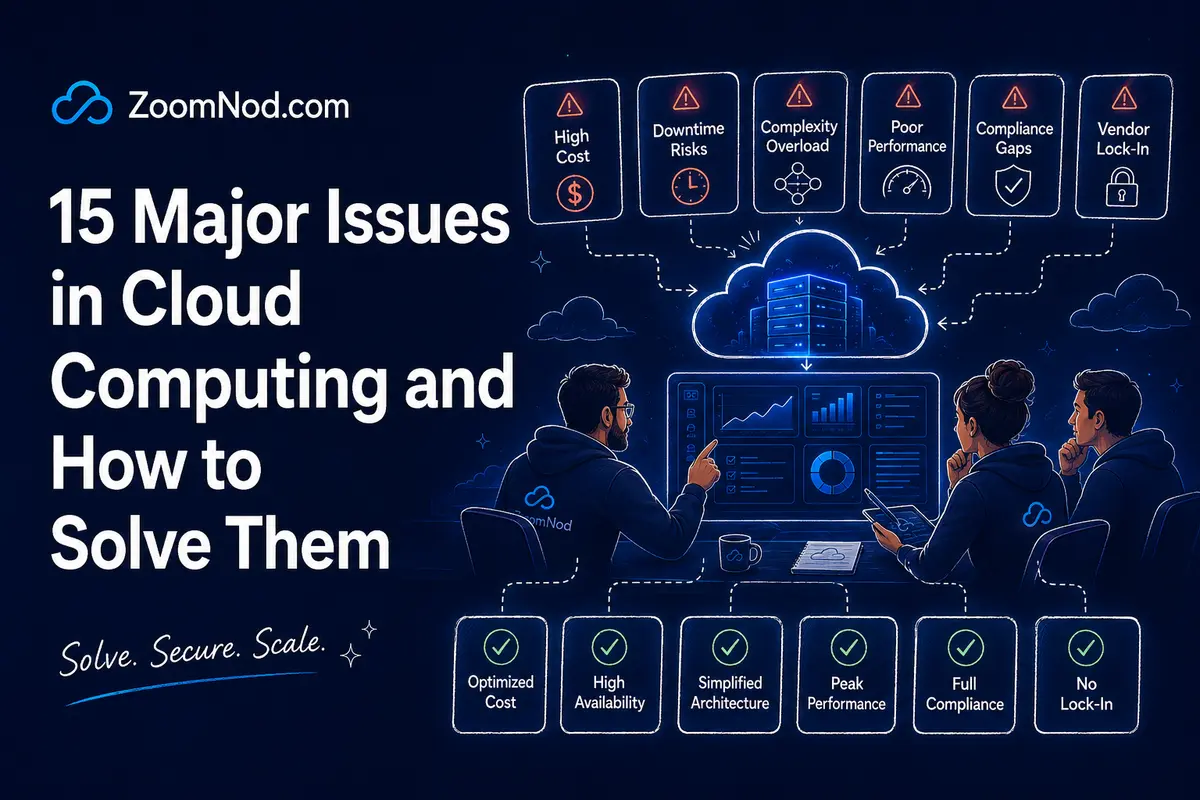
The major issues in cloud computing in 2026 include cost control, security and identity, service reliability, vendor lock-in, data transfer, performance variability, compliance, migration complexity, skills gaps, governance, observability, backup and disaster recovery, multi-cloud fragmentation, capacity and quota constraints, and growing AI infrastructure demands.
These issues do not make cloud computing a bad strategy. They show why cloud architecture requires deliberate trade-offs. Reliability generally costs more. Security adds operational controls. Global distribution can improve latency but increase complexity. Managed services can reduce engineering work while increasing provider dependence. Multi-cloud can reduce concentration risk while multiplying governance overhead.
This guide examines the largest cloud computing challenges in 2026, why they persist, how they affect small businesses and enterprises differently, and which practical controls reduce cost, risk, and operational friction.
What Are the Major Issues in Cloud Computing?
Most cloud computing issues fall into five broad categories:
- Financial: unpredictable bills, idle resources, egress, licenses, overprovisioning.
- Security and compliance: identity, misconfiguration, data protection, audits, shared responsibility.
- Reliability and performance: outages, quotas, latency, architecture complexity, recovery.
- Operational: skills, observability, automation, governance, cloud sprawl.
- Strategic: vendor lock-in, migration cost, portability, multi-cloud complexity.
Cloud platforms make infrastructure easier to create, which is both a strength and a weakness. Without effective controls, teams can create resources faster than finance, security, and operations can track them.
Major Cloud Computing Issues at a Glance
| Issue | Why It Happens | Practical Response |
|---|---|---|
| Unpredictable cost | Usage-based services and resource sprawl | Budgets, tagging, right-sizing, FinOps |
| Security and IAM | Large identity and API control surface | MFA, least privilege, configuration policy |
| Reliability | Distributed systems still fail | Redundancy, recovery targets, testing |
| Vendor lock-in | Deep use of proprietary managed services | Intentional portability boundaries |
| Data transfer | Large inter-region and outbound traffic | Architecture and egress planning |
| Performance variability | Network distance, shared systems, wrong sizing | Benchmarking and workload-aware design |
| Compliance | Data, identities and services span environments | Control mapping and continuous evidence |
| Migration complexity | Legacy dependencies and data movement | Inventory, pilot, phased migration |
| Skills gap | Cloud adds IAM, APIs, automation and governance | Training, standards, simpler architectures |
| Cloud sprawl | Self-service makes resources easy to create | Ownership, tags, lifecycle policy |
| Observability | Distributed systems generate fragmented telemetry | Central logs, metrics, traces and alerts |
| Backup and DR | Availability mistaken for recoverability | Independent backups and restore tests |
| Multi-cloud fragmentation | Providers have different control models | Central governance and limited scope |
| Quotas and capacity | Cloud resources are not infinitely available | Capacity planning and quota management |
| AI infrastructure pressure | GPU scarcity, data scale and high unit costs | Workload economics and capacity strategy |
1. Cloud Cost Can Become Unpredictable
Cloud’s pay-as-you-go model appears simple until a workload uses dozens of separately billed services.
A production cloud bill may include:
- Virtual machines
- Persistent disks
- Object storage
- Snapshots
- Managed databases
- Load balancers
- Public IPv4 addresses
- Outbound bandwidth
- Inter-region transfer
- Logging and observability
- Support
- Security services
- AI inference or GPU usage
Costs escalate when resources lack owners, development systems run continuously, oversized instances go unreviewed, and teams treat the monthly bill as someone else’s responsibility.
How to Control Cloud Costs
- Assign tags or labels for owner, environment, product, and cost center.
- Set budgets and alerts.
- Right-size compute and databases.
- Delete unused disks and snapshots.
- Schedule non-production resources.
- Review egress architecture.
- Use commitment discounts only for stable usage.
- Track unit economics such as cloud cost per customer.
Zoomnod’s cloud pricing models guide explains how on-demand, commitments, Spot, subscriptions, and other models affect cloud spend.
2. Security and Identity Remain Difficult
Cloud providers secure the underlying service infrastructure, while customers still manage major parts of identity, access, data, application security, and configuration.
Scale compounds the problem. One cloud account can contain hundreds of identities, API permissions, security groups, secrets, storage policies, serverless functions, and service integrations.
Common Security Problems
- Excessive administrator privileges
- Weak or missing MFA
- Leaked API keys
- Public storage
- Exposed databases
- Insecure cloud APIs
- Unpatched virtual machines
- Weak software supply-chain controls
Zoomnod’s cloud vulnerabilities guide covers these risks in depth.
3. Cloud Reliability Is Not Automatic
A provider may operate resilient infrastructure, but one VM in one availability zone remains one VM in one failure domain.
Reliability must be designed into the architecture.
A Reliable Cloud Workload May Need
- Multiple application instances
- Health checks
- Load balancing
- Database replication
- Multiple availability zones
- Automated recovery
- Backups
- Monitoring
- Failure testing
Current well-architected guidance from major cloud providers consistently treats reliability as a design discipline that must be balanced against cost, security, performance, and operations.
Greater reliability usually costs more. A two-zone architecture may double some resource categories. Multi-region active-active architecture adds even more complexity and cost.
Zoomnod’s load balancing algorithms guide explains one important part of high-availability design.
4. Vendor Lock-In Can Become Expensive
Cloud lock-in is not limited to virtual machines.
An application becomes harder to move when it depends deeply on:
- Provider-specific databases
- Serverless runtimes
- Event systems
- IAM models
- Proprietary AI APIs
- Data warehouses
- Monitoring services
- Infrastructure templates
- Provider-specific networking
Lock-in is not inherently bad. A managed service can save years of engineering effort. The risk comes from adopting provider-specific technology without understanding the switching cost.
Reduce Lock-In Intentionally
- Use standard containers where portability matters.
- Prefer portable databases when they meet requirements.
- Document provider-specific dependencies.
- Maintain data export procedures.
- Separate business logic from cloud integration layers.
- Use infrastructure as code.
5. Data Transfer and Egress Can Reshape Architecture
Data transfer remains one of the most underestimated cloud expenses.
Costs can arise when:
- Users download large files.
- Data leaves a cloud region.
- Services communicate across regions.
- Backups move to another provider.
- A migration exports large datasets.
- Analytics systems copy data repeatedly.
A workload that looks inexpensive at the VM level can become costly when it sends many terabytes of data each month.
Reduce Data-Transfer Problems
- Place compute close to data.
- Use CDNs for static content.
- Compress traffic.
- Avoid unnecessary cross-region calls.
- Model migration egress before moving.
- Understand which traffic paths are billable.
6. Performance Can Be Inconsistent
Cloud performance depends on more than the CPU count.
Potential causes of poor or variable performance include:
- Shared CPU contention
- Insufficient memory
- Slow storage tier
- Database latency
- Network distance
- Cross-zone dependencies
- Autoscaling delay
- Cold starts
- Noisy application neighbors
- Rate limits
Benchmark realistic workloads instead of assuming that two VMs with the same number of vCPUs will perform identically.
Region choice also matters. Zoomnod’s best server location for low latency guide explains how physical and network geography affect response time.
7. Compliance Becomes a Continuous Architecture Problem
A provider certification alone does not establish cloud compliance.
The customer must still determine:
- Where regulated data is stored.
- Who can access it.
- How access is logged.
- Which encryption is required.
- How long data is retained.
- How backups are protected.
- Which third-party services process data.
- How evidence is collected for audits.
Because cloud environments change quickly, compliance must cover continuous configuration changes rather than a one-time infrastructure review.
8. Migration Is More Complex Than Copying Servers
A cloud migration can fail even when every virtual machine starts correctly.
Applications may depend on:
- Hard-coded IP addresses
- Local file shares
- Legacy authentication
- Physical appliances
- Old database drivers
- Low-latency local systems
- Unsupported licensing
- External partner networks
Migration also involves data transfer, testing, security redesign, DNS changes, rollback planning, staff training, and cost validation.
Use Zoomnod’s cloud migration guide for a structured migration framework.
9. The Cloud Skills Gap Creates Operational Risk
Cloud platforms reduce physical infrastructure work but introduce new skills:
- IAM
- Virtual networking
- Infrastructure as code
- Cost management
- Cloud security
- Containers
- Managed databases
- Observability
- Automation
- Disaster recovery
A small team may know Linux well yet struggle with hundreds of cloud services and policy options.
Reduce the Skills Problem
- Use fewer services.
- Standardize architectures.
- Provide role-based training.
- Use reusable templates.
- Document normal operations.
- Automate repetitive tasks.
- Buy managed support where it is economically rational.
Business value should justify each layer of complexity.
10. Cloud Sprawl and Governance Get Worse With Self-Service
Creating infrastructure in minutes can lead to uncontrolled growth.
Organizations accumulate:
- Unused VMs
- Unowned storage
- Temporary databases
- Duplicate Kubernetes clusters
- Old development accounts
- Forgotten public IP addresses
- Unnecessary snapshots
- Test AI resources
Cloud Governance Controls
- Standard account/project hierarchy
- Mandatory tags
- Approved regions
- Resource policies
- Budget ownership
- Lifecycle rules
- Expiration dates for temporary resources
- Central identity management
11. Observability Becomes Harder in Distributed Systems
A traditional application may produce one server log. A cloud-native application can generate logs and metrics across dozens of services.
You may need to correlate:
- Load balancer logs
- Application traces
- Container logs
- Database metrics
- API gateway logs
- Cloud audit events
- Queue depth
- Serverless invocation errors
- Network telemetry
Observability also costs money. High-volume logs and traces can create substantial storage and ingestion charges.
Build Useful Observability
Define service-level indicators, collect the telemetry required to diagnose failures, set actionable alerts, control log retention, and avoid collecting unlimited low-value data simply because the platform allows it.
12. Backup and Disaster Recovery Are Often Misunderstood
High availability does not replace backup.
Database replication can replicate accidental deletion. Object storage durability does not prevent an authorized user from deleting data. Multi-zone architecture does not automatically protect against ransomware or corrupted application writes.
A recovery strategy should define:
- Recovery Point Objective
- Recovery Time Objective
- Backup frequency
- Retention
- Immutable/protected copies
- Off-site or cross-account copies
- Restore procedures
- Recovery testing
Zoomnod’s backup and restore guide covers the foundational recovery principles.
13. Multi-Cloud Can Multiply Complexity
Multi-cloud is often presented as protection against vendor lock-in or provider outages. It can provide strategic benefits, but it also introduces a second or third operating model.
In August 2026, NIST published a new draft focused specifically on multi-cloud security and compliance challenges. It identifies structural difficulties across provider-native services, staffing, identity, telemetry, configuration, data protection, and compliance.
Multi-Cloud Challenges
- Different IAM systems
- Different logging formats
- Different network architecture
- Different policy languages
- Different billing models
- Different database services
- Different security tools
- Different operational skills
Adopt multi-cloud only when a clear regulatory, commercial, resilience, geographic, or technical requirement justifies the added complexity.
14. Cloud Capacity, Quotas, and GPU Availability Are Not Infinite
The word “cloud” can imply unlimited capacity, but real cloud platforms still operate physical data centers.
Organizations may encounter:
- Account quotas
- Regional capacity limits
- GPU shortages
- IP address limits
- Managed-service quotas
- API rate limits
- Storage throughput limits
A mission-critical workload cannot assume that hundreds of new instances or GPUs will always be instantly available in one region.
Capacity Planning Still Matters
Request quota increases ahead of major events, validate regional capacity, maintain alternative instance types where practical, and understand autoscaling limits.
15. AI Workloads Introduce New Cloud Economics
AI adds another layer of cloud complexity in 2026.
AI workloads can involve:
- Expensive GPU instances
- Large training datasets
- High object-storage usage
- Model inference charges
- Vector databases
- Accelerator quotas
- Model observability
- Sensitive data processing
Measure AI cost per useful business outcome, not only per GPU hour.
For example, a startup might track:
- Inference cost per active customer
- Cost per generated document
- GPU cost per training run
- Storage cost per model version
- Revenue per AI request
Cloud AI can be valuable because it avoids hardware ownership, but continuously used GPU workloads may eventually justify dedicated or committed infrastructure.
Why These Cloud Computing Problems Refuse to Go Away
Cloud technology has not failed. Cloud computing optimizes for flexibility, and flexibility creates more choices.
Every new choice creates trade-offs:
- More regions improve geographic reach but complicate operations.
- More redundancy improves availability but costs more.
- More managed services reduce infrastructure work but increase lock-in.
- More self-service accelerates teams but increases sprawl.
- More security controls reduce risk but add operational overhead.
- More observability improves diagnosis but increases telemetry cost.
- More clouds reduce concentration but increase governance complexity.
Good cloud architecture therefore means choosing which complexity is worth paying for.
Cloud Computing Issues for Small Businesses
Small businesses face a different risk profile than large enterprises.
Their biggest challenges are often:
- Limited technical staff
- Unexpected bills
- Overcomplicated architecture
- Poor backup practices
- Weak IAM
- Difficulty choosing providers
A small company may be better served by a managed service or simple VPS than by a complex hyperscale cloud architecture.
Zoomnod’s cloud computing solutions for small business guide explains how to match cloud adoption to business requirements.
Cloud Computing Issues for Enterprises
Enterprises commonly struggle with scale and governance:
- Thousands of accounts and subscriptions
- Multiple business units
- Cloud acquisitions
- Conflicting architecture standards
- Large security teams
- Compliance evidence
- Legacy migration
- FinOps
- Multi-cloud
- Vendor contracts
One tool rarely solves the problem. Enterprises need organizational standards, account structure, identity governance, platform engineering, security policy, financial ownership, and repeatable operations.
Public Cloud vs Private Cloud: Which Problems Change?
Public cloud reduces hardware ownership but increases reliance on provider services and shared-responsibility operations.
Private cloud provides more infrastructure control but introduces hardware lifecycle, capacity, virtualization, storage, networking, and cloud-platform operations.
Neither model eliminates cloud problems; it changes who carries each responsibility.
Zoomnod’s public cloud vs private cloud vs VPS comparison helps match the operating model to the workload.
How to Reduce Cloud Computing Problems: 10-Step Framework
Step 1: Define Business Requirements First
Availability, performance, compliance, cost, and recovery targets should drive architecture.
Step 2: Keep the Architecture Simple
Each additional service creates another dependency, configuration surface, monitoring requirement, and potential bill.
Step 3: Establish Identity Standards
Use MFA, least privilege, centralized identity, workload identities, and access reviews.
Step 4: Establish Cost Ownership
Every significant cloud resource should have a business owner.
Step 5: Automate Repeatable Infrastructure
Infrastructure as code improves repeatability, review, and recovery.
Step 6: Design for Failure
Define recovery objectives and test real failure scenarios.
Step 7: Protect and Test Backups
Prove recovery through testing rather than assuming it will work.
Step 8: Monitor What Matters
Collect enough telemetry to answer why customers are experiencing problems without generating unlimited low-value data.
Step 9: Review Architecture Regularly
Cloud services, prices, workloads, and business requirements change.
Step 10: Measure Total Cost, Not Just Provider Bills
Include engineering time, support, compliance, migration, downtime risk, and operational burden.
Cloud Computing Problem-Solving Checklist
- Do all cloud resources have owners?
- Are budgets and alerts configured?
- Are idle resources removed?
- Is MFA required?
- Are permissions reviewed?
- Is public exposure continuously monitored?
- Are backups protected and tested?
- Are recovery targets documented?
- Are logs centralized?
- Are alerts actionable?
- Are cloud APIs protected?
- Are workloads patched?
- Is data-transfer cost understood?
- Are regional dependencies documented?
- Are quota limits monitored?
- Is vendor lock-in intentional?
- Is multi-cloud solving a specific problem?
- Are AI costs measured per business outcome?
- Can the team operate the architecture it has built?
Common Mistakes When Solving Cloud Issues
Adding Tools Instead of Reducing Complexity
Another dashboard cannot resolve unclear ownership or poor architecture.
Optimizing Cost at the Expense of Reliability
Removing redundancy may save money but increase outage impact.
Optimizing Reliability at Any Cost
A four-region active-active design can be excessive for an internal application where two hours of downtime has little business impact.
Using Multi-Cloud as a Default
Multi-cloud should solve a real requirement.
Ignoring Human Operations
A technically elegant architecture can still fail if the team cannot troubleshoot it at 3 a.m.
Cloud Issue Ownership Matrix
Cloud problems persist when everyone sees them but nobody owns the outcome. Convert each issue into an operating responsibility. Finance and engineering should jointly own cost, security and platform teams should jointly own identity and configuration, application and infrastructure teams should jointly own reliability, and business owners should approve recovery objectives. This shared model prevents teams from optimizing one metric while quietly increasing another risk.
| Issue | Primary owner | Supporting owner | Useful measure |
|---|---|---|---|
| Unpredictable cost | Platform engineering | Finance or FinOps | Unit cost and forecast variance |
| Security exposure | Security | Application and platform teams | Critical exposure age and remediation time |
| Reliability | Service owner | Platform team | Availability, error budget, recovery tests |
| Migration risk | Program owner | Application, data, and security teams | Validated cutover and rollback criteria |
| Multi-cloud complexity | Architecture or platform lead | Security, finance, and operations | Policy coverage and tool duplication |
Review the matrix monthly for critical services and quarterly for the wider estate. Each review should answer what changed, which limits were breached, which risks were accepted, and which architecture decision must be revisited. Use the cloud pricing guide for cost ownership, the cloud vulnerability guide for security priorities, and the cloud architecture guide for design trade-offs.
When multiple providers are involved, do not assume that adding a dashboard solves governance. Define a common policy, ownership model, tagging standard, incident process, and cost vocabulary first. Then choose tooling from the multi-cloud management platform comparison to enforce and measure that operating model.
Final Verdict: What Is the Biggest Issue With Cloud Computing in 2026?
The biggest cloud computing issue is uncontrolled complexity.
Cost overruns, security mistakes, poor reliability, skill gaps, lock-in, weak governance, and observability problems often share the same root cause: organizations adopt cloud capabilities faster than they establish ownership and operating standards.
The best cloud environments do not necessarily use the most services. They are the ones where teams understand:
- Why each service exists.
- Who owns it.
- How much it costs.
- How it is secured.
- How it fails.
- How it is monitored.
- How it is recovered.
- How it can be replaced.
Cloud works best when businesses apply elasticity, automation, managed services, and global infrastructure selectively. Start with clear business requirements, keep the architecture as simple as practical, automate repeatable work, monitor cost and security continuously, and add complexity only when the benefits are measurable.
Frequently Asked Questions About Cloud Computing Issues
What are the major issues in cloud computing?
Major issues include unpredictable costs, security and identity risks, outages, vendor lock-in, data-transfer expenses, performance variability, compliance, migration complexity, skills gaps, governance, observability, backup, multi-cloud complexity, quotas, and AI infrastructure costs.
What is the biggest challenge of cloud computing?
For many organizations, the central challenge is managing cost, security, reliability, identities, services, and operations as cloud usage grows.
Why is cloud computing expensive?
Cloud can become expensive when organizations use oversized resources, leave idle systems running, generate heavy data transfer or logging, use premium managed services, or fail to optimize commitments and storage.
Is cloud computing secure?
Cloud platforms can be highly secure, but customers retain responsibility for important areas such as identities, data, configurations, applications, and operating systems depending on the service model.
What is vendor lock-in in cloud computing?
Vendor lock-in occurs when applications depend heavily on provider-specific services, APIs, databases, identity systems, or data platforms, making migration expensive or technically difficult.
What is cloud sprawl?
Cloud sprawl is uncontrolled growth of accounts, VMs, storage, databases, clusters, IP addresses, and other resources without clear ownership, governance, or lifecycle management.
Why do cloud outages happen?
Cloud systems are still built from physical hardware, software, networks, APIs, and distributed systems that can fail. Application reliability depends on how workloads are architected to tolerate failures.
Is multi-cloud better than using one cloud?
Not automatically. Multi-cloud can provide strategic benefits but adds identity, security, cost, networking, logging, compliance, and operational complexity.
How can businesses reduce cloud costs?
Use budgets, ownership tags, right-sizing, lifecycle rules, scheduled development environments, appropriate discounts, storage optimization, and regular review of idle resources and data transfer.
How can cloud vendor lock-in be reduced?
Use portable technologies where they provide real value, document proprietary dependencies, maintain data export paths, use infrastructure as code, and define replacement options for critical managed services.
Why are cloud skills important?
Cloud platforms add identity, automation, networking, security, cost, observability, and managed-service concepts. Teams need sufficient skills to configure and operate those capabilities safely.
Does cloud remove the need for backups?
No. High availability and durable storage do not protect against every deletion, corruption, ransomware event, or application error. Independent backups and tested restoration remain essential.