Artificial intelligence and crypto continue to overlap in 2026 across decentralized compute, GPU marketplaces, AI-agent economies, model inference, data markets, confidential AI, and tokenized incentives. But “AI crypto” is one of the easiest narratives to market and one of the hardest categories to evaluate.
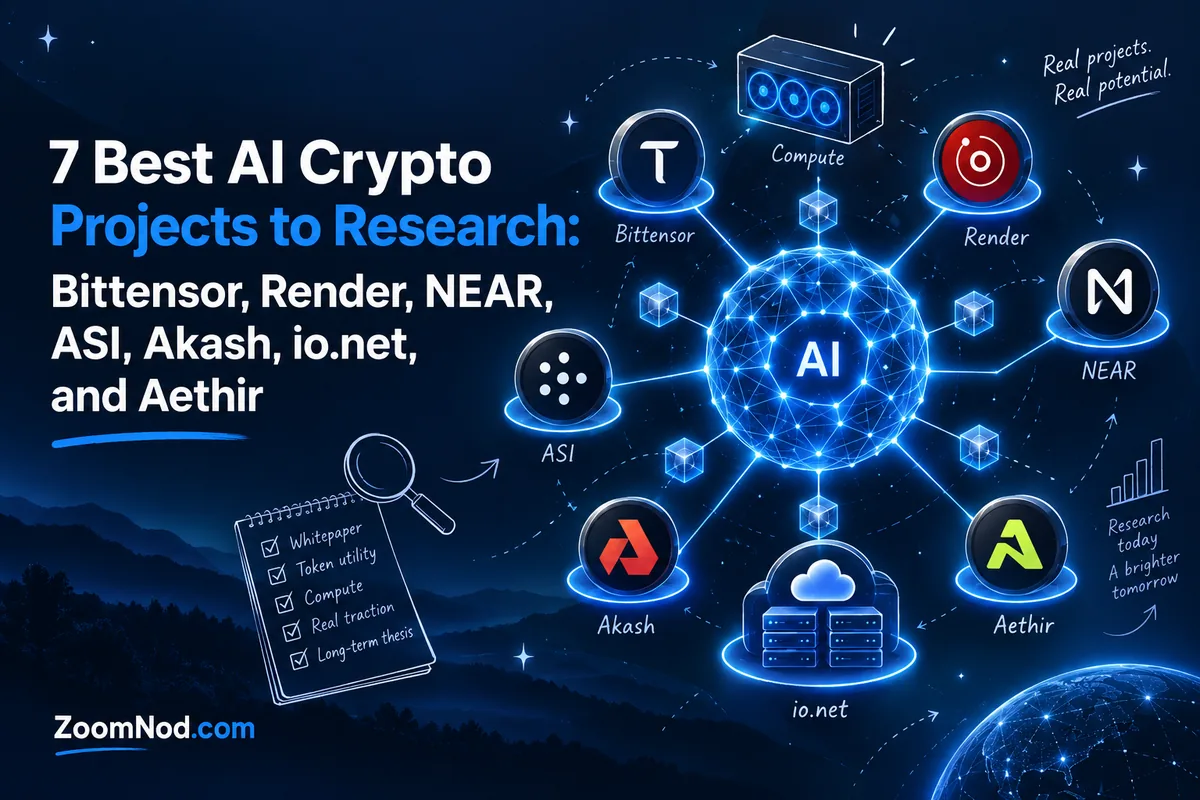
The strongest AI crypto projects to research in 2026 are those with identifiable products, active infrastructure, clear token roles, developers, and measurable technical progress—not simply projects that include “AI” in a token name. On that basis, Bittensor, Render Network, NEAR, the Artificial Superintelligence Alliance, Akash Network, io.net, and Aethir stand out as seven established ecosystems worth deeper research.
This is not a list of guaranteed investments or a prediction of which token will rise the most. A technically useful network can still have an overvalued token. Conversely, token price can rise temporarily even when underlying adoption is weak.
The correct question is not “Which AI coin will make me the most money?” It is:
What does the network actually provide, who uses it, why does the token exist, what competition does the project face, and what valuation am I paying for that expected utility?
Risk notice: crypto assets are speculative, volatile, and can lose most or all of their value. This article is educational and does not provide personalized investment advice.
Best AI Crypto Projects in 2026: Quick Comparison
| Project | Token | AI/Crypto Category | Why It Stands Out | Main Risk |
|---|---|---|---|---|
| Bittensor | TAO | Decentralized AI incentive markets | Subnet model for compute, inference, prediction, storage, and other digital commodities | Complex subnet economics and rapidly evolving protocol rules |
| Render Network | RENDER | Decentralized GPU compute/rendering | Established GPU network expanding into AI compute clients | Competitive GPU-cloud market and demand concentration |
| NEAR | NEAR | AI agents and confidential AI | Private inference, agent market, staking-based compute credits, agent infrastructure | AI thesis competes with NEAR’s broader Layer-1 positioning |
| Artificial Superintelligence Alliance | FET | Agents, models, compute, decentralized AI stack | Unified ecosystem spanning agent tooling, AI models, cloud, and AI-native chain development | Complex merger/migration roadmap and broad execution scope |
| Akash Network | AKT | Decentralized cloud and GPU compute | Permissionless compute marketplace with deployable AI/ML and GPU workloads | Must compete on reliability, supply, developer experience, and price |
| io.net | IO | Decentralized GPU infrastructure | Distributed GPU network and AI compute products | Hardware-supply economics and token incentive sustainability |
| Aethir | ATH | Decentralized GPU cloud | Enterprise-oriented GPU-as-a-Service and agentic AI infrastructure | Competitive claims must translate into durable utilization and token demand |
What Is an AI Crypto Project?
An AI crypto project uses blockchain, tokens, cryptographic incentives, or decentralized infrastructure to support an artificial-intelligence use case.
The category includes several distinct business models.
Decentralized AI Compute
Networks aggregate GPUs or other computing resources from independent providers and make them available to AI developers.
AI Model and Inference Markets
Projects coordinate model output, inference, ranking, or access through decentralized mechanisms.
AI Agents
Blockchain-based agents can own wallets, make payments, coordinate tasks, purchase services, and interact with other agents.
Data Infrastructure
Some networks tokenize data contribution, access, labeling, or ownership.
AI-Native Blockchains
Layer-1 networks can provide execution, identity, payments, privacy, and coordination specifically designed around AI agents or AI applications.
These categories have different economics. A GPU marketplace should not be valued using the same assumptions as an AI-agent network or a generic Layer-1 chain.
Why AI Crypto Coins Have Massive Potential—and Massive Risk
The optimistic thesis is easy to understand. AI applications need compute, data, payments, identity, coordination, and machine-to-machine commerce. Crypto networks can theoretically provide open markets for those resources.
Potential advantages include:
- Permissionless compute marketplaces
- Tokenized incentives for resource providers
- Global settlement
- Machine-native payments
- Verifiable ownership
- Open participation
- Decentralized governance
- Transparent economic rules
But the risks are equally large.
- Centralized AI clouds may remain cheaper or easier.
- Tokens may not be necessary for the product.
- Network usage may depend on subsidies.
- Token emissions can dilute holders.
- AI branding can outrun product delivery.
- GPU supply does not guarantee GPU demand.
- Projects can pivot faster than investors can evaluate them.
- Crypto regulation can affect token access and exchange listings.
A strong AI narrative is therefore only the beginning of due diligence.
1. Bittensor (TAO) — Best Pure Decentralized AI Incentive Network
Best for research into: decentralized AI markets, model/inference competition, specialized subnets, incentive design, and machine intelligence as an open economic network.
Bittensor is one of the most distinctive AI-native crypto networks. Instead of building a single AI application, Bittensor allows independent subnets to define specialized digital commodities and incentive mechanisms.
Current Bittensor documentation describes subnets that can produce resources such as:
- Compute
- Inference
- Storage
- Predictions
- Other measurable digital commodities
Miners produce the resource. Validators evaluate miners. Subnet owners define the incentive mechanism. Stakers allocate economic support through TAO.
Why Bittensor Stands Out in 2026
Bittensor has continued changing quickly. Its 2026 protocol releases reworked SDK/tooling and subnet economics, including how subnet value and emissions are coordinated.
This matters because Bittensor is not merely “a token for AI.” It is an economic framework in which different AI or compute markets compete inside the larger network.
What to Research
- Which subnets have real demand?
- Which subnets depend mostly on emissions?
- How concentrated is stake?
- How do validators evaluate quality?
- How do subnet tokens interact with TAO?
- How do protocol upgrades change economics?
Main Risk
Complexity. Bittensor’s economics and terminology evolve rapidly. An investor who evaluates TAO using only a generic market-cap chart can miss meaningful changes to subnet incentives, emissions, ownership, and staking behavior.
2. Render Network (RENDER) — Best Established Decentralized GPU Network
Best for research into: decentralized GPUs, generative AI, rendering, machine-learning workloads, and compute marketplaces.
Render Network began with distributed GPU rendering and continues to expand into machine-learning and generative-AI workloads.
Its current platform supports many digital-content workflows and provides a compute-client model for emerging machine-learning tasks.
AI Use Cases
- Generative AI image workflows
- Machine-learning inference
- Model fine-tuning
- Text-to-3D workflows
- Video generation
- GPU-intensive creative workloads
Render’s established rendering use case is important because it gives the network a history outside the newest AI-token narrative.
What Makes Render Different From a Generic AI Coin?
There is a concrete resource being coordinated: GPU compute.
A useful investment-research question is whether decentralized GPU supply can compete with:
- Hyperscaler clouds
- Specialist GPU clouds
- Enterprise data centers
- Other decentralized compute networks
Main Risk
Competition. GPU compute is a huge market, but it is also one of the most competitive infrastructure categories. Token value ultimately needs a durable relationship with real network demand rather than AI-sector excitement alone.
3. NEAR (NEAR) — Best AI-Agent and Confidential-AI Ecosystem
Best for research into: AI agents, confidential inference, trusted execution environments, agent payments, and blockchain-based machine economies.
NEAR’s AI strategy has become substantially more concrete in 2026.
NEAR AI currently operates confidential AI infrastructure where models and agents can execute inside hardware-enforced trusted environments. Its platform emphasizes verifiable privacy, hardware attestation, private inference, and autonomous agent workflows.
Major 2026 Components
- NEAR AI Cloud
- IronClaw agent framework
- AI Agent Market
- Confidential inference
- Agent payment infrastructure
- Staking-based AI compute credits
In July 2026, NEAR AI introduced a system where staking NEAR can generate compute credits for confidential inference and agent hosting. That creates a more explicit relationship between the network token and AI services than a generic marketing partnership.
Why NEAR Is Interesting
AI agents need more than model inference. They may need:
- Identity
- Private credentials
- Payments
- Cross-chain execution
- Task markets
- Verifiable computation
NEAR is attempting to combine these functions within one broader ecosystem.
Main Risk
NEAR is also a general-purpose Layer-1 ecosystem. Investors need to determine whether AI becomes a durable source of network activity or remains one narrative among many.
4. Artificial Superintelligence Alliance (FET) — Best Broad Decentralized AI Stack
Best for research into: autonomous agents, decentralized AI models, AI-native blockchain infrastructure, decentralized compute, and AI governance.
The Artificial Superintelligence Alliance combines technology and communities from Fetch.ai, SingularityNET, CUDOS, and related ecosystem components under a broader decentralized-AI initiative.
As of September 2026, the primary token remains FET. The Alliance’s current official information says the final ticker transition to ASI is still pending, so investors should not assume an article from an earlier migration timeline reflects the current ticker state.
Current ASI Ecosystem Components
- FET token
- AI-agent infrastructure
- ASI-1 Mini and related model work
- ASI:Cloud
- ASI:Chain development
- Agentverse
- Developer tools and grants
The Alliance therefore has one of the broadest ambitions in AI crypto.
Why FET Is Worth Researching
The token has roles around ecosystem transactions, staking, governance, and access to services. The Alliance is also building infrastructure rather than relying on a single chatbot or consumer application.
Main Risk
Execution scope. The larger the vision, the more components must work together. Investors should distinguish products that are live today from roadmap objectives and experimental systems.
5. Akash Network (AKT) — Best Open Decentralized Cloud for AI Workloads
Best for research into: decentralized cloud, GPU deployment, AI training, inference, containers, and permissionless infrastructure.
Akash Network is a decentralized cloud marketplace where independent providers bid to host workloads.
Its 2026 documentation supports deployment of:
- Web applications
- Databases
- AI/ML workloads
- LLMs
- GPU workloads
- Rendering
- Developer infrastructure
Akash’s current GPU documentation includes NVIDIA GPU deployments for model training, inference, image generation, scientific computing, and other accelerated workloads.
Why Akash Belongs in an AI Crypto List
Akash is not trying to create an AI model token. It provides infrastructure that AI applications can consume.
This “picks and shovels” exposure can be attractive to researchers who prefer compute infrastructure over betting on one AI model.
What to Evaluate
- Active GPU supply
- Workload demand
- Provider reliability
- Developer adoption
- Competitive pricing
- AKT’s role in network economics
- Enterprise readiness
Main Risk
Cloud users prioritize reliability, support, compliance, predictable capacity, integrations, and operational simplicity. A decentralized marketplace must compete on all of these—not just price.
6. io.net (IO) — Best Dedicated Decentralized AI GPU Marketplace to Watch
Best for research into: decentralized GPU clusters, AI training, inference, enterprise compute, and DePIN economics.
io.net focuses directly on distributed GPU infrastructure for artificial intelligence.
The project’s 2026 product updates show continued expansion in AI compute, GPU clusters, inference, and enterprise usage. Its platform combines distributed hardware supply with cloud-like provisioning.
Why io.net Is Interesting
AI demand increasingly spans both large training clusters and geographically distributed inference.
io.net’s thesis is that unused or independently operated GPU capacity can be aggregated into a flexible compute network rather than requiring every user to rent from a hyperscaler.
Research Questions
- How much GPU capacity is actually available?
- What percentage is actively utilized?
- How much usage comes from paying customers versus incentives?
- What workloads remain on the platform after promotional credits end?
- How does IO token demand relate to compute demand?
- How does pricing compare with centralized alternatives?
Main Risk
A large GPU supply number does not automatically mean a strong business. Utilization, customer retention, hardware quality, geographic distribution, reliability, and token incentive sustainability matter more than headline device counts.
7. Aethir (ATH) — Best Enterprise-Oriented Decentralized GPU Cloud
Best for research into: enterprise GPU-as-a-Service, AI inference, agentic AI, distributed GPU infrastructure, and tokenized compute.
Aethir operates a decentralized GPU cloud aimed at AI, gaming, and high-performance workloads.
Its 2026 materials increasingly emphasize AI inference and autonomous agents that can programmatically purchase compute.
Current Aethir AI Themes
- Enterprise AI inference
- GPU-as-a-Service
- Agentic AI compute purchasing
- Multimodal AI
- Distributed GPU capacity
- ATH-based compute economics
Aethir describes ATH as part of the payment and incentive layer for its compute ecosystem.
Why Aethir Is Worth Researching
The network is targeting a real infrastructure bottleneck: access to high-performance GPU capacity.
Its enterprise orientation differentiates it from projects focused mainly on retail token speculation.
Main Risk
Many 2026 performance, utilization, cost, and revenue statistics published by Aethir come from Aethir itself. Investors should treat issuer-reported figures as claims requiring independent verification rather than automatically accepting them as audited results.
AI Crypto Projects Compared by Category
| Category | Projects | Core Question |
|---|---|---|
| AI incentive network | Bittensor | Do subnet incentives produce valuable AI/digital commodities? |
| GPU rendering + AI | Render | Can decentralized GPUs attract sustained compute demand? |
| Agent + confidential AI stack | NEAR | Will private agents and machine payments create network demand? |
| Broad decentralized AI stack | ASI/FET | Can models, agents, chain, compute, and governance become one useful ecosystem? |
| General decentralized cloud | Akash | Can an open cloud marketplace compete on cost and reliability? |
| AI-focused GPU DePIN | io.net | Will GPU supply translate into durable paid utilization? |
| Enterprise GPU DePIN | Aethir | Can enterprise workloads create sustainable tokenized compute demand? |
How to Evaluate an AI Crypto Project
1. Identify the Real Product
Remove the word “AI” from the pitch and ask what the project actually sells or coordinates.
Is it:
- GPU compute?
- Model inference?
- Agent execution?
- Data?
- Identity?
- Payments?
- Blockchain blockspace?
2. Identify the Customer
Who pays for the service?
A network with thousands of token holders but no identifiable users has a different quality of demand from one with developers buying compute.
3. Understand Why the Token Exists
Possible token functions include:
- Payment
- Staking
- Security
- Governance
- Incentives
- Resource allocation
If the same product could function perfectly without the token, investigate why token value should track product adoption.
4. Measure Real Usage
Useful metrics may include:
- Compute jobs
- Paid GPU hours
- Active developers
- Inference requests
- Network fees
- Active providers
- Customer retention
- Agent transactions
Do not mix issuer-reported numbers with independently verifiable on-chain metrics without labeling the difference.
5. Read the Tokenomics
Check:
- Maximum supply
- Current circulating supply
- Inflation
- Emissions
- Team allocations
- Investor allocations
- Treasury
- Unlock schedule
- Staking rewards
6. Compare Valuation With Utility
A great project can still be a poor purchase at an extreme valuation.
Review:
- Market capitalization
- Fully diluted valuation
- Network revenue or fees
- Token inflation
- Comparable projects
7. Evaluate Competition Outside Crypto
AI-crypto projects do not compete only with each other.
Decentralized compute competes with:
- AWS
- Microsoft Azure
- Google Cloud
- Specialized GPU clouds
- On-premises hardware
AI-agent networks compete with normal SaaS platforms, API ecosystems, payment systems, and conventional cloud infrastructure.
AI Crypto Infrastructure: Why GPUs Matter So Much
Modern AI workloads are compute-intensive. Large models require accelerated hardware for training and inference.
That is why four projects in this list—Render, Akash, io.net, and Aethir—have meaningful GPU infrastructure exposure.
The investment thesis is not simply “AI needs GPUs.” The more useful questions are:
- Can decentralized GPU networks deliver reliable capacity?
- Can they maintain hardware quality?
- Can they compete after incentives?
- Can developers migrate workloads easily?
- Can enterprise customers meet security and compliance requirements?
For users evaluating infrastructure directly, Zoomnod’s GPU VPS guide explains when workloads benefit from dedicated GPU resources.
AI Agents and Crypto: The 2026 Opportunity
Agentic AI is another major overlap.
An autonomous agent may need to:
- Receive a task.
- Purchase compute.
- Call paid APIs.
- Store credentials.
- Make payments.
- Hire another agent.
- Verify results.
- Return output to a user.
Crypto rails can provide wallets, programmable settlement, ownership, and economic coordination.
NEAR and the ASI Alliance are especially exposed to this thesis, while Aethir is explicitly exploring agents purchasing GPU compute.
AI Crypto vs Traditional AI Stocks
An AI crypto token is not equivalent to equity.
Buying a token generally does not give the holder:
- Ownership of the operating company
- Legal claim on company assets
- Dividends
- Traditional shareholder rights
- Guaranteed claim on revenue
Token rights depend on the network and protocol.
This distinction is essential when comparing AI tokens with shares of semiconductor, cloud, or software companies.
What Makes an AI Crypto Token Valuable?
Token value can be influenced by:
- Required use inside the network
- Staking or security demand
- Scarcity
- Protocol fees
- Governance utility
- Speculation
- Liquidity
- Exchange access
- Macro market conditions
Strong product adoption does not guarantee token appreciation unless the economic design connects usage to token demand.
AI Crypto Red Flags
No Working AI Product
A white paper describing future AI is not equivalent to deployed infrastructure.
No Need for the Token
If the product can operate without a token and the token has no meaningful role, the crypto layer may be mostly promotional.
Unverifiable Partnerships
Check announcements from both parties.
Token Supply Hidden Behind a Low Price
A $0.001 token can have a larger valuation than a $500 token.
AI Claims With No Technical Detail
Terms such as “AGI,” “AI cloud,” and “neural intelligence” should be supported by documentation, code, deployed products, or measurable services.
Guaranteed Returns
No legitimate project can guarantee a future token price.
How to Build an AI Crypto Research Scorecard
| Category | Weight | Questions |
|---|---|---|
| Product | 20% | Is there a working product used for a real AI need? |
| Usage | 15% | Can activity be measured? |
| Token utility | 15% | Does usage create token demand? |
| Tokenomics | 15% | Are supply, inflation, unlocks, and incentives sustainable? |
| Technology | 10% | Is the architecture differentiated and documented? |
| Developers | 10% | Is there active building and tooling? |
| Competition | 5% | Can it compete with crypto and non-crypto alternatives? |
| Governance/security | 5% | Are control and security assumptions clear? |
| Valuation | 5% | Is expected growth already priced in? |
A scorecard does not predict returns. It prevents a flashy narrative from replacing basic research.
Should You Buy AI Crypto Projects?
That depends on your financial situation, risk tolerance, investment horizon, jurisdiction, and understanding of the project.
A safer research process is:
- Understand the technology.
- Verify the product exists.
- Identify users and demand.
- Understand token utility.
- Read tokenomics and unlocks.
- Compare market cap and FDV.
- Review governance and security.
- Compare competitors.
- Size risk appropriately if you choose to participate.
Do not buy because a project appears in a “best AI coins” article—including this one.
How to Secure AI Crypto Holdings
AI-token holdings have the same key-management risks as other crypto assets.
For long-term storage:
- Protect recovery phrases offline.
- Use separate wallets for Web3 experimentation.
- Verify token contracts and networks.
- Use strong MFA on exchanges.
- Avoid unsolicited support messages.
Zoomnod’s crypto asset security guide provides a complete 2026 checklist.
Common AI Crypto Investing Mistakes
Buying the Narrative Instead of the Product
AI attention does not create sustainable token demand automatically.
Ignoring Fully Diluted Valuation
Low circulating supply can hide large future dilution.
Comparing Tokens by Unit Price
A $1 token is not necessarily cheaper than a $500 token.
Assuming GPU Supply Equals Revenue
Unused hardware is not the same as paid demand.
Ignoring Centralized Competitors
Customers do not care whether infrastructure is decentralized if it is unreliable, expensive, or hard to use.
Confusing Token Ownership With Equity
Token holders usually do not own the project company.
Chasing “Most Profitable” Predictions
Future token returns cannot be known in advance.
Final Verdict: What Are the Best AI Crypto Projects to Research in 2026?
Bittensor is the strongest pure decentralized-AI incentive network to research. Render is one of the most established decentralized GPU ecosystems with expanding AI compute support. NEAR has one of the clearest 2026 agent and confidential-AI strategies. The Artificial Superintelligence Alliance offers a broad agent/model/compute stack under FET. Akash provides an open decentralized cloud for AI and GPU workloads. io.net specializes in distributed GPU infrastructure, while Aethir targets enterprise AI inference and GPU-as-a-Service.
These projects are interesting because they represent distinct infrastructure theses rather than seven versions of the same AI token.
But none is automatically a good investment at every price.
The best research process separates:
- Technology quality
- Product adoption
- Token economics
- Valuation
- Market risk
A project can score highly on the first two and still be unattractive on the fourth. That distinction is essential in a narrative-driven sector such as AI crypto.
Frequently Asked Questions About AI Crypto Projects
What are the best AI crypto projects in 2026?
Bittensor, Render Network, NEAR, the Artificial Superintelligence Alliance, Akash Network, io.net, and Aethir are seven established projects worth researching because they have identifiable AI, agent, compute, or infrastructure products.
What is an AI crypto coin?
An AI crypto coin or token is associated with a blockchain project that supports AI-related services such as compute, models, agents, data, inference, payments, or decentralized coordination.
Is Bittensor an AI crypto project?
Yes. Bittensor operates a network of specialized subnets where miners produce digital commodities such as inference, compute, storage, or predictions and validators score contributions.
Is Render an AI crypto project?
Render began primarily as a decentralized GPU rendering network and now supports AI and machine-learning compute workflows, including generative AI and compute clients.
Is NEAR an AI coin?
NEAR is a broader Layer-1 ecosystem, but AI is now a major part of its 2026 roadmap through NEAR AI, confidential inference, agent infrastructure, an agent market, and staking-based AI compute credits.
What is the ASI token in 2026?
As of September 2026, the Artificial Superintelligence Alliance’s official information says FET remains its primary token and the final ticker transition to ASI is still pending.
Which crypto projects provide AI GPU compute?
Render Network, Akash Network, io.net, and Aethir all provide or coordinate GPU infrastructure that can support AI workloads, although their architectures and markets differ.
Are AI crypto coins good investments?
They are speculative assets and may lose substantial value. Evaluate product usage, token utility, supply, emissions, unlocks, competition, governance, and valuation rather than assuming AI-sector growth will automatically increase token prices.
What should I check before buying an AI token?
Verify the product, users, token utility, circulating and maximum supply, vesting, emissions, developer activity, security, competition, market capitalization, and fully diluted valuation.
Does owning an AI crypto token mean I own part of the company?
Usually no. Crypto tokens generally do not provide the same ownership rights as company shares unless a specific legal structure explicitly says otherwise.
What is the biggest risk with AI crypto?
A major risk is narrative outrunning adoption. Projects can receive high valuations because of AI excitement even when product usage or token utility remains limited.
How can I protect AI crypto holdings?
Use the same crypto-security fundamentals as other digital assets: protect recovery phrases, use hardware wallets where appropriate, secure exchange accounts, verify token contracts, and isolate risky Web3 activity.