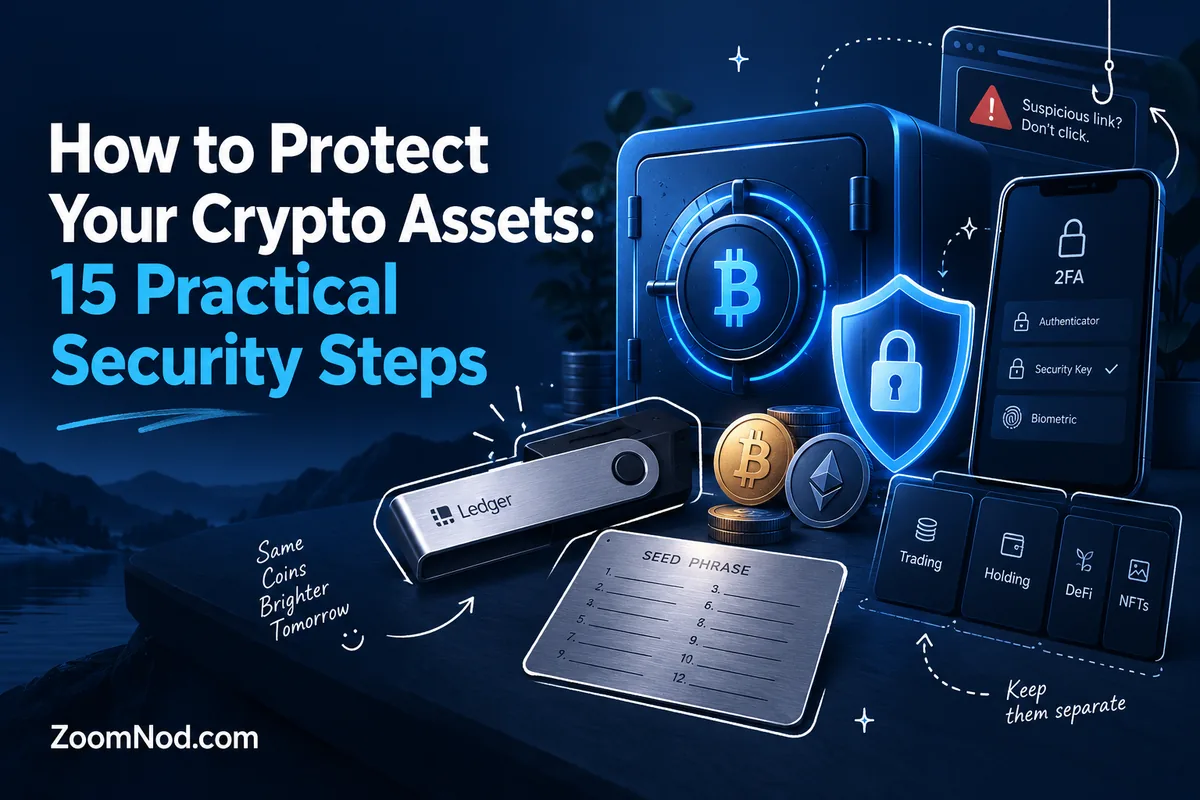
Protecting cryptocurrency in 2026 takes more than a strong password. Threats include phishing, fake wallet apps, malicious smart-contract approvals, SIM swaps, exchange-account takeovers, address poisoning, malware, fake support agents, compromised browser extensions, and lost recovery backups.
The most important rule is simple: whoever controls your private keys or recovery phrase controls your crypto. For long-term holdings, keep private keys offline where practical, protect recovery phrases against theft and physical damage, use phishing-resistant authentication, separate savings from everyday Web3 activity, and verify transactions before signing. Never give a recovery phrase, private key, password, or two-factor authentication code to someone claiming to be support.
Security agencies and wallet providers warn that scams are growing more convincing. Artificial intelligence can produce realistic messages, voices, videos, websites, and impersonations. Professional presentation is no proof of legitimacy. When evaluating tokenized AI networks, use an AI crypto project research framework and verify product, infrastructure, token utility, and official sources independently.
This guide gives investors, traders, businesses, and self-custody users a practical security model. The aim is to prevent one mistake, compromised device, malicious approval, or stolen credential from exposing an entire portfolio.
Why Must You Protect Your Crypto Assets?
Crypto ownership changes the security model. With a traditional bank account, the institution usually controls the ledger and may be able to freeze suspicious activity, reset credentials, or reverse certain unauthorized transactions.
With self-custodied cryptocurrency, transactions are generally final. If an attacker steals your recovery phrase and transfers funds, no central administrator may be able to reverse the transaction.
This makes cryptocurrency attractive to attackers because:
- Digital assets can be transferred globally.
- Transactions can settle quickly.
- Self-custody credentials can provide direct control over funds.
- Victims may interact with unfamiliar software and smart contracts.
- Attackers can impersonate exchanges, wallet companies, influencers, government agencies, employers, or investment platforms.
The FBI reported in April 2026 that cryptocurrency and AI-related complaints remained among the costliest categories of cyber-enabled crime. The FTC has also continued warning consumers that cryptocurrency payments are frequently used in scams because they are difficult to reverse.
This does not mean cryptocurrency cannot be used safely. It means security needs ongoing attention, not a one-time setup.
Crypto Security Starts With Understanding What You Are Protecting
Private Key
A private key authorizes transactions from a blockchain account. Anyone who obtains it can usually sign transactions as its owner.
Recovery Phrase or Wallet Backup
Many wallets represent their backup as a sequence of words. Depending on the wallet standard, a backup may contain 12, 20, 24, or another supported number of words.
The recovery phrase may matter more than the physical wallet. A replacement hardware wallet can usually restore accounts from the correct backup. Someone who steals that backup may restore the wallet elsewhere without the original device.
Exchange Account
On a centralized exchange, the exchange generally controls the private keys while customers access their accounts with credentials. The primary risks shift toward stolen passwords, hijacked sessions, phishing, SIM swaps, malicious API keys, and exchange counterparty failure.
Smart-Contract Permissions
Web3 applications can request token approvals. Some approvals authorize a smart contract to spend a specified amount; others can grant much broader control.
A malicious approval can put funds at risk without exposing a recovery phrase. This is often called approval phishing or ice phishing.
1. Use a Hardware Wallet for High-Value Long-Term Holdings
A hardware wallet keeps signing keys in a dedicated device rather than exposing them directly to a normal internet-connected computer or phone.
The goal is to reduce remote attack surface, not to make theft impossible.
Why Hardware Wallets Help
- Private keys remain isolated from normal desktop applications.
- Transactions require confirmation on a dedicated device.
- A compromised browser cannot simply read the private key.
- High-value holdings can be separated from daily browsing activity.
What a Hardware Wallet Does Not Protect Against
A hardware wallet cannot save you if you:
- Give someone your recovery phrase.
- Type the recovery phrase into a malicious website.
- Approve a malicious transaction on the device.
- Send funds to the wrong address.
- Buy a tampered device from an untrusted source.
- Lose both the device and every valid backup.
Hardware protection works best when you also verify each transaction carefully.
2. Keep Your Recovery Phrase Completely Offline
Your recovery phrase should not live in email, cloud notes, screenshots, photo galleries, messaging apps, password-manager notes, or ordinary documents on an internet-connected device.
Major hardware-wallet vendors continue to recommend offline storage because a stolen backup may allow someone to reconstruct the wallet.
Safer Backup Practices
- Write the phrase clearly by hand during setup.
- Store it somewhere private.
- Protect it against fire, water, and accidental disposal.
- Keep more than one protected copy if loss is a realistic risk.
- Never photograph it.
- Never type it into a website.
- Never read it aloud to support staff.
- Never send it through chat or email.
If a person, website, app, browser extension, or “support technician” asks for your recovery phrase, treat the request as hostile.
3. Separate Long-Term Storage From Web3 Activity
Separating wallets by purpose is a practical security improvement.
Do not connect the wallet containing your entire long-term portfolio to every new decentralized application, mint, airdrop, gaming site, or token presale.
A Three-Wallet Model
Vault wallet: holds long-term assets and rarely interacts with contracts.
Active wallet: holds only the amount needed for trusted DeFi, NFT, or Web3 applications.
Burner wallet: contains a small expendable balance for experimental or unfamiliar applications.
Separation limits the damage: an approval signed by the burner wallet cannot directly drain assets controlled by the separate vault wallet.
4. Use Strong, Unique Passwords
Every exchange, email account, password manager, cloud account, and crypto service should have a unique password.
A breach of one site can expose multiple accounts if you reuse passwords.
Use a Password Manager
A reputable password manager generates long, unique passwords and makes reuse less tempting.
Its autofill behavior may also help expose phishing sites because saved credentials are tied to the legitimate domain, although users should never rely on autofill alone as a phishing detector.
5. Enable Strong Multi-Factor Authentication
Use the strongest authentication option supported by the exchange or service.
In general, hardware security keys or passkey-style authentication provide stronger resistance to phishing than SMS codes.
Why SMS Is Weaker
Phone numbers can be targeted through SIM-swap or carrier-account attacks. An attacker who gains control of the number may receive SMS verification codes.
If an exchange supports security keys, passkeys, or authenticator-app codes, prefer those over SMS where practical.
6. Lock Down the Email Account Connected to Your Exchange
Your email account may be the recovery path for every other service.
Protect it with:
- A unique password
- Strong MFA
- Recovery methods you control
- Login alerts
- Review of active sessions
If an attacker takes over your email, they may be able to reset exchange credentials, hide security notifications, or impersonate you in support requests.
7. Learn to Recognize AI-Enhanced Phishing
Poor spelling and grammar are no longer reliable warning signs on their own.
Generative AI can produce polished emails, cloned voices, realistic support scripts, fake executive messages, and convincing social posts.
Phishing Red Flags
- An urgent warning that your wallet will be disabled
- A request to “verify” or “synchronize” a recovery phrase
- A surprise phone call from wallet support
- A direct message offering account recovery
- A fake airdrop requiring wallet approval
- A request to transfer funds into a “safe” wallet
- A search advertisement impersonating a wallet site
- An unexpected browser-extension update
Caller ID, voice, profile photos, and professional appearance do not prove identity. Navigate independently to the organization’s official site.
8. Verify Every Wallet Address Before Sending
Malware can replace a copied wallet address. Address-poisoning attacks also plant lookalike addresses in transaction history, hoping users copy the wrong one.
Before Sending
- Confirm the first and last characters.
- For large transfers, compare the full address where practical.
- Confirm the blockchain network.
- Use an address book for repeat recipients where supported.
- Send a small test transaction before a very large transfer.
Never rely solely on the first four and last four characters for high-value transfers if an attacker could deliberately generate a similar-looking address.
9. Verify the Network as Carefully as the Token
Multi-chain assets add another layer of transfer risk.
USDC, USDT, and other tokens may exist on several networks. A receiving service may support the token but not the network you selected.
Before sending, verify:
- Asset
- Network
- Deposit address
- Memo/tag if required
- Minimum deposit
- Current service status
Zoomnod’s best crypto for payments guide explains why the asset and blockchain rail should be treated as a combined decision.
10. Review Smart-Contract Approvals
Signing a malicious approval can cost tokens even if the private key remains secret.
In an approval-phishing attack, the transaction may grant a contract permission to move tokens later.
Before Signing a Contract Transaction
- Confirm the domain.
- Confirm the contract.
- Read the wallet simulation or transaction summary.
- Understand whether you are approving, transferring, swapping, or delegating.
- Limit approval amount if the application allows it.
- Avoid unlimited approvals for unfamiliar contracts.
After Using a Dapp
Periodically review token allowances and revoke approvals that are no longer needed.
Revoking an allowance also requires an on-chain transaction. Verify the revocation tool as carefully as the original application.
11. Secure Exchange API Keys
Automated traders must protect API credentials.
Most trading bots need only enough API access to read account data and place trades.
Withdrawal permissions should normally remain disabled.
API Security Checklist
- Create a separate API key for each application.
- Enable only required trading permissions.
- Disable withdrawals.
- Use an IP allowlist where supported.
- Rotate keys after suspected exposure.
- Store secrets outside source code.
- Never commit keys to a public repository.
- Delete unused API keys.
For users running their own trading software, Zoomnod’s VPS for crypto trading and VPS security guides provide infrastructure-hardening guidance.
12. Keep Devices and Software Updated
Wallet security also depends on the device used to access it.
Keep current:
- Operating system
- Web browser
- Wallet software
- Hardware-wallet firmware
- Password manager
- Security software
Download updates from official apps or independently verified official sites.
Be especially careful with browser extensions. A malicious extension can read pages, modify displayed addresses, or imitate wallet prompts depending on permissions.
13. Do Not Keep Your Entire Portfolio on One Exchange
Centralized exchanges simplify trading and fiat conversion but concentrate counterparty risk.
If every asset sits on one platform, a single account compromise, withdrawal freeze, insolvency, legal restriction, or operational incident can affect the full portfolio.
A practical architecture may separate:
- Long-term self-custody
- Trading balances
- Short-term payment balances
- Experimental Web3 funds
The right balance depends on technical ability. Self-custody reduces exchange counterparty exposure but makes users responsible for backups and transaction safety. For node operators, compare non-custodial masternode hosting with the risks of running and securing a server yourself.
14. Create a Crypto Inheritance and Recovery Plan
Security is incomplete if even legitimate heirs cannot recover the funds.
Create a plan that answers:
- What assets exist?
- Which wallets or exchanges hold them?
- Where are recovery instructions located?
- Who should receive access if you die or become incapacitated?
- How can the plan avoid exposing keys prematurely?
Do not put a complete recovery phrase in a normal will that may become part of a court or administrative record.
Depending on asset value and jurisdiction, professional estate-planning advice may be appropriate.
15. Prepare an Incident-Response Plan Before You Need It
A documented response plan matters when an account or wallet is compromised.
If an Exchange Account Is Compromised
- Use the exchange’s official account-lock or security process.
- Change the email password if email may be compromised.
- Revoke active sessions.
- Remove unknown API keys.
- Reset MFA through official procedures.
- Document unauthorized transactions.
- Contact the exchange through verified support channels.
If a Hot Wallet Is Compromised
- Stop interacting with suspicious sites.
- Use a known-clean device.
- Create a new wallet with a new recovery phrase.
- Move unaffected assets if it is safe to do so.
- Revoke malicious approvals where appropriate.
- Do not reuse the compromised recovery phrase.
If the Recovery Phrase Was Exposed
Assume the entire wallet can be compromised. A new hardware device using the same exposed phrase does not solve the problem. Generate a new wallet and migrate remaining assets to addresses derived from a new secure backup.
Cold Wallet vs Hot Wallet: Which Is Safer?
| Factor | Cold / Hardware Wallet | Hot Wallet |
|---|---|---|
| Internet exposure | Private keys isolated from normal connected device | Keys typically accessible to internet-connected software |
| Convenience | Lower | Higher |
| Best use | Long-term/high-value storage | Active Web3 and smaller balances |
| Transaction confirmation | Usually physical confirmation | Software confirmation |
| Phishing protection | Helps, but cannot prevent malicious signing | More exposed to device/browser attacks |
| Backup responsibility | User | User for self-custody wallets |
The strongest setup often uses both: cold storage for the majority of funds and a limited hot-wallet balance for daily activity.
Self-Custody vs Exchange Custody
Neither model is universally safer; their risks differ.
Self-Custody Risks
- Lost recovery phrase
- Malicious transaction
- Physical theft
- Bad backup practices
- User error
Exchange Custody Risks
- Account takeover
- Counterparty failure
- Withdrawal restrictions
- Platform security breach
- Regulatory restrictions
Users who cannot reliably secure a recovery phrase should not assume self-custody is safer. Choose a model you can operate securely.
How to Protect Crypto When Using Trading Bots
Automated trading creates another security surface. Self-hosted bot operators can use Linux system monitoring to detect failed processes and resource issues alongside exchange-account alerts.
If you use a crypto trading bot:
- Choose a reputable platform.
- Use exchange subaccounts if available.
- Create a dedicated API key.
- Disable withdrawals.
- Restrict the API key to the bot server’s IP.
- Set position and loss limits.
- Monitor account activity independently.
Zoomnod’s crypto arbitrage bot guide discusses API permissions and execution risk, while the Binance scalping bot guide covers trade-only API security and server restrictions.
How to Protect Yourself During Crypto Presales
Presales attract phishing because participants expect to connect wallets and send funds.
Before participating:
- Verify the official domain from multiple sources.
- Verify the smart-contract address.
- Never respond to “support” DMs.
- Use a separate wallet.
- Read the approval or transaction carefully.
- Assume a token can lose 100% of its value.
See Zoomnod’s 2026 crypto presale due-diligence guide for tokenomics, legal, contract, vesting, and scam checks.
Crypto Security Mistakes to Avoid
Taking a Screenshot of Your Seed Phrase
A screenshot turns an offline secret into a file that may be synced, indexed, backed up, or stolen remotely.
Using One Wallet for Everything
Wallet segmentation limits the effect of one malicious application.
Trusting Support in DMs
Scammers monitor public support conversations and impersonate staff.
Signing Without Reading
A transaction prompt authorizes an action; it is not a routine popup.
Keeping Old API Keys Active
Delete unused credentials to reduce attack surface.
Assuming Hardware Wallet Means Invulnerable
A hardware device cannot protect a recovery phrase you disclose or a malicious transaction you confirm.
Ignoring Physical Backup Risk
A private paper backup is useless if fire or water destroys the only copy.
Crypto Security Checklist for 2026
- Use a hardware wallet for high-value long-term holdings.
- Keep the recovery phrase offline.
- Maintain protected backup redundancy.
- Never share private keys or recovery phrases.
- Use separate vault, active, and burner wallets.
- Use unique passwords.
- Prefer phishing-resistant MFA.
- Secure the associated email account.
- Verify domains independently.
- Verify wallet addresses and networks.
- Read every contract approval.
- Revoke unused token allowances.
- Use trade-only API permissions.
- Disable API withdrawals.
- Use IP allowlists for bots.
- Keep operating systems and wallet software updated.
- Limit exchange balances to what you need.
- Create inheritance instructions.
- Prepare an incident-response plan.
Final Verdict: The Best Way to Protect Crypto Assets in 2026
The best crypto-security strategy is layered. Keep long-term keys offline, protect recovery backups physically, use strong account authentication, separate wallets by risk, verify addresses and networks, treat every smart-contract signature as a financial authorization, and minimize the permissions granted to trading bots and third-party applications.
No wallet, exchange, device, antivirus product, or tool removes every risk. Aim to prevent a single mistake from causing a total loss.
For a meaningful portfolio, design security around four independent questions:
- How can an attacker steal the keys?
- How can I accidentally authorize a transfer?
- How can I recover after device loss or damage?
- How can legitimate beneficiaries recover the assets if I cannot?
Answering all four questions gives you more protection than merely buying a hardware wallet.
Frequently Asked Questions About Protecting Crypto
What is the safest way to store cryptocurrency?
For high-value long-term holdings, a reputable hardware wallet with a properly secured offline recovery backup is one of the strongest common self-custody approaches. Users must still verify transactions and protect the recovery phrase.
Should I keep crypto on an exchange?
Exchanges are useful for trading and conversion but create counterparty and account-security risk. Many users keep only active trading balances on exchanges and store longer-term holdings separately.
Can someone steal crypto with my recovery phrase?
Yes. A recovery phrase can normally recreate the private keys for the wallet. Anyone who obtains it may be able to transfer the assets without the original device.
Should I store my seed phrase in a password manager?
For maximum separation from online compromise, hardware-wallet vendors commonly recommend keeping recovery backups offline rather than storing them on an internet-connected device or cloud service.
Can a hardware wallet be hacked?
No device eliminates all risk. Hardware wallets reduce remote key exposure, but users can still lose funds through seed-phrase theft, malicious transactions, supply-chain issues, or sending to the wrong address.
What is approval phishing?
Approval phishing tricks a wallet user into signing a token allowance or operator authorization that lets a malicious contract transfer assets later.
Should crypto trading bots have withdrawal permission?
Normally no. A trading bot generally needs read and trade permissions, not withdrawals. Grant only the minimum permissions required.
Is SMS two-factor authentication safe for crypto?
It is better than no second factor, but hardware security keys, passkeys, or authenticator-based methods generally provide stronger protection against SIM-swap and phishing attacks.
What should I do if my seed phrase is exposed?
Treat the wallet as compromised. From a known-clean environment, create a new wallet with a new recovery phrase and move remaining assets when safe. Do not reuse the exposed phrase.
How can I verify a crypto address?
Confirm the recipient, blockchain network, and full address for high-value transfers. Use trusted address books where available and consider a small test transfer before sending a large amount.
Why use multiple crypto wallets?
Separate wallets reduce blast radius. A malicious contract connected to a small burner wallet cannot directly access assets held under separate vault keys.
What is the biggest crypto-security mistake?
Exposing a recovery phrase is among the most damaging mistakes because it can give an attacker complete wallet control. Signing malicious transactions and granting dangerous contract approvals are also major risks.